Showing posts with label EBITDA. Show all posts

Wednesday, August 30, 2017

Article Review: Micro Private Equity: The Art of Acquiring Small Businesses | Divestopedia

 ,    

Takeaway: Learn about the opportunities present in micro private equity. Deal structuring will be an important skill for young entrepreneurs looking to acquire businesses and those owners seeking an exit.
Micro Private Equity: The Art of Acquiring Small Businesses
Source: flickr/DennisSylvesterHurd
Summary of points discussed:
  • The importance of timing the market when selling a business;
  • The opportunity of finding hidden value in business acquisitions;
  • How young future entrepreneurs can buy a business with little or no capital;
  • The fact that a business is worth zero if there are no interested buyers; and
  • How properly documenting five areas of your business can help increase business value.

About the Guest

Ace Chapman has bought and sold 11 companies using funds raised from high net-worth individuals and institutions.

Listen here:


You can also get this Podcast by:

Read the Full Transcript Here:


At 19, Ace Chapman came across an online stock market simulator. He loved what they were doing, but felt like they were not promoting it.
He started a web development company. He got the CEO of the simulator on the phone. He negotiated his first leveraged buyout as he was a college student with little money. They did half owner financing. With credit cards and a friend he ended up buying the business.

His friend was technically sophisticated. Find the right partner with a different skill set. The friend programmed in what was needed to facilitate good growth and Ace handled marketing.
They took the site down, did a complete rebuild. Sent out invites to other college students. We put in viral aspects where we would give them money to play trade if they spread the word.
They built a database for 500 people because they thought it would be crazy if they many over the course of the school year. In the first hour it’s 50 people and then 100 and 200. It exploded from there.
This was before the internet boomed. After the boom, they had seven-figure offers to sell the business. After the bust, the model changed. They got less than a tenth of what was offered during the boom. Now Ace is quick to sell businesses for a profit.

Cash flow attracts buyers. Assets are not a focus. Ace looks for businesses that aren’t pushing marketing as much as they could.
A recent acquisition had a 10,000-person database of past clients and customers with email, phone numbers and addresses. They never emailed, called, or direct marketed. Ace doubled the month-to-month revenue and ended up selling it six months later by targeting past customers. 
Ace looks for a hidden opportunity or a hidden asset to leverage or a situation where the seller is highly motivated to sell (divorce, death) and is highly flexible about deal structure.
When selling, Ace likes to provide several very attractive deal structures to appeal to different buyers.
Creative deal structure and leveraged buyouts will become necessary as 12 million businesses are coming to market as baby boomers retire. Nobody is training a younger generation to take over those businesses. 
With young folks, there’s preparation and the structure. Many times you can only go to a very select group of buyers. 99% of general buyers don’t have the financing or experience or don’t understand due diligence. Preparation starts with training, then building business credit.
They target businesses a buyer will be very comfortable with. They just did a publishing software business for a client. The seller is an amazing programmer. Operations were exceptional. She built a large business because she built an amazing product. The buyer brought marketing consulting from PriceWaterHouse. She saw what the business was missing. To create a win-win we allowed the seller to keep some equity.

They do not deal with banks. Banks have only done 7% of business lending. In 2008, it went down to 1%. 99% was picked up by everybody else.

They keep a database of alternative lenders and can select lenders based on the buyer's financial situation.

Examples:

  • Gold’s Gym acquisition, they leveraged the equipment. 
  • Carwash deal, they found an SBA program. 
  • Banks are going to seek some SBA-type guarantee that ties up all your business and personal assets in liens. 


They look for different types of financing to get a better deal for the business buyer.
There are a lot of local opportunities to obtain financing for specific programs. For the publishing company, part of the deal is a local loan that the state of Pennsylvania for people bringing jobs to Pittsburgh. 
Every deal is unique and they go after every type of financing that might work. They see what is leined then pick out the best financing and deal structure for the business buyer.
Ace has focused on micro-private equity (owners who are not actively involved) over the last six years. With buying a business under the $5 million dollar, the multiples are incredible. With the private equity model you need to be able to manage the business. You have to work it. Paying off a business in 3 to 4 years, is a powerful wealth building strategy. There’s just no other asset class where you’re buying something at that low a multiple.
Above $5 million, you’re competing with private equity. Below $2 million you’re doing deals max at a two multiple. The micro-private equity concept was born out of past clients who see the opportunity but just don't want to work the business. They work with younger buyer clients and invest in them and their deals.  They not only put up money, but experience, time, mentorship, and strategic planning without the day-to-day responsibilities.


For additional information regarding Florida business sales, acquisitions and valuations, please contact Eric J. Gall at Eric@EdisonAvenue.com or 239.738.6227. Also, visit our Edison Avenue website at www.EdisonAvenue.com. To search for Florida Businesses for Sale: CLICK HERE

Friday, August 18, 2017

Article Summary: How Your Company Is Valued Depends on the Buyer | Divestopedia

By 

How Your Company Is Valued Depends on the Buyer
Source: Violka08/iStock
Takeaway: Different types of acquirers use different valuation methods. 


  • There a several different types of buyers.
  • Each type will value businesses differently.
  • Business valuation is incredibly complex.
  • Business is not an exact science; they are based on many subjective decisions.
  • Business valuations can vary from appraiser to appraiser.

Basic Valuation Approaches

There are three fundamental approaches to valuing a business:
Market Approach

  • Works best in real estate due to few parameters.
  • Businesses have many number of moving parts.
  • Comparative sales have to be used with other valuation methods. 
  • Often not enough data to compare apples to apples. 

Income Approach

  • Most common for valuing private small businesses. 
  • Based on company revenues and earnings. 
  • Method #1 is Multiple of Discretionary Earnings (SDE) Method, where SDE is defined as the net operating income plus adjustments plus the owner’s salary. 
  • The multiple is the inverse of the capitalization rate (cap rate). 
  • Method #2 is discounted cash flows is based on reasonable projections (usually 5 years), and uses a discount rate (usually the cap rate plus rate of growth) to calculate the present value of the future cash flows.
Asset Approach

  • Asset approach is used when fair market value of assets represents most or all of the business value. 
  • The net tangible assets of the business comprise : the machinery, equipment, furniture and fixtures, etc. 
  • Used when the business is no longer a going concern, or losing money for a few years.

Valuation Method Depends on Buyer Type

Let’s look at the most likely valuation methods used by each buyer type:
Strategic Buyer

  • Typically large private or public companies. 
  • Strategic buyers are interested in the future synergies and not as concerned about past performance. 
  • The likely valuation method will be the discounted cash flow approach.
Sophisticated Financial Buyer

  • Typically small investment groups, private equity groups (PEGs) and small companies interested in growth by acquisition. 
  • Interest in both past performance and future opportunities for growth. 
  • The likely valuation methods will be multiples of earnings and discounted cash flow.

Lifestyle Buyer  

  • Looking to supply income, equity, and debt service from future cash flows. 
  • Will buy the future, but only pay for the past. 
  • The valuation method is multiple of seller discretionary earnings. 
  • For larger companies they may use the multiple of EBITDA.
Industry Buyer

  • Industry buyers are in your niche, you know them, and consider your company inferior. Typically bottom feeders trolling to buy on the cheap. 
  • Valuation method will be the asset approach. 
  • If this particular buyer is interested in buying your company (total assets plus goodwill), then seek professional help to even the playing field.

Article LINK


For additional information regarding Florida business sales, acquisitions and valuations, please contact Eric J. Gall, CBI, CM&AP at Eric@EdisonAvenue.com or 239.738.6227. Also, visit our Edison Avenue website at www.EdisonAvenue.com. To search for Florida Businesses for Sale: CLICK HERE

Friday, August 4, 2017

Article Summary: Should You Take an Earnout? | Axial

By , Axial | 
I have pared down the article to the key points.  If you would like to read the entire article, click on the link at the bottom of the summary - Eric Gall


  • Earnouts are a way to bridge the gap between a seller’s expectation of value and a buyer’s willingness to pay. 
  • Earnout structure varies, but the idea is buyers make additional payments post-close, dependent on the business achieving certain goals.
  • When properly structured, earnouts can work very well. 
  • Earnouts can also turn nightmarish in the event of misaligned expectations, unfriendly terms, and hidden stipulations.

Photo by Robert Caplin

When Earnouts Go Wrong

Careful legal wording can protect against bad behavior. Examples are buyers making major changes that tank the company and rollups where buyers credited the wrong business with sales to avoid the earnout.
Earnouts can create misalignment of interests between management and shareholders leading to maximizing the earnout vs. maximizing shareholder value.
Clawbacks and Earnout Alternatives
Management incentive agreements preferred over earnouts.  Agreements should include assurances if the company is acquired the owner won’t be terminated or will receive a severance.
Clawbacks allow the seller to accept a lower valuation but if the company grows to a certain level, they ‘claw back’ equity.  Clawbacks align buyer and seller on a longer term basis than an earnout.

Advice for Sellers

Earnouts require protective provisions and need to be realistic.
  1. Make sure you have a cumulative clause for multiple year earnouts. 
  2. Be wary of buyers factoring in basic risk of the industry into the earnout. 
  3. Base the earnout on revenues, not EBITDA. 

Article LINK

For additional information regarding Florida business sales, acquisitions and valuations, please contact Eric J. Gall at Eric@EdisonAvenue.com or 239.738.6227. Also, visit our Edison Avenue website at www.EdisonAvenue.com.

Wednesday, July 12, 2017

Article Summary: How Setting Clear Goals Minimizes Value Gaps in a Sale | Axial


By , Midwest Genesis | 


Original article has been thrifted to only cover the key points.  Full article can be read by clicking the link at the bottom of the article.

Determining business value can be a complex undertaking.

  • For a buyer, value is mostly driven by the likely future return, discounted by the risk, associated with the investment.
  • For a seller, value is more complex and reflects the past. Value can be defined as the sum total of all the elements that create satisfaction for the seller.  This is deeply personal and based on beliefs and not necessarily financials. 
  • Knowing all the elements that influence value for a buyer and a seller can dramatically reduce gaps between the buyer's and seller’s perception of value.
The very first question any owner should answer when considering a sale of the business is “What are my goals?”
The goals must be actionable, precise, concrete, real, and in writing. 
The steps along the path necessary to achieve a seller’s goals can take considerable time and energy to achieve. 
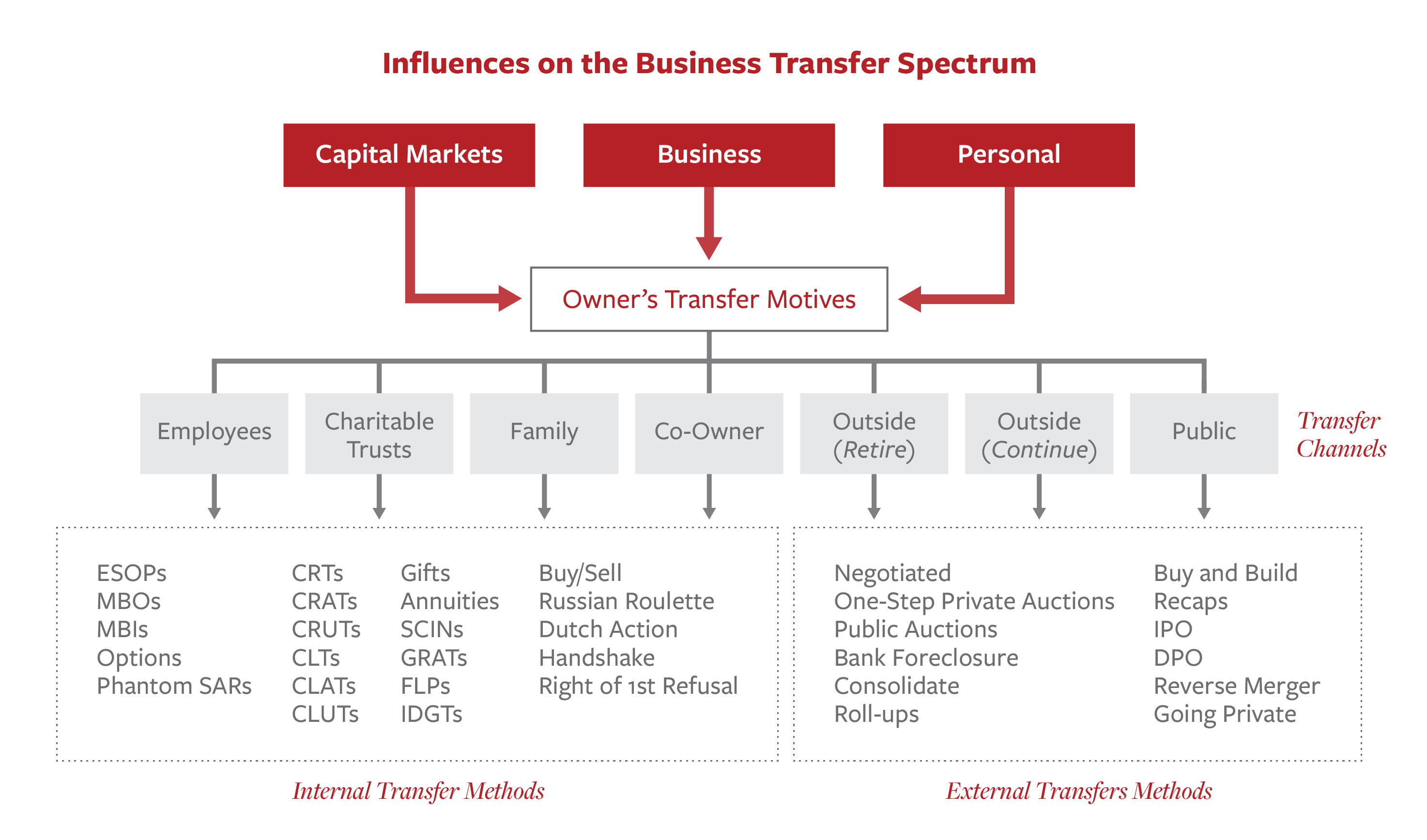
The transfer of a business is driven by the motives of the seller:  fatigue, health, competition, additional investment, technology, government regulations, economy, family issues, funding retirement, employees, etc.. These motives are influenced by one or more of the following situations:
  • the conditions of the capital markets,
  • the state of the business, and
  • the personal situation of the owner.
Understanding their influence on the readiness of the owner to pursue a transfer process is key to setting appropriate goals. Rob Slee illustrates the relationship of these factors with seller goals in the chart below:
Influences on the Business Transfer Spectrum
As shown, selling a business can get quite complex. There are multiple motives, transfer channels, and transfer methods. Each are governed by different rules and authorities. Owners need to understand how these influence their path to satisfaction in a business sale.
This task is daunting for a business owner.  Using skilled advisors can contribute considerable insight and experience.  Finding the right advisor early in the process can avoid value gaps and answer the question: “If you could have seen the road from the beginning, would you have chosen a different path?”
Full article LINK

For additional information regarding Florida business sales, acquisitions and valuations, please contact Eric J. Gall at Eric@EdisonAvenue.com or 239.738.6227. Also, visit our Edison Avenue website at www.EdisonAvenue.com or my personal website at www.BuySellFLbiz.com.

Friday, June 16, 2017

Article Review: EBITDA Adjustments From Crazytown | Axial

By , adventur.es | 
Appropriate financial recasting is critical to gaining buyer trust and completing a deal.  Some examples of inappropriate recasting to determine Adjusted EBITDA. Note, this article is not addressing Seller's Discretionary Earnings (SDE).

Owner's responsibilities are not significant?  Compensation should be a fair wage based on the owner's responsibilities, but it’s definitely not $0.

Leadership compensation varies from industry norms?  If the leadership is staying on after the sale, their compensation cannot be changed just because it varies with industry norms.

Use of more costly sub-contracted labor during a busy season?  You cannot adjust the extra cost of seasonal labor unless you add the cost of inactive full-time labor.  And if the net is cheaper, why haven't you done it?

Ineffective online marketing campaigns? They are still real spending. You can't add back real spending on the business.

One-time expenses such as the cost to develop a company’s website or inventory write-offs conducted every year?  If it’s a necessary cost of doing business, it shouldn’t be adjusted out.

Research & Development costs? New revenue streams aren’t delivered by stork. Sustainable businesses require ongoing investment, which a buyer will have to invest in as well.

Projected savings from recent, or even yet-to-be-fully-implemented, changes in process or software? You can’t change the past. The best method is to forcast how it might look in the future.

One-time litigation events? If the company must spend real money to defend itself against customers, suppliers, etc., that won’t change with ownership. Evidence of a legal history will tell a buyer such events must be accounted for in projections and valuation.

The best advice on creating a list of adjustments? Be honest and conservative. The relationship with buyers will start out on a much warmer and productive path.
Article LINK

For additional information regarding Florida business sales, acquisitions and valuations, please contact Eric J. Gall at Eric@EdisonAvenue.com or 239.738.6227. Also, visit our Edison Avenue website at www.EdisonAvenue.com. To search for Florida Businesses for Sale: CLICK HERE

Thursday, June 8, 2017

Podcast Review: How to Sell Your Business for a Crazy High Price | Divestopedia

 ,    

Takeaway: "There will always be a market for outrageous prices as long as the buyers are looking to grow, which for big companies, that's what they do."
How to Sell Your Business for a Crazy High Price
In this podcast, Kevin M. Short, Author of "Sell Your Business For An Outrageous Price", talks about:
  • How to exploit your company's competitve advantage to get the highest price:
    • You need to cause a market leader pain via a competitive advantage,
    • You need a "big" buyer that does not need bank financing,
    • You need a seller who is patient and willing to invest in the strategy,
    • You need an advisor who can do the business case and convince the buyer;
  • Aligning investment banking fees to incentivize them in getting the highest selling price; and
  • Success stories on deals selling for crazy high prices.

About the Guest

Kevin is the author of Sell Your Business For An Outrageous Price. This book synthesizes Kevin’s experience in selling mid-size companies ($10MM - $250MM in value) for up to twice the multiple of the industry average.

Listen here:


You can also get this Podcast by: 

Article LINK


For additional information regarding Florida business sales, acquisitions and valuations, please contact Eric J. Gall at Eric@EdisonAvenue.com or 239.738.6227. Also, visit our Edison Avenue website at www.EdisonAvenue.com. To search for Florida Businesses for Sale: CLICK HERE
Friday, May 26, 2017

Article Review: What is EBITDA, and Why Do Investors Care About It? | Axial

| 

Key Takeaways:

For the novice only.  Very basic article explaining what EBITDA is and how to calculate it.

  • EBITDA stands for earnings before interest, taxes, depreciation, and amortization. EBITDA indicates whether a business is profitable by revealing the amount of its normal operational earnings.
  • EBITDA is used by traders, analysts, portfolio managers and others as an indicator of whether companies are properly valued.  In the sale of a business a buyer will pay a multiple of EBITDA for a business.
  • EBITDA is used by lenders to see if companies will be able to pay their future debt obligations. 
  • EBITDA does not necessarily provide a complete picture of a business’ true value or performance.
  • EBITDA is not cash flow, but serves as a proxy for pre-tax operational cash flow.  Because a company’s depreciation, amortization, debt, and tax profile will change as a result of a deal, EBITDA removes those components from the picture. EBITDA is a more standardized way for buyers to compare companies within their respective sectors.


For additional information regarding Florida business sales, acquisitions and valuations, please contact Eric J. Gall at Eric@EdisonAvenue.com or 239.738.6227. Also, visit our Edison Avenue website at www.EdisonAvenue.com. To search for Florida Businesses for Sale: CLICK HERE

Thursday, May 11, 2017

Podcast Review: Why Don't Business Owners Embrace Exit Planning? | Divestopedia

Key Takeaway: "Just because you have a business that produces a lot of income, doesn’t necessarily mean you have a business that is transferable or has any value."
Why Don't Business Owners Embrace Exit Planning?
In this podcast, Chiris Snider, CEO of the Exit Planning Institute, talks about:
  • Why exit planning is considered a "blue ocean market";
  • The importance of setting goals and teamwork in business exit planning;
  • Emotional aspects of selling a business;
  • The current state of exit planning and where it is headed; and
  • The real meaning of the word, "exit," and why it is important to your business.

Listen here:


You can also get the podcast by:

Other Takeaways

Blue Ocean Strategy:  Blue Ocean Strategy is one of the top strategy books.  A blue ocean symbolizes a new market vs. say a red ocean which is an existing market.  Exit Strategy Planning is a blue ocean market.
The Market: Two-thirds of privately held businesses owned by baby boomers, the youngest of which is 50 now, the oldest is 68. A survey that EPI underwrote last year for business owners, 76% of those owners that were surveyed indicated they wanted to transition their businesses in the next 10 years, 48% in the next 5 years, others roughly 6 million businesses with payroll. So that equates to about 4.5 million businesses transitioning in the next 10 years.
Goals: For an exit plan to be successful, you have to make sure that all three - your personal goals, your business goals, and your financial goals - are all aligned. 
Teamwork: You have to have a successful team in order to exit successfully, and what we find is that a lot of the advisors are not working as a team. 

For additional information regarding Florida business sales, acquisitions and valuations, please contact Eric J. Gall at Eric@EdisonAvenue.com or 239.738.6227. Also, visit our Edison Avenue website at www.EdisonAvenue.com. To search for Florida Businesses for Sale: CLICK HERE

Monday, May 1, 2017

The Value of a Valuation | Divestopedia

The Value of a Valuation Source: phongphan5922/iStock

Key Takeaways:

Takeaway 1:  Take the time to understand the factors that drive the valuation of a company.
Takeaway 2:  Understand what dictates the multiplier attributed to the valuation of a company to answer the quesiton, "What is my business worth?"
Takeaway 3:  Companies in industries that are in high demand will command higher multiples vs. companies in industries in out-of-favor sectors.  Healthcare, education, technology and business support & service are high demand.  Oil & gas and construction are low demand.
Takeaway 4:  Companies with high potential growth rates will command a higher multiples.  A business plan is the best tool to project and defend plans for future growth.
Takeaway 5:  The buyer's perceived risk plays a large part in what they are willing to value the business.  Talk to me about the 15 risk factors that can devalue your business. 
Takeaway 6:  Try to find strategic buyers.  Strategic buyers generally look for larger projects, $1M+ EBITDA, that are a great fit for their existing customer base, product line, or an untapped geographical region, i.e., they believe they can easily scale up revenues while simultaneously streamlining back office support.

Article LINK


For additional information regarding Florida business sales, acquisitions and valuations, please contact Eric J. Gall at Eric@EdisonAvenue.com or 239.738.6227. Also, visit our Edison Avenue website at www.EdisonAvenue.com. To search for Florida Businesses for Sale: CLICK HERE

Thursday, April 27, 2017

Business Valuation for Small Businesses (Less than $1M EBITDA) | Edison Avenue

Business Valuation
The value of a business is primarily a function of (in order of importance):
•    Seller’s Discretionary Earnings = Net Income plus Non-Cash Expenses, Non-Operating Expenses, Owner’s Salary, Benefits and Perks
•    Revenue
•    Inventory and Asset adjustments
•    Industry (barriers to entry)

Major Defects (Risk)
Result in major reductions in value; reduce probability of sale:
•    Under $60K in SDE (Asset Sale)
•    Unclean bokkeeping
•    Declining SDE and/or Revenue
•    Low customer diversity
•    Years in business (if less than 3)

Risk Reduction Factors
Always improve value:
1.   Clean financial records
2.   Positive growth; $125K+ SDE
3.   Strong industry outlook
4.   Fast receivables turnover
5.   Business plan/forecast
6.   High customer diversity
7.   Low owner involvement
8.   High product diversity
9.   High transaction rate
10. Strong management team
11. Low employee turnover
12. Active assets
13. Willingness to accept financing

14. Documented processes


Over $60K SDE:
•   Maximum equals 3 times SDE
•   Minimum equals 1 times SDE with adjustments for assets and inventory

Under $60K SDE:
•   Distressed sale
•   Maximum equals the value of the assets

For additional information regarding Florida business sales, acquisitions and valuations, please contact Eric J. Gall at Eric@EdisonAvenue.com or 239.738.6227. Also, visit our Edison Avenue website at www.EdisonAvenue.com. To search for Florida Businesses for Sale: CLICK HERE

Monday, April 10, 2017

Should My Accountant Do My Business Valuation? | Divestopedia

Takeaway: Accountants are a vital part of business functions, but are likely not the best choice for business valuation.
Should My Accountant Do My Business Valuation?
Source: Artystarty/iStock
I run a split practice. I specialize in both transactional advisory and business valuations. In my transactional advisory practice, it amazes me the number of times clients have come knocking on my door to discuss the sale of their business and present me with a ‘valuation report’ that has been prepared by their accountant.
What’s wrong with this, you say? Surely your accountant, given their knowledge of businesses and their accounting skills, should be perfectly suited to valuing a business? Based on the many valuation reports I have seen that have been produced by accountants, I would strongly disagree.
Many of the accountant-produced valuation reports I’ve come across just don’t stack up. In fact, many of them are not valuation reports at all — they’re simply calculations (i.e., net profit x 3 = value) — if your accountant has sold you something like this before, ask for your money back!
Here are the reasons why you should never ask your accountant to value your business:

Your Accountant Doesn’t Sell Businesses

I am of the strong opinion that one of the most important pieces of knowledge a valuer should have is an understanding of the ever-changing business sales marketplace, and accordingly strong knowledge about what prices business buyers will pay for what businesses.
As a case in point, I recall a recent accountant-produced valuation report which stated that a particular manufacturing company (with revenues of approximately $5 million) was worth 5x net profit plus the written down value of all physical assets. I can assure you that a business of this type would never transact in the marketplace for anything close to this — hence, the valuation report was a complete waste of money.

Your Accountant Most Likely Doesn’t Complete Valuations Very Often

Trust your accountant to do what they’re good at — let them calculate your EBITDA (there are some adjustments they can help you with), your present inventory value, etc. Most accountants are specialists in taxation, so unless your accountant is a specialist in business valuations, you should engage someone else to value your business.
I would never ever attempt to advise you on your taxes — it’s not what I do! Unfortunately, many accountants in the hunt for fee revenue will take on engagements to complete business valuations, even though it is not their area of expertise, and not something they do very often.
Unfortunately, this means a great deal of the accountant-produced valuation reports I’ve seen clearly demonstrate that the accountants responsible for them didn’t even pass Valuations101. Why waste your money?

Your Accountant Is Not Independent

Many businesses and individuals have used the same accountant for years and years. Given the length of the relationship between client and accountant, accountants cease to be an independent, arm’s length advisor and instead become an advocate for their client. Most times, this works exceedingly well to the benefit of the client. However, when it comes to valuing your business, you should engage someone who can act at arm’s length and provide independent advice.

So Who Should You Engage to Value Your Business?

I’ve found the best business valuations are produced by practitioners who specialize in completing valuations. These practitioners have specialist knowledge and expertise in the field of business valuations, meaning their advice is grounded in experience and logic. If you needed heart surgery, you wouldn’t use your GP — you’d go to a specialist. The same applies to business valuations!
Valuers should also have a well-rounded knowledge on the current state of the business sales marketplace. This means they should know how different businesses are transacting in the marketplace, and on what prices and terms business buyers and sellers are completing transactions. Understanding the business sales marketplace is vital to producing logical and defendable valuations that stand up in the face of current market conditions.
Further, it pays to know that there are many specialist business valuers in the market who have unique expertise in valuing businesses within specific industries. If, for example, you own a pharmacy, it would be prudent to engage a specialist pharmacy valuer who understands the nuances of businesses in the pharmacy industry and what impact these factors will have on a business’ value.
So ask yourself this question: does your accountant tick all those boxes?

For additional information regarding Florida business sales, acquisitions and valuations, please contact Eric J. Gall at Eric@EdisonAvenue.com or 239.738.6227. Also, visit our Edison Avenue website at www.EdisonAvenue.com.

To search for Florida Businesses for Sale: CLICK HERE

Wednesday, March 22, 2017

When EBITDA Is Just a Number: The Limitations of EBITDA | Axial

Karen Sibayan | January 20, 2016
Experts agree that EBITDA has limitations and should be taken in the context of other factors in the transaction. Buyers seriously interested in your company will also conduct in-depth due diligence processes to examine your company’s financials over a longer period of time. This is essential for buyers to get a proper assessment of a business’s worth.
“EBITDA is only the starting point and due diligence should result in the discovery of whatever operational issues there are in the financial reporting and EBITDA,” says John Weld, managing director at Strategic Value Advisors.
The due diligence can either happen before or after the letter of intent (LOI). There is no set practice for when due diligence is conducted — many buyers already conduct rigorous due diligence before they submit an LOI or have a more intensive process after the LOI. An M&A advisor can provide you with more information about the due diligence process and timeline.
The norm is for buyers to examine a minimum of three years of financial statements and tax returns — with many of them looking at five years — to determine a target’s profitability trends. “They look at a firm’s tax returns and compare them to its financial accounting reports because these returns may tell something about the business’ expense structure as well as the quality of a company’s profitability that might not be apparent from the financial statements,” Weld says.
Beyond this, buyers will look at a target company’s balance sheet history as a means of discovering existing or potential cash flow issues. “Thus, reported EBITDA is important, but is not, by any means, all that a buyer looks at to determine value of a target,” he says.
Conducting a quality of earnings review by looking at three- to five- years of EBITDA will allow buyers to see whether the metric has gone up or down or if it has shown consistency over that period. This gives a sense of a business’ predictability.
Through due diligence, investors are looking for “growth and an indication of whether a company will continue to grow in the future,” says Adams Price, a managing director at the Forbes M&A Group. “The more important things are consistency and quality of earnings.”
Among other factors, what buyers seek “is EBITDA consistently growing over time,” Price says. “Looking at a longer period of time is always better — certainly a period near an economic cycle, which would give a good indication of performance.” Companies that still had predictable earnings or that had not gone down during the downturn in 2009-2010 are particularly attractive.

The Limitations of EBITDA

EBITDA is a reliable number that the industry cannot ignore. However, investors have to use a variety of measurements when buying a company — including, as demonstrated above, testing for the quality of earnings as part of their due diligence.

“While EBITDA is a good measure especially when comparing investments, it is not a catch-all metric that can completely capture a company’s worth,” says Craig Dickens, founder and CEO of the Merit Harbor Group. “Many owners have become fixated on multiples of earnings or multiples of EBITDA. That can leave significant value on the table.”  This is especially true, he says, as intangibles are increasingly becoming a larger part of a company’s overall value.
Intangibles — non-physical assets like intellectual property (i.e. patents and trademarks) and brand recognition — “are receiving more and greater importance in deals and, ultimately, multiples,” Dickens says. Building a company’s value through intangibles can significantly increase its value over time.
The case of intangibles is clearly a situation where EBITDA plays a smaller part in valuing a company. “Especially at early stages of operations of such companies, EBITDA might not provide a sound basis for determining the real value of the enterprise,” says Strategic Value’s Weld.
The warning here is — “don’t just stop at looking at EBITDA as a proxy for value. Great bankers can help owners monetize the intangibles as well,” Dickens says. “As with many things, the total value of a company cannot be reduced to just one number.”
He encourages acquirers to factor in the following as part of their analysis:
  •   Growth rates
  •   Size
  •   Intangibles
  •   Quality of earnings
  •   Intellectual property
  •   Barriers to entry
  •   Recurring revenue
  •   Customer concentration issues
These are “on par or even more important than EBITDA,” Dickens says. For a business owner considering sale, it’s important to focus on and account for each of these factors of interest.
Article LINK

For additional information regarding Florida business sales, acquisitions and valuations, please contact Eric J. Gall at Eric@EdisonAvenue.com or 239.738.6227. Also, visit our Edison Avenue website at www.EdisonAvenue.com or my personal website at www.BuySellFLbiz.com.