Showing posts with label business broker collier county. Show all posts

Thursday, May 4, 2017

JUST SOLD: Florist Business in Southwest Florida


May 1, 2017

Another business SOLD by

Eric J. Gall of Edison Avenue!


Award Winning Florist Business
in Southwest Florida


For additional information regarding Florida business
sales, acquisitions and valuations, please contact:


Eric J. Gall
Eric@EdisonAvenue.com 
239.738.6227

Monday, April 17, 2017

JUST SOLD: Community Association Management Business in Southwest Florida


March 7, 2017

Another business SOLD by Eric J. Gall of Edison Avenue!


Community Association Management Business
in Southwest Florida


For additional information regarding Florida business
sales, acquisitions and valuations, please contact:


Eric J. Gall
Eric@EdisonAvenue.com 
239.738.6227

Thursday, April 13, 2017

JUST SOLD: Adult Group Home in Southwest Florida


March 28, 2017

Another business SOLD by Eric J. Gall of Edison Avenue!


Adult Group Home in Southwest Florida


For additional information regarding Florida business sales, acquisitions and valuations, please contact:

Eric J. Gall
Eric@EdisonAvenue.com 
239.738.6227
 www.EdisonAvenue.com

Wednesday, April 5, 2017

Avoid Unwanted Surprises During Due Diligence | Axial

By , BKD | 
Potential buyers frequently uncover unwanted surprises during due diligence — resulting in downward purchase price negotiations, lower valuation multiples, lenders getting scared off, or the deal falling through.
In today’s economic climate, potential buyers are willing to search long and hard to identify the best acquisition candidate. Transparent financial and operating information is more important than ever.
For companies anticipating sale, sell-side due diligence can identify and quantify issues and exposures that could negatively impact a deal.

How Sell-Side Due Diligence Helps Sellers

According to a recent survey commissioned by BKD, 66% of closely held/family-owned businesses anticipate a change in ownership in the next 10 years. For would-be sellers looking to maximize value, it is prudent to begin preparing now.
Sell-side due diligence is a process in which a company hires a third-party expert to conduct a dry run diligence assessment. It usually covers areas such as financial statements, taxation, information systems, and operations.
The sell-side diligence process will assist companies in resolving or managing potential issues before potential buyers discover the problems on their own. To best position a company for a successful sale, we recommend beginning the sell-side diligence process one to three years in advance of the anticipated sale.
Here are a few specific ways in which sell-side due diligence can expose potential issues in advance of a transaction.
  • Make sure EBITDA addbacks are appropriate
To reduce the likelihood of purchase price disputes, sellers should take caution to make sure adjustments to restated EBITDA are appropriate and supported through proper documentation. For instance, a manufacturer who has leveraged process changes or purchasing practices to drive EBITDA growth needs to depict or model the actual run rate improvements that they should get full credit for. This should be supported by data that demonstrates throughput rate increases and purchase price decreases.
  • Avoid disputes around net working capital 
Unless clearly defined early in the process, target net working capital is another area commonly disputed during transaction negotiations. Purchase agreements frequently define closing net working capital computations as “consistently applied and in accordance with generally accepted accounting principles (GAAP).” Costly disputes can arise when a company consistently applies certain accounting policies that are not in accordance with GAAP, particularly at interim period-ends.
If as the seller, you haven’t followed GAAP “to the letter,” it’s often beneficial to address this with the buyer early in the process. For example, in a recent manufacturing deal we assisted on, the seller proactively defined the accounting methods he had used around valuation of inventory. With some effort, the buyer was able to get comfortable with inventory and the deal proceeded to close. Sell-side due diligence can identify GAAP departures early on to help ensure net working capital computations are clearly defined prior to the purchase agreement.
  • Develop meaningful analytical information to support valuation
Sell-side due diligence can help a company produce meaningful analytical information from its accounting system (i.e., gross margin by customer, product line, market segment, etc.). This supporting detail can help substantiate changes in historical EBITDA as well as model future performance (given varying assumptions).
In one recent deal, a manufacturer combined invoice details, purchasing data, and bill of materials to illustrate material margins at a customer and product level. Even before conducting due diligence, the buyer had a clear view to the drivers of changes in performance, and was able to focus on future opportunities among customers and products.
  • Uncover liability issues and exposures
In nearly every buy-side due diligence engagement, we have uncovered liability issues and exposures related to state tax compliance and nexus, many of which surprised the seller. These types of exposures are common in privately held companies and can frequently be addressed and mitigated in advance of going to market. State and local tax (SALT) due diligence can also identify savings opportunities by identifying potential tax reductions. Savings generated through reduced SALT payments effectively increase EBITDA, which can lead to increased company valuations.
  • Identify technology improvements to increase EBITDA
Information systems sell-side diligence focuses on identifying current technology capabilities, suggested improvement opportunities and internal controls while balancing investment demands and priorities. Operations sell-side diligence is a fact-based and metric-driven analysis to provide a company with potential improvement opportunities and cost saving suggestions, both of which could generate increased EBITDA.
Other situations where sell-side due diligence in advance of a sale process are beneficial include:
  • When the company has made one or more recent acquisitions and is presenting financial information on a pro forma basis, as if the acquisition(s) had occurred at the beginning of the period, and wants to present meaningful trend analysis
  • When the company is unaudited and complex GAAP accounting requirements (i.e., multiple deliverable revenue recognition) apply to its financial information
  • When the company records its financial statements on the cash basis of accounting, while buyers would require GAAP basis accrual financial information
In summary, sell-side due diligence provides companies with an objective third-party view from the buyer’s perspective and helps companies resolve issues before potential buyers discover them on their own. By engaging in sell-side due diligence several years out from a transaction, companies can avoid unwanted surprises and ensure a transaction runs as smoothly as possible.

This article was co-written by Monte McKee, Managing Director – Transaction Services at BKD and Chris Schumann, Managing Director at BKDnext. 

For additional information regarding Florida business sales, acquisitions and valuations, please contact Eric J. Gall at Eric@EdisonAvenue.com or 239.738.6227. Also, visit our Edison Avenue website at www.EdisonAvenue.com.

Thursday, March 30, 2017

5 Things You Can Do to Grow Your Business This Year | All Business

business growth
I love “shaking things up,” and if you’re like most entrepreneurs, you do, too. Unlike the average person, you probably thrive on change and can always find in it a way to grow your business. No wonder entrepreneurs have a sunnier outlook than the general public. Some 60% of small business owners in a recent New York Life survey expect their financial situation to improve this year, compared to 43% of Americans overall.
What exactly is behind this optimism? Entrepreneurs in the survey believe the following areas will have a positive effect on their business this year:
  • Technology – 75%
  • The new political landscape – 57%
  • The employment market/talent pool – 56%
  • Interest rates – 54%
  • Health insurance – 53%
More than half of small business owners surveyed say they plan to hire new employees, look for additional capital, and take steps to grow their businesses in 2017. Here are the details on what they’re planning to do, and related steps you might want to take to grow your business this year.

66% plan to incorporate mobile technology in their businesses.

You’re probably already using mobile technology, but there’s undoubtedly more you could be doing. For instance, are you getting the most value out of your smartphones and tablets? Think about ways you could use them to simplify procedures or apps you could download to save time and effort. Perhaps you could accept payments in your store using smartphones to cut customers’ wait time, or have customers complete forms on tablets so you don’t have to retype or scan the information into your computer.
Don’t forget to consider how your customers and prospects are using their mobile devices. Use responsive design to make sure your business website displays properly on all types of smartphones and tablets. Try a mobile marketing campaign to reach prospects wherever they are.

64% plan to network more with other business owners and/or professionals.

Are you and your employees using your social media profiles to the fullest? You probably have a presence on LinkedIn, but if you sell B2B, chances are it’s not doing all it could be to grow your business. Take some time to learn about LinkedIn’s many tools and capabilities, including some of the premium features—they can really help you make connections. Reach out to new connections and participate in LinkedIn Groups to raise your profile.
Be sure to incorporate face-to-face networking into your efforts, too. Reach out to contacts you’ve met solely through social media and suggest meeting up for coffee to discuss mutual opportunities. Try out a new networking group or two to meet some new faces. Or, if you’re happy with your current networking organizations, offer to step up to a leadership role to expand your opportunities there.

62% plan to grow their companies (i.e., open another location, increase revenues, expand capabilities).

Do a SWOT (strengths, weaknesses, opportunities, and threats) analysis to spot areas where your business needs to improve and opportunities you can seize. (Download this SWOT Analysis Worksheet to help.) Develop a plan for growth just as you did with your initial business plan when you launched your company. Working backward from your ultimate growth goal, break it down into smaller, achievable steps. Then hold yourself accountable.

52% plan to hire more employees; 49 percent plan to improve their employee benefits package.

Many small businesses rely on independent contractors, but sometimes you need to grow your core team of permanent workers. Before making any hiring decision, take the time to develop a detailed job description so you can find the perfect person for the position. 
Happy with the employees you already have on staff? That’s great; just make sure your employee benefits are good enough to keep them happy. Based on multiple surveys I’ve seen, health insurance remains the most-desired employee benefit, with retirement benefits such as 401(k) plans close behind. There are affordable options for even the smallest business to offer both types of benefits, so don’t assume they’re beyond your reach.

55% plan to seek additional capital; 46 percent plan to take out a loan.

Before you seek business financing of any type, create a detailed financial plan to determine exactly how much money you need, when you’ll need it, and what you will use it for. You’ll also need financial projections to figure out when you will be able to pay it back.
Bank loans aren’t your only option anymore. From crowdsourcing to invoice financing, there is a wide range of creative financing solutions available for small business owners. You may also want to investigate angel investors. Just be sure to think through the pros and cons of each type of financing before you attempt to get it.

For additional information regarding Florida business sales, acquisitions and valuations, please contact Eric J. Gall at Eric@EdisonAvenue.com or 239.738.6227. Also, visit our Edison Avenue website at www.EdisonAvenue.com.

Thursday, January 26, 2017

5 Ways to Target the Right Audience | SBA

By mbramble, Contributor
Published: January 12, 2016Updated: January 22, 2016
What is a business without customers? The most important step in business planning is finding out who your customers are, what their needs are, and why they want to buy from you. Is the market right for you? Are you targeting the right customers? Do they identify with your value proposition and your brand promise? If you don’t know the answers to these questions you may want to revisit the planning stage.
1) Be clear about whom you are and your unique value proposition
Sounds obvious, but more than just a product or service, what are you really selling? What problem are you solving and why would your product or service resonate with your customers? What unique benefits do you offer? This is what you must lock down in your brand promise.
Think about it. Take a look at some of the businesses and brands that you resonate with. What about their brand keeps you coming back for more? Certainly you have other options to choose from, so what is it that keeps you coming back for more, what is their unique benefit? What they are really selling is a combination of product, value, ambience (or not), and brand experience.
Take a look at this blog about the power of emotional marketing. This blog offers tips on how you can develop and capitalize on these elements of value.
2) Stay Focused
One of the pitfalls of not defining what you have to offer is that you can quickly become a jack-of-all-trades and master of none. This can have a negative impact on business growth.
Think about it from the perspective of a consumer. How often do you see marketing flyers promoting the service of a local handy man who claims to be an expert in everything from drywall installation to plumbing repairs, and so on? Or the restaurant that offers Chinese food, pizza, and subs. You wouldn’t choose either of these, because they have no specialty.  You’ll win a lot more business with a strong strategic focus on something specific.
3) Identify Your Niche
The flip side of being a jack-of-all-trades is finding your niche and playing to your strengths within that niche.  Creating a niche for your business is essential to success. For example, say you want to quit your day job and become a freelance writer. You know there’s a need in the market for a trustworthy, reliable, and consistently good technical writer – and clients are willing to pay a certain price point for that quality and value.
Now you could simply advertise your services on an online freelance marketplace, as many do, and hope to pick up any business from any customer anywhere on the map. But by identifying your niche and choosing to attract customers who will value your services, you will quickly build on that niche and be on the path towards business success. 
4) Find Your Target Customer
Identifying and finding your ideal target customer is a process few businesses can’t afford to get wrong. A few simple steps can help get you along the way and are covered here in this SBA guide: Identifying Your Target Market.
5) Tailor your brand promise
Now that you’ve identified your target market you’ll need to craft a message that reaches and speaks to that market while reinforcing your brand identity. It not only explains what you have to offer, why you’re different, and why anyone should buy from you, but it should communicate the promise you’re making the customer. This promise speaks to the integrity of your business.
The moral of the story is be clear, be specific, and communicate your unique value. Here are some additional resources to help you on your way.
Established business owners: how did you establish your target market? What are some of the lessons you learned?


For additional information regarding Florida business sales, acquisitions and valuations, please contact Eric J. Gall at Eric@EdisonAvenue.com or 239.738.6227. Also, visit our Edison Avenue website at www.EdisonAvenue.com.

Thursday, July 14, 2016

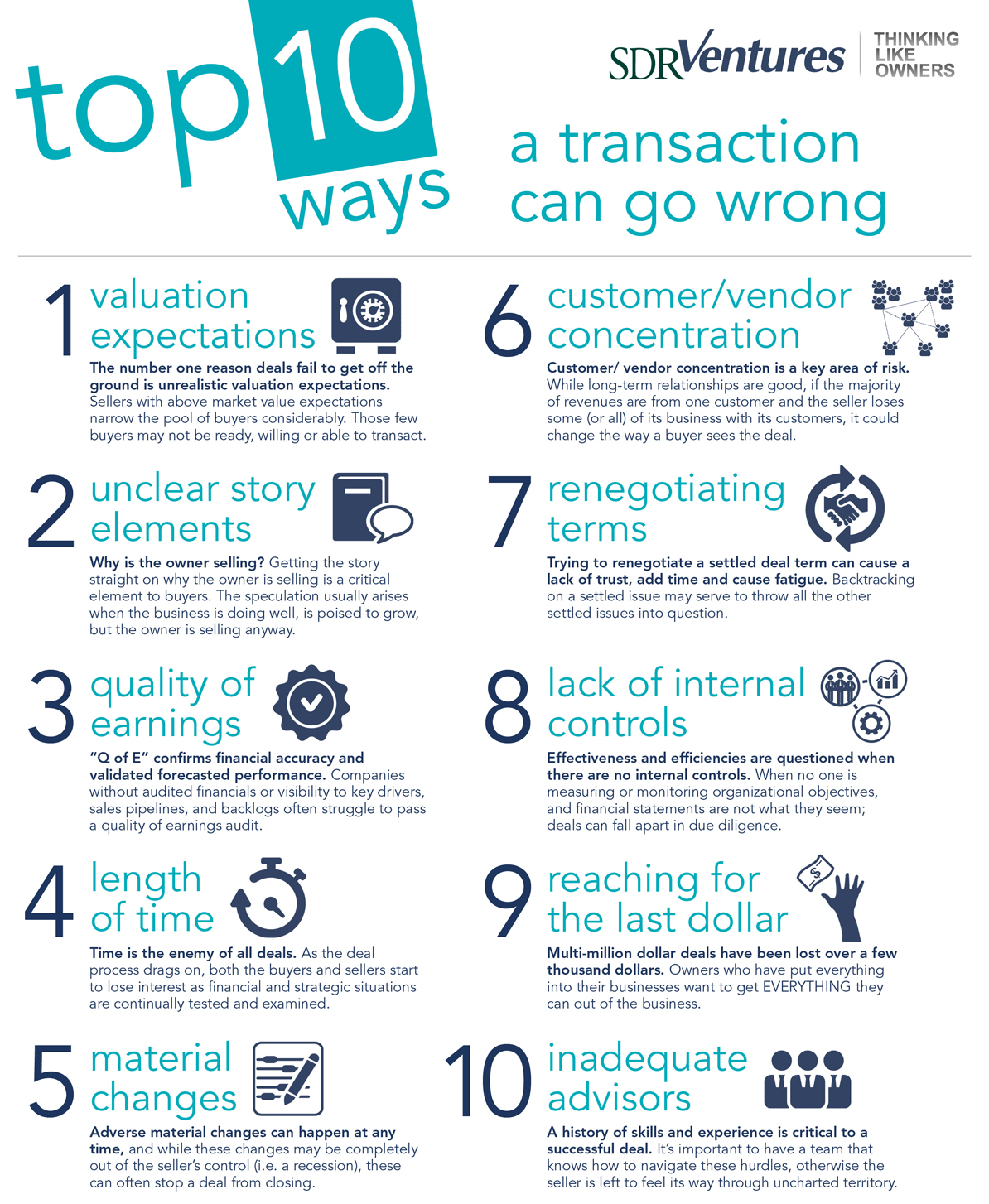
Top 10 Ways an M&A Transaction Can Go Wrong | Axial


By , SDR Ventures | 

Top-10-ways-a-transaction-can-go-wrong-Axial-SDR Ventures-graphic (1)
Many business owners are jumping on the bandwagon to sell their companies, trying to take advantage of the current hot market and frothy multiples being paid by buyers. With the impending Baby Boomer tsunami, more businesses are and will be for sale over the next few years than at any other point in history. This trend creates a competitive environment among sellers and leads buyers to look more closely at the quality and price value relationship of any potential acquisition.
For some time now, due to strong earnings, low interest rates and favorable capital markets, many buyers have sought to grow their businesses more rapidly through acquisitions vs. organic growth. Therefore, one would think that sellers would have a field day in selling their businesses.
Some sources estimate that 80% of small and middle market business owners who put their businesses up for sale never close the transaction. From years of observation, I have found that most deals fall apart (i.e., fail to close) for 10 basic reasons.
1. Unrealistic Value Expectations
The number one reason deals fail to close is because a seller’s valuation expectations are too high.
Many business owners read and hear about companies or competitors operating in their same space selling for very high valuations. Therefore, they believe that their businesses are worth the same.
2. Unclear Story Elements
Business owners need to think like buyers. Attracting a buyer is like preparing for a beauty contest. Companies that “show best” win first place.
Often, because of poor strategic planning, the business owner cannot articulate clearly the company’s competitive advantages, its growth opportunities, its revenue potential, and its ability to produce significant returns on invested capital.
Further, business owners often fail to communicate the strength of their management team and their entrepreneurial desire to continue growth and expand the business post transaction.
3. Quality of Earnings
Audited financial statements confirm financial accuracy and help validate forecasted performance. Lack of clarity and visibility regarding key business drivers, sales pipeline backlogs, back office operations, and the consistency of growth and earnings inhibit a buyer’s enthusiasm to continue its due diligence.
4. Length of Time
Every deal has a life of its own and its own momentum. Recognizing the ebb and flow of the deal momentum is critical to deal success. Time is the enemy of all deals. As the deal process drags on, both buyers and sellers start to lose interest. Substandard or unduly drawn out due diligence analysis of financial and strategic matters is the worst culprit. If the buyer does not have a strong due diligence team, or if the seller is not prepared well for the buyer’s due diligence process, deal momentum is lost.
5. Material Changes
Material changes in the business’s operations can occur at any time. While these changes may be completely out of the seller’s control (e.g., recession, loss of a large client, loss of a key employee), often these changes can stop a deal from closing.
If a material change does occur, the seller should disclose it promptly and fully to the potential buyer. Nothing will destroy a buyer’s trust quicker than the seller failing to be up front about a material change in the business.

6. Customer/Vendor Concentration
If a significant amount of revenues is concentrated in a few customers, or if critical supply chain raw materials are concentrated in one vendor, the buyer’s perception of risk is elevated substantially.
Regardless of the longstanding business relationship that the seller may have with any customer or vendor, buyers have to factor in the potential loss of that customer or supplier. Ultimately, mapping out the consequences of that loss could cause the buyer to walk away from the deal.
7. Renegotiating Terms of the Deal
Renegotiating the terms, conditions, structure, and representations and warranties of a settled deal can be a deal killer. At the very least, back-tracking deal components that have been previously agreed upon kills deal momentum, adds time, and causes deal fatigue.” It also fosters distrust and can call into question all other components of the deal structure previously negotiated.
8. Lack of Robust Internal Controls
Frequently, the buyer’s due diligence process will reveal sloppiness (or worse) in internal controls (e.g., weak collection processes for aged receivables, manufacturing error rates, aberrations in the financial statements, regulatory filing inconsistencies). A buyer may become concerned that the business is not well run. Effectiveness and operating efficiencies come into question when there is a lack of effective internal controls. Once the buyer becomes concerned about the seller’s internal controls, the deal can go south in a hurry.
9. Reaching for the Last Dollar
It is completely understandable that sellers who have put everything into their business want to get every dollar they can out of their business. Often, owners trap themselves mentally by fixating on a specific price for the company.Many owners will decide to pass on a deal, believing that the next potential buyer will pay more than the current potential buyer. Multi-million dollar deals have been lost over a few thousand dollars.
I recommend to our clients that they should examine all components of the deal’s structure — not just the final offering price. If the particular deal meets their exit plan goals, my counsel is not to get hung up on price components alone.
10. Inadequate Advisors
Selecting a quality deal team is critical to deal success. In my experience, business owners are very good at building successful businesses, but often stumble when seeking to monetize them in some form of exit.
Selling a business is a once-in-a-lifetime event for most business owners. Most owners have never sold a business and do not have the skills to complete a deal on their own.
Research indicates that owners who go it alone more often than not will leave money on the table and fail to obtain the best terms and conditions for the transaction.
I believe a successful deal team has five key members: (1) an experienced M&A consultant to lead the transaction team; (2) a skilled wealth management firm to help owners maximize proceeds and to minimize tax obligations from the sale of the company; (3) a transaction law firm (which may or may not be the owner’s regular corporate law firm) that has significant transaction experience and expertise; (4) a transaction accounting firm familiar with the tax implications of various deal structures and who can work collaboratively with the owner’s wealth management firm; and, (5) a strong investment banking firm with deep industry experience in the space, solid valuation expertise, and keen negotiating and closing transaction skill sets.
Article LINK
For additional information regarding Florida business sales, acquisitions and valuations, please contact Eric J. Gall at Eric@EdisonAvenue.com or 239.738.6227. Also, visit our Edison Avenue website at www.EdisonAvenue.com or my personal website at www.BuySellFLbiz.com.

Friday, June 10, 2016

FOR SALE: Award Winning Franchise Bakery - Franchise Transfer Not Mandatory

DESCRIPTION
Recently opened award-winning franchise bakery. Gaining momentum in Southwest Florida. Step into a newly renovated space. Spacious baking kitchen. Ample seating. Bake and serve delicious cupcakes, cakes, cookies, brownies, bars and ice cream. In an area of several restaurants. Sellers have family matters they must attend to so make an offer. Franchise transfer not mandatory if you have your own concept.

OPPORTUNITY
Revenue $257,400; owner benefit $27,400.  Could add Sunday hours to generate additional revenue.

PRICE
$99,000

CONTACT
For additional information regarding Florida business sales, acquisitions and valuations, please contact Eric J. Gall at Eric@EdisonAvenue.com or 239.738.6227. Also, visit our Edison Avenue website at www.EdisonAvenue.com or my personal website at www.BuySellFLbiz.com.

Friday, April 8, 2016

FOR SALE: Pet Sitting and Dog Walking Home-Based Business in Southwest Florida

DESCRIPTION
Turn-key dog walking and pet sitting business with 6 part-time walkers/sitters and one part-time scheduling manager.  Great add-on for existing pet business or a first business for a young entrepreneur or retiree looking for a small business to run.  Numbers assume buyer will replace the part-time scheduling manager. Majority of customers in North Collier and South Lee Counties. Phone, laptop, scheduling software, website, URL, etc. all included in the sale.

OPPORTUNITY
Great opportunity to grow the business as no marketing has been done for years.
Revenue $63,000; owner benefit $16,000.

PRICE
$25,000

CONTACT
For additional information regarding Florida business sales, acquisitions and valuations, please contact Eric J. Gall at Eric@EdisonAvenue.com or 239.738.6227. Also, visit our Edison Avenue website at www.EdisonAvenue.com or my personal website at www.BuySellFLbiz.com.

Monday, January 25, 2016

M&A activity may peak, but should remain elevated in 2016

Sunday, 24 January 2016 22:13

Written by  Mark Sanchez

Rate this item
(0 votes)
M&A activity may peak, but should remain elevated in 2016
If you want to sell your business this year, you still have a pretty good chance of cutting a favorable deal as the seller’s market continues.
Professionals who work in mergers and acquisitions say the market remains strong early in 2016 for deals of all sizes, from small businesses to the middle market and up. Key deal drivers are readily available credit and capital for transactions, as well as high valuations that prompted some sellers to come to the market.
“The timing is right for a lot of companies to sell and cash out of their business,” said Eugene Franks, an attorney at the Muskegon office of Smith Haughey Rice & Roegge PC. “Based on what I’ve seen, it’s a good time to be a seller — and continues to be.”
Deal volumes remain high among both small business and middle-market transactions, the latter of which often has strategic buyers competing with private equity firms for an acquisition. On top of that is continued moderate economic growth that’s contributing to the M&A environment, said Kevin Hirdes, managing partner at NuVescor Group LLC.
The Grand Rapids firm, which works in the lower middle market, had a strong year in 2015 and expects another one for 2016. NuVescor entered the new year with 20 letters of intent for clients across multiple sectors, by far the highest ever at one time, Hirdes said.
Perhaps the biggest challenge to deal flow he and other brokers face right now is finding enough quality prospects for would-be buyers.
“We certainly need more sellers. Our inventory is dwindling,” said Hirdes, who expects a strong M&A market to continue well into 2016.
“I think ’16 is feeling pretty good out of the gate and I would anticipate that it will stay that way for at least some period of time to come,” he said. “Just from our inventory and pipeline of deal flow currently, it looks like ’16 is going to be a terrific year.”
M&A attorneys, brokers and senior business executives surveyed late last summer by law firm Dykema expected M&A activity to continue at a good pace this year, although there was some indication that it was peaking toward late 2015.
Only 37 percent of respondents to Dykema’s survey said they expected a stronger M&A market in 2016. That compares to 59 percent a year earlier who expected strengthening in 2015. Twenty percent of the survey respondents expected the M&A market to weaken this year, compared to just 9 percent a year earlier.
Meanwhile, 42.7 percent of respondents expect no significant change in 2016.

OPTIMISM FOR M&A IN MICHIGAN
Tom Vaughn, co-leader of the Dykema M&A practice at the firm’s Detroit office, said the results of the survey, conducted in August and early September in a cross-section of economic sectors, reflect a market that’s been in an extended period of strong activity.
“Our respondents are beginning to wonder how long this pace is sustainable,” Vaughn said. “We definitely saw a lot more concern about whether we’re starting to reach the peak of M&A activity.”
Even with the tempered expectations, survey results still indicate “continued, strong M&A activity at least through 2016,” Vaughn said.
The Dykema report notes that the survey occurred “during a period of acute turmoil for world markets and the lead-up to the Federal Reserve’s September 2015 decision on interest rates — which may have heightened dealmakers’ concerns regarding these issues.” Ultimately, the Fed opted not to increase rates in September, but did move rates up a quarter of a point at its December meeting.
Nearly half of survey respondents cited the availability of capital as the factor most responsible for fueling activity, followed by 22 percent who cited the U.S. economy and 17 percent who noted favorable interest rates.
Expectations for Michigan were more optimistic than the national results. Among the Michigan respondents to the Dykema survey, 45 percent expected the M&A market in the state to strengthen in 2016, said Brian Page of Dykema’s Grand Rapids office.
Compared to the U.S. as a whole, Michigan may see a higher percentage of foreign buyers coming into the market for a deal, Page said. The automotive sector should remain active as well, he added.
M&A attorneys and business brokers say the strong market has left valuations high for many transactions and often enables them to present multiple sale proposals to their clients who are exiting a business for whatever reason.

PE CONTINUES TO BUY
M&A attorney Tracy Larsen of the Grand Rapids office of Barnes & Thornburg LLP reports an “absolutely gangbuster year” for 2015 with significant deal activity and a “very competitive” market that was dominated by strategic and private equity buyers. A majority of the deals Larsen’s working on right now have private equity buyers, as well.
“Private equity wants to get their capital deployed. There were a lot of bolt-on acquisitions last year by private equity, but also some significant platform acquisitions that they’ll go ahead and build on here in the ensuing years. So it’s just a very frothy market,” said Larsen, who generally works in structured sales processes.
“Every sales process that I did in 2015, and I was involved in lots of them, had competitive bidders,” Larsen said. “The very strong companies that come to market are always going to attract a lot of attention, and there were a lot of very strong companies that came to market last year.”
That’s a contrast to when the U.S. economy was coming out of recession five years ago and “oftentimes, we got very few bidders on transactions,” and sometimes none, he said.
Across the U.S., private equity accounted for a record 71.5 percent of all middle-market buyout activity, according to the most recent private equity report from Pitchbook.com. Competition among private equity firms “is becoming significant, since the inventory of companies worth buying isn’t limitless,” according to Pitchbook’s November report.
“With plenty of dry powder and access to debt, PE investors have flocked to the middle market in search of more reasonably priced, worthwhile opportunities. But that push has now helped drive up valuations at the upper reaches of the middle market, especially as there aren’t that many quality targets in that size range,” Pitchbook reported.
Larsen reported multiples in the double digits for deals in certain sectors such as health care and technology. Manufacturing companies, however, are in the historic range of the mid-single digits.
Multiples should remain high as long as demand from buyers outpaces the availability of good prospects on the market, said Vaughn of Dykema.
“Multiples will follow pretty closely (to) deal volume activity,” he said.

COMPETITION FOR DEALS
Despite the higher competition for deals, Grand Rapids-based private equity firm Blackford Capital has found no shortage of opportunities for making acquisitions in Michigan, said Managing Director Jeff Helminski.
Nor does Blackford Capital have any problem getting deals financed, as banks are “very aggressive” in offering support for M&A, he said.
“There’s a lot of demand on the credit side and the debt side for the types of deals that we do,” Helminski said. “It’s very, very aggressive, both in the rates coming down and the amount of money.”
In the small business market, “there’s no shortage of buyers” for the right opportunity, said business broker Max Friar of Calder Capital LLC in Grand Rapids. The interest is particularly high for small businesses whose owners are not involved in the day-to-day operations, which makes for a smoother transition to the buyer.
“If you have a company that makes money and is not entirely dependent on that owner, there’s a buyer for that company,” Friar said. “It makes the appetite for making an offer in those types of businesses much higher.”
Bizbuysell.com, an online portal that lists small businesses for sale nationally, reports handling 3.6 percent fewer transactions in 2015, although the decline came from a record year in 2014.
“Part of the reason transaction activity stabilized in 2015 may be that small businesses continue to grow financially healthier, allowing owners to ask for more money, creating a more balanced market,” according to Bizbuysell.com’s fourth quarter Insight report that details activity for the year.
Still, the improved financial performance did allow small businesses listed on the website to ask and get a higher price from buyers. The median sales price in 2015 increased 7.6 percent to $199,000, according to the website.
Given the strong seller’s market and the ability for some business owners to get a premium for their companies, executives do need to make sure they don’t set an asking price that’s too high, Friar said.
“At the end of the day, it has to be fair,” he said.

WHAT’S AHEAD?
Barring a major global event that throws the U.S economy into turmoil, M&A professionals don’t see anything on the horizon that can significantly slow activity this year. Rising interest rates, unless they go up dramatically, won’t affect the market, either.
The quarter-point increase in the federal funds rate in December “is really not that significant,” said Hirdes of NuVescor.
“A rate increase that small has some impact at the very margins of a deal, but not at the core of it,” he said. “There’s a certain inertia of deal flow that will happen based on the needs of the sellers, and buyers wanting to buy businesses.”
Even one or two subsequent quarter-point interest rate increases won’t slow activity, although they may compress multiples, said Larsen of Barnes & Thornburg. Interest rates are moving off of historic lows and even with a few increases, would remain comparatively low versus rates from a decade ago, he said.
“As long as the interest rate increases are predictable and at the level expected, I really don’t see interest rate rises to be any impediment to the market in 2016,” Larsen said.
Article LINK

For additional information regarding Florida business sales, acquisitions and valuations, please contact Eric J. Gall at Eric@EdisonAvenue.com or 239.738.6227. Also, visit our Edison Avenue website at www.EdisonAvenue.com or my personal website at www.BuySellFLbiz.com.

Thursday, December 3, 2015

What Is Seller Financing? | Axial


By  | 

PE firms often leverage target companies to increase the probability of reaching target returns. Leverage is a useful tool because it helps generate the necessary capital to drive profitable improvements all while keeping the initial price at a reasonable level.
Firms can use senior bank credit or a mezzanine debt strategy to achieve leverage, but there are times when bank financing doesn’t fit or dries up (a major problem in 2008 and early 2009, for example). A third, less heralded form of financing is known as “seller financing” or “owner financing,” whereby the seller agrees to help finance the transaction.
How Seller Financing Works in a Business Purchase
Credit markets aren’t always priced to everyone’s liking, so the parties to a deal sometimes need to get creative to find a solution. The quintessential seller financing scenario involves a small deal with a privately-owned target company and an acquirer with limited capital. If both sides are committed to making it work, the seller might agree to finance a portion of the deal over a specified term — usually three to seven years — with the buyer acting as the debtor.
Notes are often non-guaranteed, but sellers can push to receive a corporate guarantee or principal guarantee. Normally, the acquiring party makes a down payment and the seller carries a promissory note (“seller paper”) for the rest of the purchase price. Conceptually, a seller-financed acquisition isn’t much different than going shopping on a store credit card.
Payment terms on seller financing agreements are extremely flexible. Interest can be deferred or payments might be interest-only for the first six-12 months. Many end with balloon payments. Increasingly, deals involve other provisions based on the performance of the acquired business.
“There is a spectrum of seller financing mechanisms,” according to Leonard Washko, Senior Analyst at Sunbelt Business Advisors, an Axial member. These include “pure debt, notes contingent on performance, even equity participation.” Some involve changing the risk structure through earn-outs – a form of incentive to keep key players on board after the transition period or to protect the firm from overpaying.
“In every deal, both sides must reach an acceptable level of risk to reach a closing,” says Washko. “We have found it is smart for both seller and acquirer in the middle market to consider how seller financing can be employed to change the risk structure.”
Pros and Cons of Seller Financing
On the surface, seller financing immediately disadvantages the seller, who must wait to receive full payment after control of the company transfers. The buyer is similarly advantaged through lower up-front costs.
Sellers often ask for more attractive interest rates or a higher purchase price to offset the delayed payment or vulnerability to limited contractual protections. Acquirers might offer a portion of the company’s equity as dressing on the seller paper, which is particularly attractive for owner/CEO’s who want to remain in the game. However, few sellers would accept seller financing — even with relatively friendly terms — if a cash buyout is on the table.
In competitive bidding environments, acquirers use seller financing in their proposals to effectively inflate the headline value of their bids and simultaneously drive down the need for third-party financing.
There are risks, though. Some sellers might be looking for a large capital influx to invest in new ventures, in which case the prospect of seller paper might be too illiquid. Acquirers might be forced to accept higher interest payments, which could offset the benefits of leverage and drive down IRR. The prospect of a huge balloon payment might be intimidating, too. 
When Seller Financing Makes Sense
Even though seller financing is most associated with private acquirers that may not be able to source enough capital without help from the target, Washko notes this isn’t always the case. “We have had a number of middle market transactions with strategic corporate buyers,” he points out, “that reach the finish line with some form of seller financing.”

In one deal, Washko saw seller financing as a complimentary tool to make both parties comfortable. “The corporate acquirer was concerned about two risks: the valuation depended on a high growth projection; and key customers might be lost with the exit of the current CEO/owner.” In other words, the acquirer needed some form of collateral and wanted to price the deal to compensate for the possibility of underperformance. Ultimately, the solution involved distributing the risk burden in a more equitable fashion.
“We proposed a combination of ongoing equity participation for the CEO, and an earn-out structured as a note paid on the realization of key growth metrics.” Washko indicated it was important for the acquirer to tie the price to future performance and for the seller to “accept risk by staying in with equity,” which “gave the acquirer a lot of confidence and reduced their immediate risk exposure.” Says Washko, this structure “was really critical in moving the deal to close.”
Article LINK

For additional information regarding Florida business sales, acquisitions and valuations, please contact Eric J. Gall at Eric@EdisonAvenue.com or 239.738.6227. Also, visit our Edison Avenue website at www.EdisonAvenue.com or my personal website at www.BuySellFLbiz.com.