Showing posts with label private equity group. Show all posts

Monday, October 19, 2015

What are PE Firms Searching For? | Axial Forum

By  | 
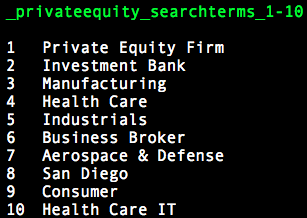
Nothing reveals one’s curiosity like their search history. To find out exactly what private equity firms are looking for as they troll the internet in search of deals, we pulled the top 50 most-searched terms that these investors used on Axial in the last 30 days. While most of the results serve as signals about the industries and regions that are top of mind amongst financial sponsors, we weren’t necessarily surprised to see that the most frequented search term was, in fact, “Private Equity Firms”. As we see a robust M&A environment continue, dry powder pile up, new entrants emerge, and more and more private companies come up for sale, the thing private equity firms are most concerned with is keeping an eye on their competition.
Screen Shot 2015-07-07 at 3.48.41 PM
When it comes to searching for counterparties, private equity firms continue to rely on intermediaries for dealflow. Not surprisingly, finding “Investment Banks” to gain access to the best deals is a priority amongst sponsors. Investors also frequently search for “Business Brokers”, recognizing that some of the best deals remain in the hands of smaller, boutique operations or one-man shops. We’ve seen this trend play out on the network as investors continue to seek out growing, profitable middle market and lower middle market companies that the big banks may not have access to.
Screen Shot 2015-07-07 at 3.48.49 PM
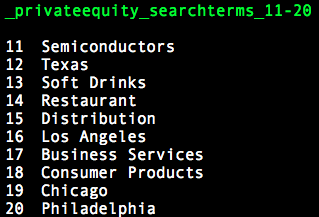
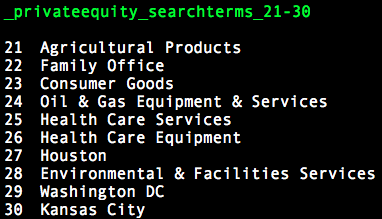
We’ve written about two particularly hot sectors and what’s stoking their fires and our data confirms that “Manufacturing” and “Healthcare” are still in vogue. Next on the list are the “Industrials”, “Aerospace & Defense” and “Consumer” sectors. More specifically, however, investors are looking at opportunities in “Health Care IT” and “Semiconductor” spaces. Even “Soft Drinks” is bubbling it’s way to the top.
Screen Shot 2015-07-07 at 3.48.58 PM
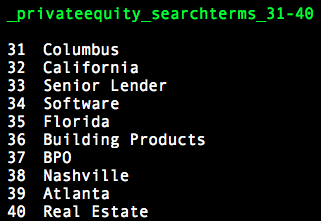
Regionally, California and Texas are the two big states to look at. Interestingly, however, investors tend to search more specifically for California cities, with “San Diego” topping the list, whereas the first Southwest regional term is simply “Texas”. Within Texas, “Houston” wins out, which points to targeted interest in opportunities within oil & gas even while prices are stifled.
Screen Shot 2015-07-07 at 3.49.07 PM
The term “Family Office” is also in the top 25 and rightfully so. When it comes to competition, family offices have started to take some share away from the PE industry, shying away from their traditional role as LPs and investing directly in private companies themselves.
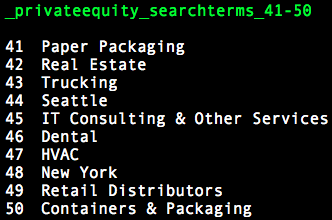
Screen Shot 2015-07-07 at 3.49.15 PM
When it comes to deal sourcing, being able to find and be found by the right counterparties and companies is paramount to private equity firms’ success. And as the data tells us, more and more, that search is starting online.
Article LINK

For additional information regarding Florida business sales, acquisitions and valuations, please contact Eric J. Gall at Eric@EdisonAvenue.com or 239.738.6227. Also, visit our Edison Avenue website at www.EdisonAvenue.com or my personal website at www.BuySellFLbiz.com.

Wednesday, July 22, 2015

5 Scary Stats About Private Equity | Axial Forum

By  | 

Pitchbook recently released its quarterly breakdown of global private equity activity, and while some of the statistics may raise some eyebrows, the moral of the story is that private equity investors are living in a new normal. Competition has never been more intense, deal FOMO is very real and LPs are wisening to an environment where outperformance is a rarity and careful fund selection is paramount to achieving superior returns.
Here are 5 stats about the industry and how we, at Axial, see them playing out within the industry:
1. The number of funds closed is down from 2Q 2014, from 119 to 94.
LPs are becoming increasingly scrutinous of not only fund performance, but the way GPs differentiate themselves in the market to win over sellers. It’s not sufficient anymore to be a generalist private equity firm. Firms need to have a unique set of industry-specific strategies to help them stand out as the partner of choice to the CEOs they are targeting. That’s how funds will generate outsized returns, especially in a hyper-competitive environment.
Investors have also become keen to understand private equity firms’ deal sourcing and business development strategies. “Proprietary deal flow” is viewed with extreme skepticism now by smart LPs, and instead they’re focusing on whether or not the firm has a well-oiled business development machine to help maximize credible deal flow or whether it remains a haphazard and “everyone just chips in” process.
2. Capital raised is significantly down from 2Q 2014, from $90.7B to $43.7B.
Private Equity funds are sitting on a lot of dry powder right now, with a record year of fundraising in 2014 and money to put to work even from the last cycle. Some funds are spending this capital by investing in a greater number of smaller deals (including add-ons) and raising smaller funds because of it. On top of this, middle market and lower middle market deals are ones that have proven to offer maximum upside in investment performance. If you’re not one of the very few mega funds or a middle market firm with a great returns profile, you’re a bit betwixt and between.
3. PE deal flow is down 20% YoY, 12% from 1Q.
Securing consistent, quality deal flow remains a challenge for private equity firms. As the market becomes increasingly competitive, new entrants emerge, and the number of potential buyers further fragments, each individual firm is up against a lot to make sure they are seeing all the deals they want to. The boutique advisor movement and recent regulation has also made it so that almost anyone can sell a company and GPs are learning they have to be more proactive about building relationships with new intermediaries. It’s still a seller’s market and there’s more demand than there is supply. This will shift over the next few years as we begin to see baby boomers retire in droves, representing a significant transfer of ownership of mid-sized businesses.
4. Deal count, capital invested and median deal size are all down from this time last year. In Q2 2014, PE firms inked 1,608 deals compared to 1,279 this year. Capital invested dropped from $267.4b to $191.6b YOY. And the median deal size fell from $50m at 2nd quarter end 2014 to $32m this year.
2014 was a banner year, so it’s not surprising to see these numbers down across the board. In addition to a natural movement into the middle market, as well as a boost in add-on acquisitions as firms build upon their platform investments, firms have become averse to the headline risk of big deals. Even though we’re seeing smaller deals, 2015 will still be one of the strongest for the M&A market since the recession.
5. Too high valuations and unrealistic pricing expectations from sellers remain the top reasons investors struggle to close deals.
This was one of the key insights we gained from gathering over 200+ private market professionals at Axial’s recent New York City summit. Even though 80% of the crowd expects M&A activity to remain steady or increase in the second half of 2015, attendees still pointed to valuation levels and pricing expectations as the chief reasons some deals aren’t getting done. Both of these seem to be a function of the supply and demand dynamics we’re experiencing currently. With fewer deals to be had, some buyers are overpaying to win out and would-be sellers are using those deals as a barometer for what they should expect.
Article LINK

For additional information regarding Florida business sales, acquisitions and valuations, please contact Eric J. Gall at Eric@EdisonAvenue.com or 239.738.6227. Also, visit our Edison Avenue website at www.EdisonAvenue.com or my personal website at www.BuySellFLbiz.com.