Showing posts with label business value. Show all posts

Friday, July 21, 2017

Article Summary: 6 Things You Probably Don't Know About Your Company Value | PR Newswire

I've summarized this article capturing only the key points.  If you would like to read the article in its entirety, click on the link at the bottom of my summary.  Edison Avenue offers complimentary opinions of value and more formal valuation opinions at reasonable prices -- Eric Gall.

BELLEVUE, Wash., June 2, 2016 /PRNewswire 
Most small business owners have unrealistic ideas of how much their business is worth. 
The sale of big companies and their reported valuations have very little to do with the value of small, privately held businesses.  Here are 6 business valuation facts surprising to most small business owners:
1. Small businesses usually don't sell for a multiple of their revenues. Buyers are most often individuals who need to make sure the business generates profit to pay their bills. Profits matter more to the business valuation than revenues.
2. Growth potential doesn't increase the value much. Buyers primarily value the business on its past profitability.
3. Value doesn't go up because the business was established a long time. Having too short of a history can harm the value, but a company in business 50 years is not automatically more valuable than one in business 10 years.
4. Most recent year's performance trumps historical performance. A profitable business for many years experiencing a bad year last year will be dramatically discounted. A business performing poorly for many years experiencing a great year last year will see a dramatic increase in value.
5. The buyers don't pay extra for equipment. The company equipment is stuff one needs to run the business. A lot of expensive equipment does not necessarily increase the business valuation.
6. It takes time to translate a business valuation from paper to cash. The average time to sell a business is 9 to 12 months. The larger the business, the longer it takes to sell,
Article LINK
For additional information regarding Florida business sales, acquisitions and valuations, please contact Eric J. Gall at Eric@EdisonAvenue.com or 239.738.6227. Also, visit our Edison Avenue website at www.EdisonAvenue.com or my personal website at www.BuySellFLbiz.com.

Wednesday, July 19, 2017

Article Summary: Ready to sell your business and retire? | CNBC

Sharon Epperson | Katie Young

NBC Television


Note:  I've thrifted the wording of this article to capture only the key points.  If you would like to read the entire article, click on the link at the bottom of my summary.  Eric Gall.

When it is nearing time to retire and sell your business, will you be prepared?
Force yourself to define your objectives:

  • Will you have enough money to retire?
  • What will be your legacy in the business?
  • How will the transition impact your employees?

Value your company:

  • Who are my prospective buyers?
  • What are typical multiples in my industry? 
  • Is there an accomplished business broker I can speak with?
Prepare for succession:

  • Can the business run without you?
  • Have you developed an internal successor, or second-in-command?
  • Which prospective buyers are the best fit?
Knowing the company you've created will continue to be successful will help you let go and retire well.
Article LINK

For additional information regarding Florida business sales, acquisitions and valuations, please contact Eric J. Gall at Eric@EdisonAvenue.com or 239.738.6227. Also, visit our Edison Avenue website at www.EdisonAvenue.com or my personal website at www.BuySellFLbiz.com.

Wednesday, July 12, 2017

Article Summary: How Setting Clear Goals Minimizes Value Gaps in a Sale | Axial


By , Midwest Genesis | 


Original article has been thrifted to only cover the key points.  Full article can be read by clicking the link at the bottom of the article.

Determining business value can be a complex undertaking.

  • For a buyer, value is mostly driven by the likely future return, discounted by the risk, associated with the investment.
  • For a seller, value is more complex and reflects the past. Value can be defined as the sum total of all the elements that create satisfaction for the seller.  This is deeply personal and based on beliefs and not necessarily financials. 
  • Knowing all the elements that influence value for a buyer and a seller can dramatically reduce gaps between the buyer's and seller’s perception of value.
The very first question any owner should answer when considering a sale of the business is “What are my goals?”
The goals must be actionable, precise, concrete, real, and in writing. 
The steps along the path necessary to achieve a seller’s goals can take considerable time and energy to achieve. 
The transfer of a business is driven by the motives of the seller:  fatigue, health, competition, additional investment, technology, government regulations, economy, family issues, funding retirement, employees, etc.. These motives are influenced by one or more of the following situations:
  • the conditions of the capital markets,
  • the state of the business, and
  • the personal situation of the owner.
Understanding their influence on the readiness of the owner to pursue a transfer process is key to setting appropriate goals. Rob Slee illustrates the relationship of these factors with seller goals in the chart below:
Influences on the Business Transfer Spectrum
As shown, selling a business can get quite complex. There are multiple motives, transfer channels, and transfer methods. Each are governed by different rules and authorities. Owners need to understand how these influence their path to satisfaction in a business sale.
This task is daunting for a business owner.  Using skilled advisors can contribute considerable insight and experience.  Finding the right advisor early in the process can avoid value gaps and answer the question: “If you could have seen the road from the beginning, would you have chosen a different path?”
Full article LINK

For additional information regarding Florida business sales, acquisitions and valuations, please contact Eric J. Gall at Eric@EdisonAvenue.com or 239.738.6227. Also, visit our Edison Avenue website at www.EdisonAvenue.com or my personal website at www.BuySellFLbiz.com.

Tuesday, July 11, 2017

Article Summary: 3 Tips for Maximizing the Sale of Your Businesss | Clark, Schaefer Hackett


Article LINK

For additional information regarding Florida business sales, acquisitions and valuations, please contact Eric J. Gall at Eric@EdisonAvenue.com or 239.738.6227. Also, visit our Edison Avenue website at www.EdisonAvenue.com or my personal website at www.BuySellFLbiz.com.

Thursday, June 1, 2017

Article Review: 4 Business Valuation Considerations for Owners | Axial

By , Axial | 
Key Takeaway:  Knowing the value of your business is important whether you are ready to sell now or five years down the road.
Other Takeaways:

  1. As an owner you are an expert in managing your business; however, you may not understand everything that goes into a valuation.  Bringing in an objective view from an outside expert will give a more accurate value.
  2. It is very important to disclose very minute details about the business because even things you believe are unimportant, such as the lease rate being above or below market rate, can have a large impact on the valuation.
  3. Don't become emotional over differences in your opinion and the valuation.  Do your best to point out the strengths and weaknesses and accept the expert's opinion based on what you have provided.
  4. Make sure your expert is experienced in valuations and understands valuation methodology.  Valuing a business is more than looking at comps.  It should also factor in financial and industry trends as well.


For additional information regarding Florida business sales, acquisitions and valuations, please contact Eric J. Gall at Eric@EdisonAvenue.com or 239.738.6227. Also, visit our Edison Avenue website at www.EdisonAvenue.com. To search for Florida Businesses for Sale: CLICK HERE

Friday, May 12, 2017

Article Review: 75% of Owners Are Ready for Their Exits, But Their Businesses Aren’t | Axial

Article by , BEI | 
Key Takeaways:

  • 75% of business owners answered yes to the question, "If a buyer offered you enough cash for your business to provide you with complete financial security, would you sell today?"
  • Only 26% of surveyed owners believed they are ready to exit their businesses successfully. 
  • Prepare your business for sale before you feel the need to exit.
  • An exit plan provides you with flexibility, leverage, and negotiating power.
Determine the likely sale price of your business before you go to market.

  • Business brokers will provide you with an estimate of your business’ value today, at no cost.  
  • Make sure you hire a Certified Business Intermediary (CBI) or Certified Mergers & Acquisitions Professional (CMAP) to conduct the valuation. 
  • If the value is insufficient for you to exit your business, begin planning to create sufficient value. 
Increase transferable value.

  • Transferable value is what a business is worth to a buyer without the owner’s continued involvement. 
  • If a business requires the owner’s presence to maintain and increase cash flow, the company, without the owner, has limited value. 
  • If a business can continue without the owner, it has transferable value.
  • I could take 5–10 years to create adequate value. 
Preparing your business for a sale before you prepare yourself positions you to sell your business when you want, for the money you need, and to the person you choose.

For additional information regarding Florida business sales, acquisitions and valuations, please contact Eric J. Gall at Eric@EdisonAvenue.com or 239.738.6227. Also, visit our Edison Avenue website at www.EdisonAvenue.com. To search for Florida Businesses for Sale: CLICK HERE

Sunday, December 18, 2016

3 Hidden Factors that Impact Your Business Value | Built to Sell Radio

When you get an acquisition offer, your eye will immediately go to the offer price. That’s only natural. But, there are two other negotiating points that could have just as large an impact on your windfall when selling your business.
Groot discovered the importance of all three when he went to sell JP’s Coffee Shop – a business that USA TODAY® voted one of “Top 10 Coffeehouses in America”.
In Jack Groot’s case, he sold his business to a supplier.
Your supply chain will include natural acquirers adjacent to your business. We’ll help you identify a short list of strategic acquirers during month 11 of The Value Builder System. It all starts with getting your Value Builder Score.
About Jack Groot
Jack grew up in Grandville, lives in Hudsonville, and owned his business in Holland MI for over 20 years. Jack Groot’s entrepreneurial role model was his father, Jake Groot. The family business of homebuilding and developing and selling real estate started in the late 1940s, shortly after Jake emigrated from the Netherlands. Jack credits his father for being a great example of problem solving, thinking outside the box, and how to do customer service. In 1993, Jack founded JP’s Coffee in Holland, named a “Top 10 Coffeehouse in America” by USA TODAY® Travel Destinations. He also created an international coffeehouse and business training school, and was an industry consultant, industry magazine columnist and blogger. After Jack sold his business interests, he returned to his homegrown roots in customer service, buying and selling real estate, as well as consulting for others in business start-up and operations.
Some Highlights of the Show
Business: JP’s Coffee Shop
2:56: A timely dream.
4:00: “Award winning downtown, fabulous location… at that point we were leasing the building.”
4:20: Started the business in 1993 and sold in 2014.
4:46: “1994 saw the first $250,000 in revenue… within five years I had paid off all of my debt.”
6:30: “My goal was to move from working IN my business to working ON my business.”
7:00: “I was no longer needed as it pertained to the operations of the business. My job, it morphed into being a leader.”
7:44: “In 1993, my landlord said to me, “Buy the building, please…” I can’t, so I leased… Five years later I was debt free and ready to purchase… I tried over the next 15 years… until I finally got the building in 2013.”
10:12: The triggering event.
10:50: “My business existed to serve me; I didn’t exist to serve it.”
11:15: “One of my vendors came to me… ‘If you ever decide to sell, I want to be first in line.’”
12:10: “Somebody tried to buy my business… I’m not looking to sell… What do I do?”
12:20: “Jack, whether you sell or not is irrelevant. You must follow this process, improve and learn from this process… Come out better for it.”
14:50: Consulting practice, barista school, industry products – everything, lock, stock and barrel.
16:00: Pre-existing relationship with the vendor built trust as a future acquirer.
19:30: Juice and smoothie bar franchise concept with poor financial performance.
20:45: Words of advice on failure.
21:45: “Large amount of debt resting on the shoulders of the performance of the coffee shop.”
25:40: The valuation range.
27:00: Negotiating the terms without attorneys present.
29:45: “If John sells his business, it accelerates the contract.”
30:40: “Lucrative position with a lot of upside over the next few years.”
30:50: The employment contract.
38:30: leaderization.com

The Value Builder System™
Built to Sell Radio is brought to you by The Value Builder System™ where, our global network of Certified Value Builders™ will help you improve the value of your company by up to 71%. It all starts with getting your Value Builder Score here.

Link to article
For additional information regarding Florida business sales, acquisitions and valuations, please contact Eric J. Gall at Eric@EdisonAvenue.com or 239.738.6227. Also, visit our Edison Avenue website at www.EdisonAvenue.com or my personal website at www.BuySellFLbiz.com.
Tuesday, September 27, 2016

In a Sale, Soft Elements Can Have Hard Consequences | Axial

By , Midwest Genesis | 
When it comes to selling a business, many advisors make a point of how business valuation plays a key role in establishing what a seller might expect from a sale transaction. But just as there is more to determining value than a valuation, there is more to achieving a satisfying experience than getting a good price, structuring acceptable deal terms, and minimizing taxes. On the buy-side, there are obvious factors like investment hurdle rates, financial projections, “add-backs” to profits, future economic conditions, availability and cost of funding, etc. that play a role in developing a purchase offer.
But no less important than these “hard” components of an acceptable deal are the softer sides of a transaction. Buyers include conditions like the strength of the management team, the culture that dictates how the business is expected to operate in the future, the strategy for future development, and the challenges of integration.
If not considered long before the negotiation process, these “soft” elements in a sale process can create significant gaps that are difficult to bridge.
Buyers view these softer factors as risks that can take considerable time to understand and manage. They require judgment and often influence the discount rates that are applied to calculate a net present value of the business. Consequently, they are a critical part of a resulting offer.
As a seller, it’s helpful to understand what these risks are and how they influence an offer in order to minimize them before engaging in a sale process.
On the sell-side, experienced M&A advisors know that an owner can have a strong personal connection to their company. Jim Afinowich from M&A advisory firm IBG Fox & Fin Financial Group likens this situation to parenting: “nurturing the company though sleepless nights, protecting it from threats, helping it recover from illness, constantly leading and nudging it in the right direction, and preparing it to survive without them.” This helps explain the emotional attachment and out-of-character reaction owners can have to the sale process. It’s not just a source of an owner’s income and wealth; it is frequently a major source of their identity and purpose. Successfully separating from these connections can mean the difference between a very satisfying or disappointing transaction experience.
Building and selling a solid company requires successfully accomplishing several key business development stages. Each stage takes more and more financial and emotional currency and comes with increased attachment. Being able to deal with this attachment and separate from the business can mean the difference between satisfaction and disappointment for everyone involved. The degree to which sellers can judge how well they have accomplished these stages is ultimately measured by the fitness for the business to grow in the hands of a new owner. Therein lies the true value for the buyer.
Ownership Business Development Stages
  1. Conception
  2. Formation
  3. Establish Core Values
  4. Feed, Nurture, Protect
  5. Build Management Team
  6. Reduce Future Risk
  7. Separation
  8. Transition Out
A fulfilling transaction may have nothing whatever to do with what a buyer is willing to pay or the amount of financial return garnered by the seller. The real ROI takes into account all the conditions for satisfaction, many of which are mutually exclusive to the financial considerations a buyer brings to the table. They encompass benefits for both the business and the seller. They involve resources that can generate future success for employees, customers, suppliers and the local community under new ownership as well as opportunities for the seller that contribute to a satisfying life after the sale. The key is knowing what they are, who controls them and how they can be realized.
The Successful Transition Planning Institute has developed a framework with ten areas that owners need to address to minimize their unconscious sabotage of the deal – and make sure they have a life they can’t wait to live on the other side.
Framework
Even if there isn’t a pending retirement in the near future, these psychological, emotional, intellectual, lifestyle and even spiritual factors can influence the seller’s state of mind in a very subtle way. Ignoring or minimizing the impact of any one of these “soft” factors can cause a deal to blow up at the last minute.
Peter Drucker in his book "Managing Oneself" points out that the one prerequisite to successfully managing separation from a business and transitioning to life after a sale is that “you must begin working on it long before you enter it.” Lee Iacocca, former CEO of Ford Motor Company and retired CEO of Chrysler, said; “You plan everything in life, and then the roof caves in on you because you have not done enough thinking about who you are and what you should do with the rest of your life.”
If not adequately addressed, the soft sides of sale can generate a very hard and disappointing gap in the value and ultimate satisfaction expected from a transaction.
Article LINK

For additional information regarding Florida business sales, acquisitions and valuations, please contact Eric J. Gall at Eric@EdisonAvenue.com or 239.738.6227. Also, visit our Edison Avenue website at www.EdisonAvenue.com or my personal website at www.BuySellFLbiz.com.

Wednesday, July 6, 2016

Choosing the Right Business Valuation Option | Axial

By , Midwest Genesis | 
When selling a business, knowing its value is top of mind for both seller and buyer. But differences in perspective can lead to significant gaps in value.
Value for a privately owned company is influenced not just by the condition of the business and the availability and cost of capital to fund the purchase but the objectives and personal motives of the parties involved. To add to the complexity, a sale transaction is often a result of negotiations involving cash, assumption of debt, future earnings, assets, and deal terms.
To help establish a perspective, a formal appraisal or valuation of the business is often performed. But keep in mind, there is a big distinction between value and a valuation. Value is based on perception while a valuation is based on a formal independent assessment.
A valuation is useful because it is a structured and disciplined process requiring experience, judgment, and skill. But it too relies on assumptions that involve as much (if not more) art as it does science. Fortunately, there are standards mandated by various authorities to establish consistency and quality. The final valuation opinion is usually presented as a range. The limits of the range are influenced by professional judgment and the rules for performing the necessary calculations. The credibility of the valuation depends on the experience and credentials of the appraiser.
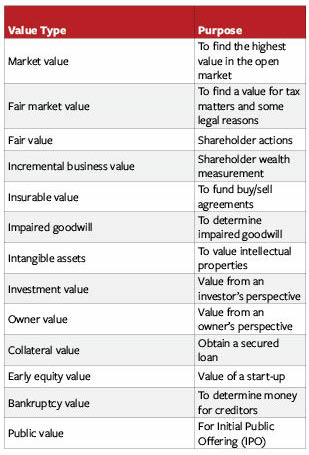
The kind of valuation most appropriate for an ownership transfer depends on its purpose. For example, you might not want to use the same approach to resolve a dispute (such as a divorce settlement) or file bankruptcy as to sell a business to a competitor. Rob Slee in his comprehensive treatise on “Private Capital Markets” outlines thirteen types of business values. All have a different purpose, function and rules for use.
Valuations are a Function of Need
Element+Advisor
Source: Private Capital Markets by Robert T. Slee, 2nd edition
In selling a business, a great deal depends on who the buyer is. Selling to the employees through an ESOP (Employee Stock Ownership Plan) requires a Fair Market Value assessment with all the rules and limitations of that process. Insurable value for a Buy/Sell agreement is a way to fund the acquisition of part of a private company due to the loss of an existing owner. Still others are interested in what they can garner from the open market. Here, market value is influenced by the state of the business and capital available for funding the purchase.                                                                                                      
Many sellers don’t realize that every private company has at least three market values at the same time. Each of these represents the most likely selling price based on the most likely buyer type; Asset, Financial, or Strategic.
Asset Buyers
Asset buyers look at a company’s worth based on net value of the company’s assets. Here, beyond the possible write-up of the assets, the buyer is not buying the company’s earnings stream or giving credit to the company’s operations or goodwill (name, reputation, customer base etc.). This valuation approach is most useful if the business being sold is experiencing negative growth or some of the assets (e.g., real estate) do not contribute to the operations going forward.
Financial Buyers
A financial buyer is one that will pay for the business as a going concern, including goodwill. The valuation is based on the company’s historical financial statements and 3-5 year projections of the P&L and balance sheet. The company’s profit (Earnings Before Interest, Taxes, Depreciation and Amortization or EBITDA) projections are discounted back to the time of purchase to determine a net present value. The discount rate that is applied is a function of the company’s size, industry, dependence on economic conditions, debt leverage, and risk factors such as supplier or customer concentration, management strength, culture, business plan, etc.
Sellers can improve a buyer’s net present value for their company by minimizing these risks before entering into a sale process. Benchmarking the NPV against M&A supply/demand experience helps in framing “what the market will bear.” Competitive valuations are benchmarks that are formulated using multiples of EBITDA of like businesses purchased by like buyers. To achieve a conclusion, a valuation professional will likely apply some weighted average of the various calculations and determine a range of values for the subject business.
Strategic Buyers
A strategic buyer is one who already has some investment in a related business. By combining the existing business with the seller’s business, the buyer expects synergies that will generate improved sales and/or profits beyond what the businesses generate separately. Valuation professionals typically have little insight into what a strategic buyer will pay for a business because only the buyer knows what synergies might have an impact on an integrated concern. Typical synergies can result from the seller’s product, process or technology capabilities as well as customer relationships. Buyers who are consolidators look for economies of scale and lower cost structures as a result of the combination. Growth buyers expect to avoid the costs associated with business development for synergistic sales and operations. Either of these lead to the potential for a greater purchase price than what could be available from a financial buyer if the strategic is willing to share some of the profits from the combined businesses with the seller. On the downside, the value of a strategic buyer to the seller may not be as compelling if the net result of the combination has a negative impact on the seller’s employees, customers, or local community.
The Ultimate Valuation
Owners can secure a premium price for their company when capital for financing is attractive, they have minimized future growth risk in the business, and they find a strategic buyer who is both acceptable and willing to share the benefits of synergies. Fortunately, there are a number of financial advisors that can help make that happen. But it is important to keep in mind, at the end of the day, no matter what the purpose, a business is only worth what someone is willing to pay.
Article LINK

For additional information regarding Florida business sales, acquisitions and valuations, please contact Eric J. Gall at Eric@EdisonAvenue.com or 239.738.6227. Also, visit our Edison Avenue website at www.EdisonAvenue.com or my personal website at www.BuySellFLbiz.com.

Tuesday, June 28, 2016

Explaining The Advantages Of Selling A Business To Employees Vs. To Outsiders | Forbes

When you sell your business, you have a basic choice to make: Do you want to sell it externally, or do you want to sell it internally to your employees or family members?
There are many things to consider when making this decision, such as whether or not you have a management team with an interest in buying your business, or how important it is that you keep your business operating in its current location, etc.
Arguably the most important consideration is price. How important are your after-tax proceeds of the sale relative to other considerations? If price is your most important priority, you’re generally going to get a better deal selling your business externally to a company with a strategic reason to buy your business.
BTSR notes photo_FINAL-Barry-Wood
Credit: Barry Wood
Barry Wood: A Case Of Two Different Exits
Barry Wood, a serial entrepreneur, provides a unique insight into the differences between an external and an internal sale, because he has participated in both in the same industry.
Wood took over M&I Door Systems in 1995. M&I, based in Barrie, Ontario, made large commercial grade doors, often for industrial applications like airports or oil refineries.
In 1998 an American competitor approached Wood about buying M&I. The American company was tired of competing with Wood on jobs and liked the product line M&I had created. Wood asked the company to make him an offer and, to his pleasant surprise, his American competitor offered the equivalent of almost nine times EBITDA – almost twice the going rate of five times EBITDA that Wood had seen his industry peers trade for.
Wood accepted the offer, honoured his five year non-compete and then started a new door business called TNR Doors in 2003. Like M&I, TNR became an industry leader in industrial doors. By 2013, Wood was ready to get out. This time, he decided he wanted to give his colleagues the chance to buy him out in the form of an internal sale.
Wood ended up selling his shares to his employees at an industry standard multiple of five times EBITDA, or almost half of what he got when selling a similar company externally. In the first sale, the American competitor had a strategic reason to buy M&I and could immediately increase the bottom line of both Wood’s company and their own. They were therefore willing to pay more.
When selling internally, employees usually have to borrow the money to buy into your business. They rarely have any strategic assets to leverage, and in order for them to see a return on their investment in the future, they need to buy low and hope to sell high.
Could Wood have gotten more for his shares in TNR if he had chosen to sell externally? Probably, but for Wood, who had already had a lucrative exit, maximizing the value of TNR was somewhat secondary to considerations like ensuring his employees still had a job after the sale.
When it comes to deciding to sell externally or internally, there is no right or wrong answer. It comes down to your personal priorities.

Article LINK


For additional information regarding Florida business sales, acquisitions and valuations, please contact Eric J. Gall at Eric@EdisonAvenue.com or 239.738.6227. Also, visit our Edison Avenue website at www.EdisonAvenue.com or my personal website at www.BuySellFLbiz.com.