Showing posts with label discretionary earnings. Show all posts

Monday, August 21, 2017

Article Summary: 3 Ways to Value the Sale of Your Business | Manta

I have thrifted the article to its key points. To read the entire article, click the link at the end of the summary - Eric Gall.

By Chance Butler, Pacific Landfall - July 28, 2017

3 Ways to Value the Sale of Your Business

How much is your business worth? There are three ways to estimate its value on the open market:

Some industries have standard models for determining value, e.g, accounting practices one times annual revenue.  Most industries do not and must rely on other approaches.
  1. Income Approach - The business is viewed as an investment. Focus is on future cash flows and growth. Method used is called the Discounted Cash Flow (DCF) approach looking at 5 to 10 years of income. 
  2. Market Approach - Your business is compared to the sales price of other businesses based on multiples of Discretionary Earnings (DE) and Revenue. 
  3. Asset Approach - If your business isn't generating enough DE to support a working owner and provide a solid return on investment, the business is worth no more than the value of your company’s assets. 
Understanding the methods and value of your business can help identify the best time for you to sell. 

For additional information regarding Florida business sales, acquisitions and valuations, please contact Eric J. Gall, CBI, CM&AP at Eric@EdisonAvenue.com or 239.738.6227. Also, visit our Edison Avenue website at www.EdisonAvenue.com. To search for Florida Businesses for Sale: CLICK HERE

Monday, August 14, 2017

Simple Cash Flow Spreadsheet Anybody Can Use | SBA

As they say in the business world, "cash flow is king."  The article below describes a simple little spreadsheet for small business owners to calculate their cash flow.  Eric Gall

By Tim Berry, Guest Blogger
Published: March 22, 2016Updated: March 28, 2016


If there's just one formal business skill every business owner should have, it's understanding and forecasting cash flow. It's not intuitive because it's not the same as profits; but it's vital. We spend cash, not profits.
Here's my recommendation for a relatively simple way to lay out cash flow in a spreadsheet, so you can see it. It doesn't take a CPA or an MBA to do it ... just knowing your own business.

Do Your Numbers

Simple Cash Flow Projections

Making Your Estimates

  1. In lines 3 and 4, you forecast the revenue from sales. Yours might be just cash sales, a single line. If you have sales on account, you know it. If you're not sure (maybe you're looking at a startup so you don't have the experience yet), assume you do have sales on account if you sell to other businesses; and probably not if you sell to consumers. Line 4 is your prediction for when the business customers will pay invoices.
  2. The "Start" column reflects the starting balances and starting funding for a startup. With an ongoing business, you might have that balance labeled "Dec" for the ending month of the previous year. In this example, the startup owner borrows $55,000 and gets $25,000 as new investment.
  3. Lines 5 and 6 are important because new money from loans and investments doesn't show up in your profits, but it's there.
  4. That whole block of rows 3-6 is a simplification. You know your business. Where else does money come in? Maybe you're selling assets too? Stay flexible. Take this simple example as just that, an example. Make yours specific to your business.  
  5. Rows 9-10 are also simplified. Use as many rows as you want to estimate operating expenses, focusing mainly on fixed costs, rent, utilities, and payroll.  
  6. Row 11 is there to make the point that cash flow counts what you spend for inventory and other direct costs of sales, when you spend it – not when it shows up in profit and loss. When a bookstore spends $10,000 in November to buy books to sell, those books might not show up in profits (as cost of goods sold) until December, January, or beyond ... but that money leaves your bank in November. So you put it into your cash flow in November. If you don't sell products, and don't deal with inventory, then you might have a row for direct costs such as hosting, or customer
  7. Row 12 is there because most businesses pay a lot of expenses at the end of the month, or 30-45 days after received. For example, the ad you place might come through as an invoice that you'll pay later. Row 12 is for all those things you pay later. And, just in case you're keeping track, these are expenses, including tax and interest. The projected interest on that $55,000 loan is included there.
  8. Rows 13 and 14 show two items that are often forgotten in cash flow planning. Principal payments on debts, and buying new assets, don't show up in profit and loss. But they cost money that goes out of your bank account.

Simple Calculations

As you can see in the illustration, row 7 sums the money coming in, row 15 sums the money going out, row 16 shows the cash flow for the month, and row 17 shows the projected cash balance. You can see from the illustration how the cash flow is the change in the cash balance, and the cash balance is the equivalent of checking account balance; it's how much money you have.

The Key is Using it Right

First, tailor your cash plan to match the actual details of your business. This is a very simple example. Be flexible about adjusting it so it matches your business, and your bookkeeping,
Second, using it correctly requires keeping it up to date. Review it every month. Calculate the differences between what you expected and what actually happened, and make adjustments.
You never guess right. And this is all guessing. What matters is watching carefully and updating so you can react to changes in time.
Like all business planning, the value is in the decision. The business value of cash planning is the decisions it causes.


For additional information regarding Florida business sales, acquisitions and valuations, please contact Eric J. Gall at Eric@EdisonAvenue.com or 239.738.6227. Also, visit our Edison Avenue website at www.EdisonAvenue.com.

Wednesday, July 12, 2017

Article Summary: How Setting Clear Goals Minimizes Value Gaps in a Sale | Axial


By , Midwest Genesis | 


Original article has been thrifted to only cover the key points.  Full article can be read by clicking the link at the bottom of the article.

Determining business value can be a complex undertaking.

  • For a buyer, value is mostly driven by the likely future return, discounted by the risk, associated with the investment.
  • For a seller, value is more complex and reflects the past. Value can be defined as the sum total of all the elements that create satisfaction for the seller.  This is deeply personal and based on beliefs and not necessarily financials. 
  • Knowing all the elements that influence value for a buyer and a seller can dramatically reduce gaps between the buyer's and seller’s perception of value.
The very first question any owner should answer when considering a sale of the business is “What are my goals?”
The goals must be actionable, precise, concrete, real, and in writing. 
The steps along the path necessary to achieve a seller’s goals can take considerable time and energy to achieve. 
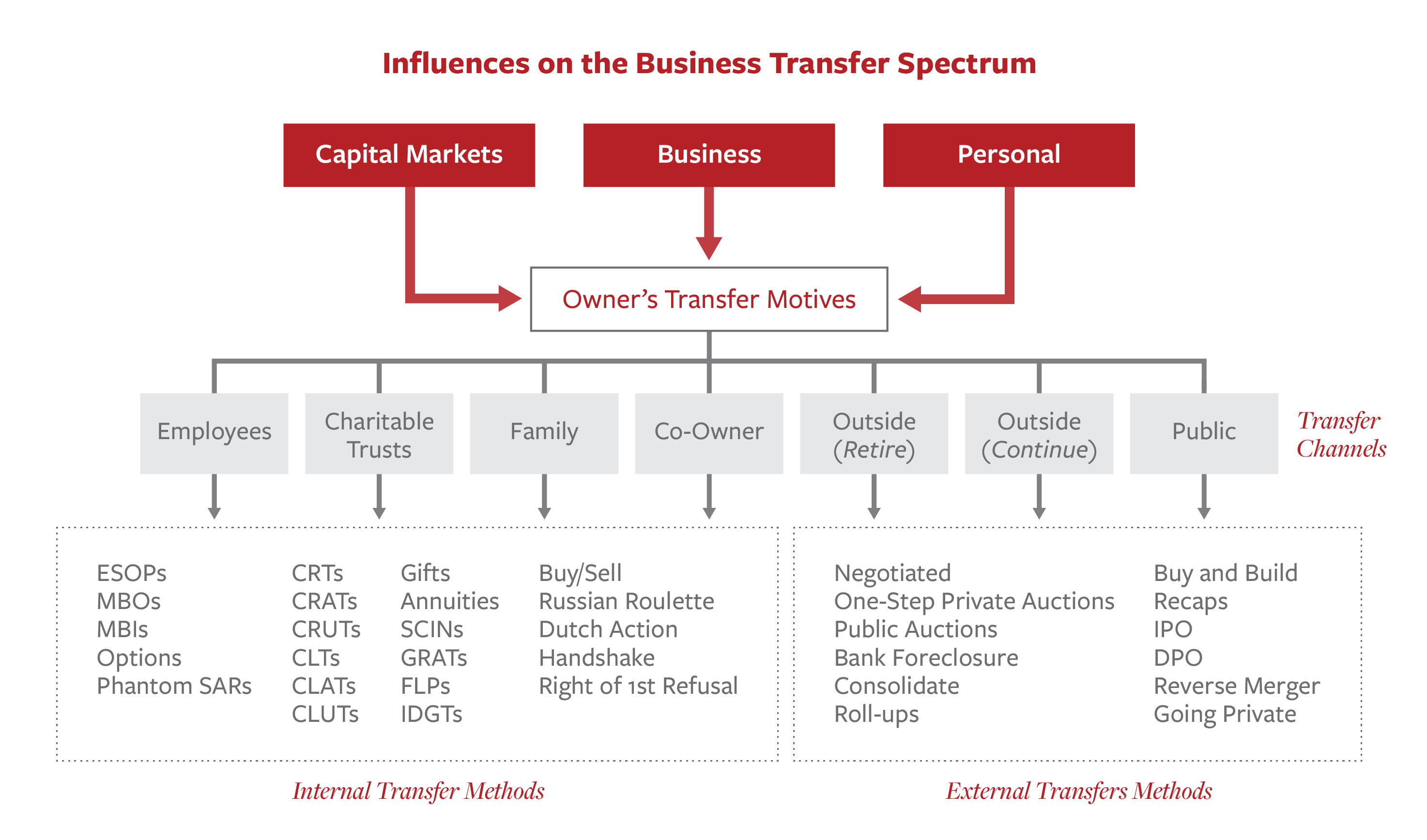
The transfer of a business is driven by the motives of the seller:  fatigue, health, competition, additional investment, technology, government regulations, economy, family issues, funding retirement, employees, etc.. These motives are influenced by one or more of the following situations:
  • the conditions of the capital markets,
  • the state of the business, and
  • the personal situation of the owner.
Understanding their influence on the readiness of the owner to pursue a transfer process is key to setting appropriate goals. Rob Slee illustrates the relationship of these factors with seller goals in the chart below:
Influences on the Business Transfer Spectrum
As shown, selling a business can get quite complex. There are multiple motives, transfer channels, and transfer methods. Each are governed by different rules and authorities. Owners need to understand how these influence their path to satisfaction in a business sale.
This task is daunting for a business owner.  Using skilled advisors can contribute considerable insight and experience.  Finding the right advisor early in the process can avoid value gaps and answer the question: “If you could have seen the road from the beginning, would you have chosen a different path?”
Full article LINK

For additional information regarding Florida business sales, acquisitions and valuations, please contact Eric J. Gall at Eric@EdisonAvenue.com or 239.738.6227. Also, visit our Edison Avenue website at www.EdisonAvenue.com or my personal website at www.BuySellFLbiz.com.

Saturday, July 26, 2014

Is Growth More Important Than Profits? | Inc.com

The value of your company can be measured by applying a multiple to your earnings. Your multiple is determined by an acquirer and can be driven by a number of elements.  One of the biggest swing factors is how large your company is.


At SellabilityScore.com we've been looking at the offers business owners have received for their companies over the last three years. During that time, we've noticed companies with at least $3 million in revenue get offers that are about 25% higher than the average business (which is much smaller).

It turns out that size really does matter when it comes to the value of your company. Here are three reasons why big companies get richer offers:

1. Owner Independence 
Buyers assume that companies with $3 million in revenue have found a way to scale their sales and marketing operations to the point where they are less dependent on the owner's personal salesmanship.

2. Private Equity Companies Want $3 Million Businesses 
There was a time where private equity companies wouldn't consider investing in a company unless it had at least $3 million in Earnings Before Interest Taxes Depreciation and Amortization (EBITDA). As the private equity market has become more mature, and more money is chasing fewer deals, private equity companies have adjusted downward the size of company they will consider acquiring. These days, there are private equity companies that will consider investing in companies with as little as $500,000 in EBITDA. A $3 million business with a 17% EBITDA margin is likely to attract some private equity buyers but a $1 million dollar business with a 20% EBITDA margin is unlikely to meet their minimum criteria. Fewer bidders for smaller companies means lower prices.

3. The A-team Factor 
When a big company buys a little one, the acquirer has a "deal team" that executes the transaction. This usually includes a buy side M&A firm or internal corporate development executive and a collection of $800-an-hour lawyers.  Acquirers rarely have a "B" deal team for small acquisitions so they use the same ultra-expensive professionals to buy a million dollar business as they would a one hundred million dollar company.  The frictional costs of deploying the A-team are easier to justify on a larger business.

Returning to the original question, which is more important to the value of your company: growth or profits?

Both.

Think of yourself as a pilot with air speed and altitude to juggle simultaneously. Focus on one at the expense of the other and you're in trouble.  If your goal is to sell your business one day, it's important to balance both the profitability and the top line revenue growth of your business.

Focus too much on profitability over growth and you may end up with a highly profitable business that will only command a modest multiple of earnings when you sell it.  Likewise, if you grow your top line at all costs, there will be very little profit to multiply.

Getting the balance right is what drives up the value of your business."

Article at:
Is Growth More Important Than Profits? | Inc.com:

For additional information regarding Florida business sales, acquisitions and valuations, please contact Eric J. Gall at info@buysellflbiz.com or 239.738.6227. Also, visit our Florida Business Exchange website at www.fbxbrokers.com and my personal website at www.buysellflbiz.com.