Showing posts with label Reason to sell. Show all posts

Wednesday, July 12, 2017

Article Summary: How Setting Clear Goals Minimizes Value Gaps in a Sale | Axial


By , Midwest Genesis | 


Original article has been thrifted to only cover the key points.  Full article can be read by clicking the link at the bottom of the article.

Determining business value can be a complex undertaking.

  • For a buyer, value is mostly driven by the likely future return, discounted by the risk, associated with the investment.
  • For a seller, value is more complex and reflects the past. Value can be defined as the sum total of all the elements that create satisfaction for the seller.  This is deeply personal and based on beliefs and not necessarily financials. 
  • Knowing all the elements that influence value for a buyer and a seller can dramatically reduce gaps between the buyer's and seller’s perception of value.
The very first question any owner should answer when considering a sale of the business is “What are my goals?”
The goals must be actionable, precise, concrete, real, and in writing. 
The steps along the path necessary to achieve a seller’s goals can take considerable time and energy to achieve. 
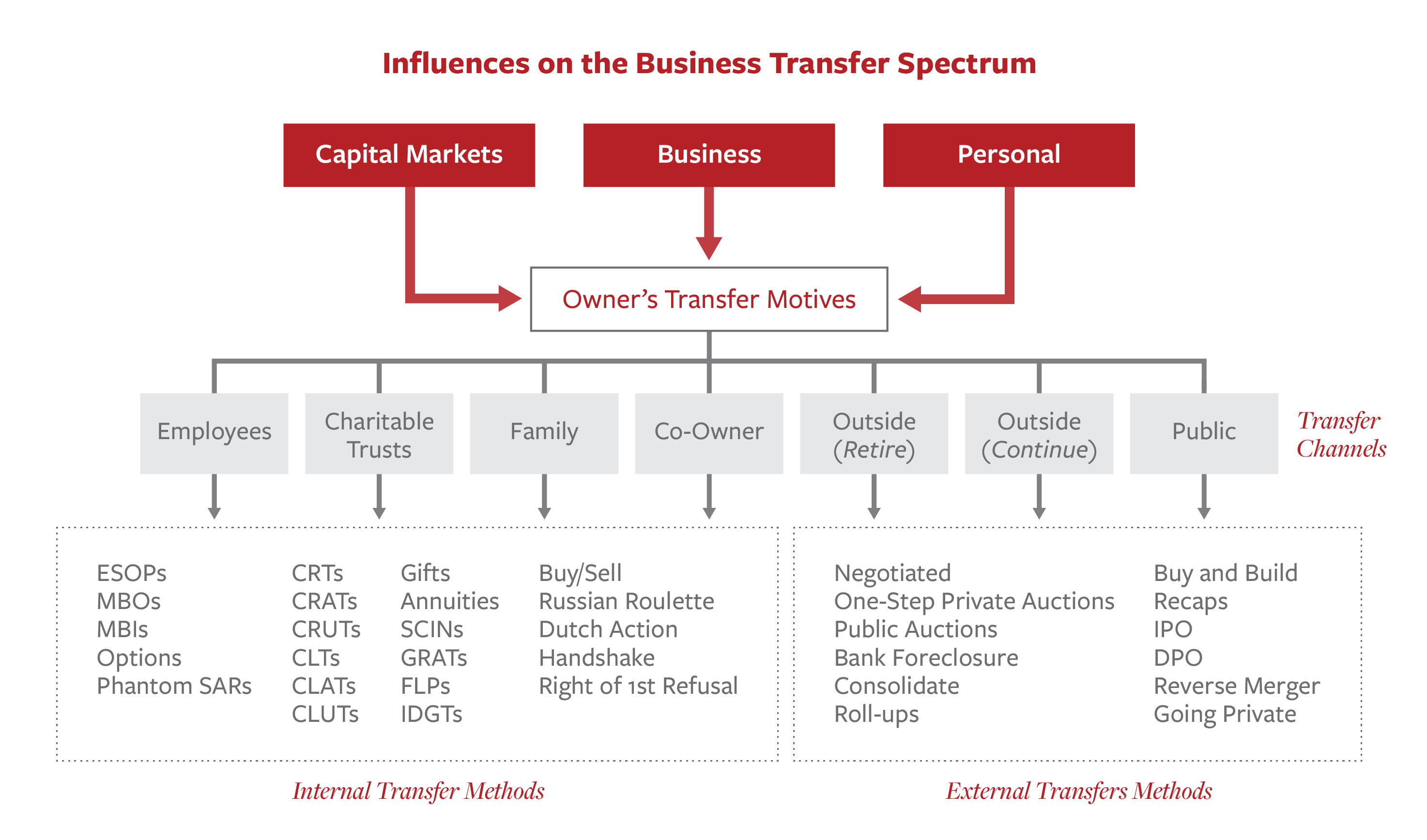
The transfer of a business is driven by the motives of the seller:  fatigue, health, competition, additional investment, technology, government regulations, economy, family issues, funding retirement, employees, etc.. These motives are influenced by one or more of the following situations:
  • the conditions of the capital markets,
  • the state of the business, and
  • the personal situation of the owner.
Understanding their influence on the readiness of the owner to pursue a transfer process is key to setting appropriate goals. Rob Slee illustrates the relationship of these factors with seller goals in the chart below:
Influences on the Business Transfer Spectrum
As shown, selling a business can get quite complex. There are multiple motives, transfer channels, and transfer methods. Each are governed by different rules and authorities. Owners need to understand how these influence their path to satisfaction in a business sale.
This task is daunting for a business owner.  Using skilled advisors can contribute considerable insight and experience.  Finding the right advisor early in the process can avoid value gaps and answer the question: “If you could have seen the road from the beginning, would you have chosen a different path?”
Full article LINK

For additional information regarding Florida business sales, acquisitions and valuations, please contact Eric J. Gall at Eric@EdisonAvenue.com or 239.738.6227. Also, visit our Edison Avenue website at www.EdisonAvenue.com or my personal website at www.BuySellFLbiz.com.

Monday, June 5, 2017

Article Review: Life After Selling Your Business | Divestopedia

 ,  

   
A helpful guide to figuring out if you are ready to sell and what you can look forward to after.
Life After Selling Your Business
Source: Ivelinr/Dreamstime.com
Key Takeaways: 
  • Entrepreneurs should consider life after selling their business long before they sell. It is easier to accept selling if they are prepared for it and committed to selling a year or two before they actually sell.
  • Discuss plans with your spouse, family, close friends who own businesses and their trusted advisors. Business ownership is typically the focal point of one's life and it is a big change.
  • An entrepreneur exiting their third company will handle selling with more ease than one who built their company over 30 years. The latter will face different challenges and will often accept post-sale life reluctantly.
  • Younger sellers are likely to start or acquire a new business or invest actively in somebody else’s business. 
  • Sometimes, when a private equity firm buys a business, it may be a requirement for the seller to work for the acquirer for a period of time. 
  • Older clients may not be interested in running a company any longer and are looking to retire.
  • In order to be successful post-sale, entrepreneurs should take control of their destiny and consider the active use of their time and capital as well as the passive use of their capital.
    • Active use of time and capital includes investing in another business or volunteering.
    • Passive use of capital involves engaging a financial planner or an investment advisor in order to ensure the money earned in the sale is protected.
  • Be careful not to spend your money on foolish things or make poor investment choices. 
  • Choosing the right financial/wealth advisor is imperative. Ultimately, entrepreneurs need to make sure they engage someone they can trust.

Article LINK

For additional information regarding Florida business sales, acquisitions and valuations, please contact Eric J. Gall at Eric@EdisonAvenue.com or 239.738.6227. Also, visit our Edison Avenue website at www.EdisonAvenue.com. To search for Florida Businesses for Sale: CLICK HERE

Tuesday, January 3, 2017

Purposefully Planning the Exit from Your Business | Divestopedia

By  ,  

Takeaway: Why should you start planning the exit from your business now? Well, it can help prepare you emotionally and financially to go from wealth accumulation to wealth utilization.
Purposefully Planning the Exit from Your Business
In this session, you will learn about:
  • 3 things owners can do now to start the exit planning (succession planning) process;
  • The best pre-sale tax and estate planning opportunities;
  • How to prepare emotionally and financially to go from wealth accumulation to wealth utilization;
  • Tax strategies that the wealthy are using right now; and
  • The most important things families can do to maintain harmony after selling a business.

About the Guest

John A. Warnick is the founder of the Purposeful Planning Institute and Family Wealth Transitions & Solutions. John balances his enthusiasm for tax savings with in-depth discovery and purposeful questions to ensure the planning is congruent with his client’s core values. He delivers workshops across the nation for estate planning attorneys and financial planners, sharing the six paradigms of Purposeful Planning and the Seven Keys of the Purposeful Trust.

Listen Here:


You can also get this Podcast by:

Read the Full Transcript Here:

Noah Rosenfarb: This is Noah Rosenfarb for the Divestopedia Exit Strategy podcast, and with us today, a great guest, John A. Warnick. A recovering tax attorney, the Founder of Purposeful Planning Institute, John A. consults with families of wealth and families in business through his consulting practice Family Wealth Transitions and Solutions.Really glad to have you with us today, John, and let's jump right into it. I want to know, based on your experience, what three things can any owner start doing right now to prepare for an exit?

John A. Warnick: Well, Noah, thank you. It's really a privilege to be with you this morning. I think the three things that I would suggest that an owner start doing yesterday to prepare for their exit from the business would be first, find a new owner, and I'll mention that, that's not what people are thinking when they hear that. I think I would suggest finding what I call a Value Maximization Consultant. And the third would be creating what I call a Team of Affinity.

Noah Rosenfarb: So maybe describe a little bit of each of those because I think most people might say, where do I find them? How do I start looking? So why don't you give them some advice?

John A. Warnick: The reality is the new owner that I'm speaking of is the owner himself or herself. You need to find the new owner. That is what is going to excite you and get you up every morning with the same level of energy and excitement that you had when you started your business, when you were in the kind of most productive years of that business. What is there ahead of you that would give you that same excitement and energy? Because if you don't find that new owner, you're going to be filled with what I call Seller's Remorse.

Noah Rosenfarb: Yes. And then the other interesting thing you recommend is finding a Value Maximizer. Is that someone that you'd like to have on your team full-time? Is that a consultant? How often do you see that expressing itself with preparing for...

John A. Warnick: Well, I think that this can -- it's most often done through the consulting arrangement, but this is an individual. It could actually be depending on the size of the business. It could be a Board of Directors of outside experts that sit on your board. But the idea here is to really get strategic advice around how you're going to maximize the value of the business. 

I've seen so many clients just make up their mind, "Snap, I'm going to sell the business," and go immediately to a business broker or an investment banker without any thought towards "How can we really make this business more valuable to a potential buyer?" So that is -- this really is starting early and probably 5 or 10 years before someone really wants to seriously pursue an exit planning stratetgy, I think they need to be dealing with this Value Maximizer, as you called it. 

Noah Rosenfarb: Great. And then the third piece you mentioned was about finding a team to collaborate with. 

John A. Warnick: A Team of Affinity is this collaborative team description that I like. I think that it's very important that every member of your team of advisers have an affinity for where you're going and that they're bringing their best skills and advice to the table and that they will work well and complement each other. And if you don't have that level of affinity for your purposes and your interest and people who will collaborate well with each other, I don't think you're going to get the maximum benefit from the Advisory Team. So I really do feel there's tremendous power in collaboration and you've got to find the right collaborative advisers. And if you don't have -- if you have someone who isn't a good collaborator, you have to ask yourself, should this individual really be part of my team going forward?

Noah Rosenfarb: And one of the ways I see that manifest in the early stages is when talking about tax and estate planning for clients that are contemplating a transition and you need to integrate your personal financial plan with your business plan and your estate tax attorney and your accountant. So tell me a little bit from your experience, where do you see the best pre-sale tax and estate planning opportunities arise? And how would clients go about finding out that information and implementing them, those suggestions?

John A. Warnick: Well, I think that's a great question, Noah, and it's important for all those people listening to our conversation this morning to realize that there are opportunities to really minimize the tax consequences as well as to really nicely and strategically set up estate planning opportunities. So this exit planning field is one that's right for the type of advice you're suggesting clients should be looking to. And I just wrote the two techniques that I most commonly discuss with clients that are in this stage of the life of a business would be a a sale to a Grantor Retained Annuity Trust or it’s cousin, an Intentionally Defective Grantor Trust, what is called an IDIGIT, or the Chartitable Remainder trust. The Charitable Remainder Trust has fallen in popularity. We don't see much of it today because of the incredibly low interest rate environment. But still, in the right situation with a client who has a strong, strong philanthropic mission or purpose in mind, a Charitable Remainder Trust or its cousin, the Family Foundation, should not be overlooked.

Noah Rosenfarb: Maybe you could give us our brief description of grantor-retained annuity trust, the grant that you referred to?

John A. Warnick: Well, the grant, the easiest way to describe a grant is what the grant is going to do is create a strategy that allows the future growth and appreciation in the business interest it's transferred to the grant to escape federal transfer taxation. You get back in what we call a zeroed out grant. You zero out the gift so that what you put into the grant, you get back over the term of the grant with a minimum return that is equal to what the discount rate is the IRS uses for estate and gift tax planning purposes. 

And that rate’s incredibly low right now (2013), in the mid-1% range. And so today, effectively, a grant is almost interest-free. This is an incredible planning strategy and means that if you're going to unleash because -- let's say that the interest in the businesses is held through either stock or a membership interest and an LLC, you’re going to transfer that stock or LLC interest some percentage of your ownership to this grant. You'll get back today's value. 

But today's value is suppressed. It’s suppressed by two discounts that we see in the business valuation world. One is a discount for lack of marketability and the other is a discount for lack of control or a minority interest discount. Those two interests with an operating business could very easily conservatively be in a 35% to 40% discount. You're going to unlock that discount when you put the sale in motion and cause it to happen. And that 35% to 40% is almost assured to pass without gift tax to your heirs. 

So that's an overview of the grant structure. I would caution people that I really feel -- I've seen a lot of seller’s remorse about not the grant itself but about the trust that the grant became after the grant term, which is usually two years -- sometimes it might be set up for three years or five years, but it's most likely to be two years -- that at the end of that two-year term, there's a trust and whatever value has been unlocked through the liquidity event is left in that trust. And I’ve had a lot of a remorse over that trust was too rigid or that trust didn't contemplate all of the things that I would like a trust. 

So this is one area that I think our purposeful planning concepts are of extreme interest and value, and the exercise that we use at the Purposeful Planning Institute that we call Why Trust is almost an absolute must, I think, for any business owner who’s contemplating a grant.

Noah Rosenfarb: And any business owner that's considering a trust probably has some of the same concerns about how is this money going to pass and what will it be used for, and I think the framework that you’ve designed is real helpful. And maybe we’ll be able to get into that a little bit later in the call because it's real valuable for business owners to start contemplating.

John A. Warnick: Thank you, Noah. 

Noah Rosenfarb: So let's move on to a different area and maybe your experience of how people get prepared emotionally and financially to go from earning money for now spending money. You know, through this transition, oftentimes people have great cash flow and their wealth is tied up in a small business, medium-size business, large business and then all of a sudden, they convert that to liquidity through some transaction and they've got to start utilizing their wealth. And it's an emotionally challenging process for people. So what are the ways you would encourage owners to get prepared?

John A. Warnick: It really is -- and Noah, I'd like to suggest here that -- let me just share what I've done to become a better consultant in this area. I was privileged about a year and a half ago to meet a gentleman by the name of Jack Beauregard in Boston, who is the Founder of the Successful Transition Planning Institute. And through STPI, I became certified as a successful Transition Planning Consultant. 

The two things that I have learned from working with Jack Beauregard and Paul Cronin, the two owners of that Institute, is the value of what's called the Owner Clarification Report. This is an online assessment tool, takes about 45 minutes for the owner to do, and you then get about a 20-page report that really is a roadmap to help the owner get clarity around the what they need to do to find that new owner and to be prepared emotionally for this transition. So that's -- the cost of the report itself is not that expensive. 

The consulting work, the strategic work that can be done guided by the roadmap that clarification report is invaluable. It’s going to be expensive but I think it's well worth the investment. And so I would -- that, from my experience, I've not found anything better to prepare an owner for the emotional transition in the new world that he or she is stepping into when they move from being an entrepreneur and executive business owner to this new world of family wealth that the they’ll find themselves in -- then this process that the Successful Transition Planning Institute has shared with their consultants.

Noah Rosenfarb: And kind of in line with that, some of the strategies you talked about for the pre-sale estate planning opportunities, do you find clients are open to minimizing their taxes post transition? And what do you find are the most useful tools there?

John A. Warnick: Yes. I think truthfully, STPI, its strength is in the decision to sell -- not -- there are great sources and Noah, I think you're one of them frankly, they’re great sources for the value maximization advice. STPI is not necessarily going to add anything to that. But it's going to add tremendous clarity around the transition itself, how to prepare for it as you said emotionally. And there are three kind of modules to the process that STPI has. One is called Live, which is the modules that really help you get the vision around what that new owner, you, is going to be doing a year, 5, 15 years from now. There’s Decide, which are the modules for the owner who’s really trying to decide how do I sell and in a sense, when do I sell. And then there’s Drive, which is also tied into how are we going to really get the maximum value, not out of just the sale but out of what I do with the capital that I've harvested through the liquidity event.

Noah Rosenfarb: Well, let's move onto little bit of a different topic in maintaining family harmony. And maybe based on your experience, you could describe some of the most important families can do to maintain their family harmony after transition.

John A. Warnick: Well, I think in terms of strategies that clients use to minimize their taxes, this may -- this is very simple, but where do you live? You know, many business owners, because of the location of their business, are tied to a jurisdiction that may have what they might consider an oppressive state income tax rate. Federal rates are going to follow us wherever we live. But one of the things that I see happen extremely often with the sale of the business is relocation of income tax situs for the owner to a jurisdiction. Typically it's a tax-favored jurisdiction with a warmer climate than where I’ve lived while I was building my business. So that's certainly a huge saver in terms of either avoiding or minimizing state income tax. 

And then beyond that, I think the strategies are there's going to be a combination of strategies that are going to be employed here but broadly, we could speak about the opportunities with tax exempt investments, maximizing exposure to capital gains rather than ordinary income, and under our current tax law -- but this of course is something that's very much in question, is the tax favorability of dividend income. So those are very broad descriptions of strategies, but there's a lot of opportunities here for clients to minimize the tax bite after the sale of the business.

Noah Rosenfarb: So let's move on to a different topic about maintaining family harmony. And maybe you could share with the listeners some of the most important things that they can do with their family to try and maintain harmony.

John A. Warnick: Well, I really want to say how much I appreciate the thoughtfulness of this question. I think that family too often gets to be something that's in the wake of the sale, the liquidity event, rather than something that's in the forefront. So I did, as I contemplated this question, Noah, I came up with a few suggestions here. It's hard to say whether these are the most important things because there's lots of opportunities for family leadership that will contribute significantly to enhancing family harmony. But the first thing I would say is don't make the mistake of starting to do this work now. 

If anybody's listening to this call that still has children at home, make sure that you are building relationships with those children while they’re kids and teenagers. And I've had a lot of sad experiences with business owners who turned 55 and decide to sell the business and then say, "Hey, kids. Come join me. I'm now going to be really excited about how we're going to make the world a better place with our family foundation, and I want the three of you to join me in this quest," and I’ve had more than one occassion where that business owner, who's enjoyed the harvesting of success through a liquidity event, experienced huge disappointment because he cannot get his children to join with him. 

And I've helped them to understand that too often, the children are caught in a pattern that he, the owner, initiated when they were very young. And it was they had another sibling that they competed with for his attention and his time, and that other sibling was called the business. And now that he sold the business, they see his new family foundation as the sibling that they're competing with and they're not, as adults, interested in playing that game. So I do think it's very important that we start early, but there're many things that you can do. Do not give up hope here. 

If you haven't had the greatest relationship with your children, don't expect this to change overnight. This is -- you're not going to be able to be as nimble about causing a new direction in your relationship with your children like you would be turning an F-15. This is more like a 747. It's going to be slow and deliberate. You'll get there but it's going to take you a lot longer to turn and make that turn than what you could do with if you were in an F-15. 

But here’s three things, Noah, that I think are very important. On boarding. That is -- what I mean by on boarding is how do we bring the new daughter-in-law, son-in-law or significant other into our family circle? 

If you do on boarding well, that goes a long way to creating the type of family harmony and family culture that you want. And I think there's an art to on boarding, and you need to be careful, it's a very sensitive area because if you don't do this right, there are wounds inflicted that take years and years to heal and overcome. 

The second thing that I think is very important is to really work on shared values and shared mission as a family. And this leads naturally to family meetings and quality family experiences. I think that a formula for success in terms of building relationships, building family culture, are family meetings and what I call quality family experiences. Those can be trips together, they can be Sunday dinners when the family gathers if you’re blessed to be in a geographic proximity to each other. It's a combination of the communication and the structure of family meetings with these quality family experiences.

Noah Rosenfarb: Those are great ideas. In kind of keeping with that theme, you mentioned that some owners fail to encourage their children to see the sibling of the business as either equal sibling or a sibling they should love, so when do you think these owners should be talking about their exit plans with their family?

John A. Warnick: Sooner rather than later. I think that it is one of the most common mistakes that business owners make, the veiled secrecy around my plans for the business. And if you do not have these conversations, there is a huge opportunity for disappointment because the children may have had expectations that you were totally unaware of. So this is a sensitive topic. It's an extremely important topic. Even discussing this not just with the children but with the spouse, you know, this is sometimes difficult for owners to do. They may need some help. This is where a consultant of -- a communications facilitator or a consultant with great communication skills and experience can be of great help in helping with these difficult conversations. But they're absolutely crucial and they need to happen sooner rather than later. 

Noah Rosenfarb: In conjunction with that, a lot of families that I talked to were concerned that this new liquidity that might come into the owner's lap, can become a negative asset you know, that it might harm their children, their children's expectations, their children's values. So what advice do you have for families that share this concern and maybe how owners might connect that with discussing their exit plan with their family?

John A. Warnick: Well, the first item I would offer here is money isn't a negative thing. It's our relationship with money and our attitude towards money which can be problematic. 

I was struck - I did watch a great deal of Republican National Convention last night, and there was a video that was shown that exposed the family side of Mitt Romney. This is a pretty incredible success story. Whether you agree with Gov. Romney's politics and his political philosophy or his plans for the country, I think the story is rather inspiring, that you can have the level of business success that he had and to create a family as healthy as his family is. And it was pretty obvious from watching that video and then seeing on the stage the children and the grandchildren. This is a very successful -- this is a poster family that every business owner in America could learn from and model after what they've done. And I think what I saw from very early in his days at Bain Capital when he was putting extremely long hours in, there was a commitment for him to try to be there for dinners with the family and for activities at night with the kids. So while his wife had the primary responsibility, he was still involved. It is a team effort that takes both a husband and a wife. It's not to say that single parents can't have tremendous influence on their children, but it really is -- it starts with the roots of the relationships. And then it really boils down to sharing the values that -- or the core values that are ingredients for success and teaching those to our children at early ages. 

There were some stories, very touching stories last night of him, as one person put it, tagging along his children with him as he was engaged in these acts of service that were really incredibly inspiring. He was taking his kids with him so know what? I would just say I know it's troublesome. You worry that the money is going to disincent your kids. But I don’t think that while it’s a good worry to have, you should not lose hope and there are ways in which you can really try to help your family develop healthy attitudes towards values into model and teach the values that will lead them to be successful in their relationships with wealth.

Noah Rosenfarb: Yes, good advice. So one of the other areas that I think is important for owners to consider in sharing their family values and developing, as you described earlier, a shared vision and a shared mission is through the use of family meetings and in identifying what type of family governance structure should be put in place. So maybe let's start off with different family governance structures and how families should go about choosing something that might fit for their family.

John A. Warnick: Well, I'm a little bit -- I have a little bit of a caution here that I think the governance structure for families really needs to reflect the family itself. But I will speak to a couple of things that I think are fundamentally important beyond this. 

The form that you choose will be much more guided by the circumstances of your family, and you shouldn't necessarily -- I mean, while I said we could learn something from the Romney's, I'm not going to suggest that the Romney patterns are going to be what will be most successful for every family. But here's a couple of things that I think are very important. If you look at governance structures, I see two general patterns, Noah, that you could describe these governance structures. 

One is top down, very generational hierarchical in orientation with the senior generation family members up here at the top and the younger generations down below. This is a common pattern. However, it's not a pattern that works well in terms of empowering and preparing the next generations of your family or the transition of the wealth and the responsibility that comes with that wealth. 

So I prefer those models that are what are based on what I call the empowered from within. I prefer models the really create appropriate opportunities and over time, this will develop, mature as the skills capacities and the time and interest of the children and grandchildren permit. But very much, I'm very much an advocate of a lead from behind. 

And I caution my clients that the words that we use are important here. Too many business owners refer to their kids as kids and fail to realize these are my former children. They’re now adults. They’re former children. And just using the descriptor former children when you’re talking about your children validates their roles as adults. Beyond that, I've been involved, just finished an 18-month consulting project with a Fortune 500 family. We did a marvelous job of bringing all three generations of that family together to envision a governance structure that will work for them in the next 3 to 5 years and that will allow eventually the emergence of the third generation in a very meaningful way. 

So that structure involved, in addition to a family council, an executive committee. And then it involved serious committees and what we called the G3 Council, a council devoted to the needs and interests of the third generation and a support system within that G3 Council of mentoring the younger G3's as they approach and enter the family governance. So it's a topic that we can spend a lot more time, but I do think this concept of forget about using the word kids, respect them and treat them and call them your former children and then look for governance structures that are going to be empowered from within rather than top-down. 

Noah Rosenfarb: And in conjunction with that, are you seeing families run family meetings and having those experiences kind of simultaneously with developing their family governance structure and you can describe how a family would go about having a gathering that might be different than the way it used to be?

John A. Warnick: Well, it's very interesting, this project that I just was referencing. We used -- that family meets three times a year. The family meetings usually consist of a half-day of what I call the quality family experience. That could be a recreational experience. They maybe come together for golfing, boating, something fun. And then the next day is a serious day of business, usually somewhere in the neighborhood of six hours. It may have committee meetings that are taking place in between these meetings, but yes, Noah, the answer is, is that you can use the family meeting to create the family council and then from that, as you get the family involved in the family council, it may be that if the family is large enough and the wealth is sufficiently great, that you need more structure than just the family council. 
You may adopt a formal or informal committee structure that runs underneath that family council. But in terms of how you kind of get started with this, I go back, people will say this is too simplistic, but I do think this starts with having very meaningful conversations over dinner before the kids leave the nest. But beyond that, if you don't have it or a pattern of family meetings with some structure, I would suggest -- there aren't a lot of books that are written about this. 

I think this is an area where a consultant, who has experience in facilitating these family meetings and working with someone who wants to really invest in their family governance could be helpful. And I would say that sometimes, there are issues that need to be dealt with in terms of family dynamics before you can really get to successful family meetings. And I might just put a plug in here for the work of Dr. Dean Fowler. There is another assessment tool that's called Family Wealth Comprehensive Roadmap or Family Business Comprehensive Roadmap. Its a 306 -- online 68 questions that delve into 12 critical factors for success in the transition of a business or the transition of wealth. It's a tool that I used with the consulting project that I just describing. 

It was immensely helpful because it helped us see that this family, largely because of a concerted effort over the last 25 years, was in a great position to be able to move to a very elaborate family governance structure. But other families may, through this comprehensive roadmap, see that we've got to spend some time working on just basic communication before we even get to the family meeting stage. So don't run too fast. Don't think that the family meeting is going to be a panacea. I think this is where a very holistic assessment like Dr. Fowlers’ could be of extreme value to a family that wants to start this journey.

Noah Rosenfarb: I think all of the advice that you’re giving is designed to help owners that are thoughtful and proactive in their objective is to make sure that their legacy is long lasting and positive. And in line with that thinking and making sure that people lead a memorable life, what suggestions would you have aside from the family meetings, aside from the family governance and the things that we’ve discussed already, are there any other suggestions that you would recommend the owners start thinking about or implementing?

John A. Warnick: Well, I wish I had my book finished, Noah. I'm working on a book that describes the seven keys of purposeful gifts and trust because I think that really is a -- it really is a powerful recipe for how someone can go about creating this sustainable and positive legacy that you're referencing. But let me give you an example of a chapter that I'm working on right now in the book. And this is revolutionary. It traces back to George Washington. George Washington hand wrote his will, 30 pages of handwritten directions. And I'm going to share with you at our listeners about 50 words from George Washington's will. He said, "I give to each of my nephews one of my swords. Each to choose in the order in which they are named" -- and then he had the five names of the nephews, "And to hold the sword with the following solemn injunction, that they will never raise it except in the case of self-defense or in defense of the Republic and its liberties and in the latter case, that they would prefer falling with this sword in their hands to the relinquishment thereof." 

Now what George Washington did in approximately 50, 60 words, is he took a metal object, a sword, and he somehow imbued that sword with purpose and meaning. Four of those five swords today are at Mt. Vernon. Those four swords stayed in the Washington nephews’ bloodlines for six and seven generations before those swords were transferred to Mt. Vernon to be held by the Martha Washington Foundation and exhibited. With this fifth sword, there's an interesting story about how it got lost. It was sold in an estate of a young grandson who died with a widow and two young children. The sword was the most valuable asset and had to be sold. But the other four swords were treasured heirlooms that represented Washington's values. 

And I think the Washington story is a powerful one to help us understand that it isn't just about talking about our values that will create a lasting legacy. But there is a magic, an alchemy so to speak, around how we can capture our purpose, our deepest meaning for the gifts that we want to create in to -- through the written word or the recorded word preserve the purpose and meaning of these gifts in a very powerful way. 

That's one of the keys, one of the seven keys of the key of meaning and purpose. And I think these are ways in which clients who are interested in discovering what are - whats their formula or the recipe for a long lasting and positive legacy. I can't suggest anything better than the seven keys of purposeful trusts and gifts and the kind of supporting what I call six paradigms of purposeful planning.

Noah Rosenfarb: Great. Well, I know we're almost running out of time, John, so maybe before we go, you could share a story with our listeners about an owner that had the courage and vision to make difficult decisions because they knew it was going to be best for them in the long run. I think we want to encourage all of our listeners to take action and maybe through the sharing of another story, they can see value.

John A. Warnick: I appreciate this invitation, and I thought about what I would share here. And the best story that came to mind, I think, is I had a client that was contemplating a huge liquidity event. He had built a business from scratch. In less than 20 years, this business had gone from zero to a value in the neighborhood of $250 million. And in the earliest days of the business at the advise of his tax attorneys, he had placed 60% of the business in three trusts, 20% each, a trust for each of his children. And he had never told the kids about this. In fact, when the children, he would call the children to come over to his home just before taxes were due, and he would have them sign, put a paper over the top, he’d have them sign the tax returns. 

And so these kids were in the mid-20s to early 30s when this event happened. But it was the marriage, prospective marriage of the oldest child that led to this. And we had a conversation with a client, and he wanted a prenuptial agreement. And he asked me to prepare a prenuptial for his son and he with the son. And as I did that, one of the things that I had to do was - there’s a disclosure required for prenups, financial exhibits. And we had to disclose this.

So I took the prenup out to a business lunch with the clients and I handed him the prenup, and we were going through it. And he kind of started thumbing ahead and he got to the exhibits and he interrupted me in midsentence as I was explaining one of the key provisions to say, "Mr. Warnick, there's something terribly wrong," and I said, "What's wrong?" He said, "You've given me my father's financial statement." And I was worried because this was a case where the father and son shared the name and it's quite possible that we had done that. I had not assembled the financial statement. I had left that to the legal assistant to do. And so I quickly pulled it back and looked and looked at it and there was a big sigh of relief on my part because it was indeed the correct financial statement. 

And I handed it back to him and I said, "No, that is your financial statement." And his mouth dropped and he asked this question, he says, "Where is it? This significant balance sheet that showed a personal net worth in the eight digits, where was it?" And that's when I explained to him that when he was really just a teenager, his father had made a gift and created a trust. And this wealth was in this trust. He had - he knew nothing about the trust. He knew nothing about the fact that he was worth -- he was a multimillionaire at his young age. And I reported back to the client the experience and this is where his courage came in. 
He realized that he had really done a disservice to his children, and he didn't want to repeat that experience with the other kids. He realized that he needed to begin pulling the curtain back, introducing them to the world that he had created for them, and he needed to prepare them for that world. And that led to a marvelous 5-year experience of three family meetings a year working around that. 

We created a marvelous team of affinity that helped him with that project and I'm happy to report today that he would probably say the commitment that he made to that process is the best decision that he ever had the courage to make and it's paid huge dividends for him and his family.

Noah Rosenfarb: That's great. Well, I appreciate your sharing and share your time today, John A. Warnick, the leader of Family Wealth Transitions and Solutions and the Founder of Purposeful Planning Institute. John, if a listeners wanted to get in touch with you, what's the best way to reach you?

John A. Warnick: I think it'd be through our website, and that's www.PurposefulPlanningInstitute.com, and our phone number is 303-256-6300.

Noah Rosenfarb: Great. Thanks, again, for joining us today. And to our listeners, if you have any questions for John A, I'm sure he’d welcome your call. Everybody, take care. This is Noah Rosenfarb, I hope to have you listen to us again soon. 


For additional information regarding Florida business sales, acquisitions and valuations, please contact Eric J. Gall at Eric@EdisonAvenue.com or 239.738.6227. Also, visit our Edison Avenue website at www.EdisonAvenue.com.

Sunday, November 6, 2016

Acquisition Growth Strategies for Middle Market Companies | Divestopedia

By  , 
Acquisition Growth Strategies for Middle Market Companies
Source: Ximagination/Dreamstime.com
In this podcast, John Bly, author of "Cracking the Code: An Entrepreneur’s Guide to Growing Your Business Through Mergers and Acquisitions for Pennies on the Dollar," talks about:
  • The benefits of acquiring an existing company versus starting a business;
  • Biggest challenges encountered with acquisition integration;
  • Strategies when negotiating the purchase price in an M&A transaction;
  • Role of advisors during the acquisition process;
  • What is currently evolving in the M&A marketplace;
  • Important takeaways for owners that are thinking about exiting; and
  • His best advice to successfully execute an acquisition.

About the Guest

John Bly is the co-managing member of LBA Haynes Strand, PLLC, located in the Charlotte area. John’s entrepreneurial guidance as co-managing member has propelled the firm to rapid growth. He utilizes M&A to drive development—in nine years, LBA has grown from $0 to more than $4 million, through a series of eight acquisitions and two mergers. John is also seen by his peers as an expert on the topic and consults on 20 to 30 M&A transactions a year.
John's book serves as a guide to effectively find good deals for entrepreneurial businesses in the $1 to $30 million range. It provides a blueprint for how to tackle issues, such as determining whether it’s a good fit, due diligence, structuring the deal, valuation, tax issues and how to land the perfect catch.

Listen Here:

You can also get this Podcast by:

Read the Full Transcript Here:

Noah Rosenfarb: Hello everyone and welcome. It’s your host, Noah Rosenfarb, from Freedom Business Advisors here with John Bly. He’s the author of "Cracking the Code: An Entrepreneur’s Guide to Growing Your Business Through Mergers and Acquisitions for Pennies On The Dollar." John, thanks so much for joining us today.
John Bly: Noah, looking forward to it. Thanks for having me and hopefully, can help your listeners with a few different ideas.
Noah Rosenfarb: Yes. You’re a CPA. We’re brethren in that respect. How did you get interested in cracking the code?
John Bly: Good question. It really started about 11 years ago just thinking about how growing a professional service firm was a struggle organically and so got really excited about growing it inorganically and so now in the last 11 years have done 11 acquisitions on the CPA side and have done three as of last week on the fitness business side, so I have two different core businesses and have done 14 acquisitions in the last 11 years, and also have done a bunch of exits. We’ve sold four divisions of our company over that period and so over that period, just getting really excited about helping entrepreneurs think about both buy side and sell side and adding value so that when they decide they want to get out, they have the right formula, the right buy out, and the right structure. That’s really how I got passionate about it.
Noah Rosenfarb: Perhaps it might be unfair to call an addiction to acquisition. What keeps you in this process of continuing to buy companies instead of grow organically or in addition to, I should say’?
John Bly: Well, it’s funny. I haven’t heard it called an addiction but I have heard people call me a junkie, so I don’t know. I think the thing that excites about acquiring as a strategy is it helps people grow faster. A lot of people are looking to grow and they look at hiring another sales person, starting a new niche area, opening a new market, different city. They look at those as exit strategies but really there are studies out there on starting new businesses are 80+% fail in five years but 90% of all businesses purchased in the US according to banking studies are still in business five years later.
Those two dynamics are radically different and so it’s a way that entrepreneurs can grow their company faster with less risk, in my opinion, and at the same time, the benefits of growing company for those people who have a company that has grown is it allows them to really focus on what they are really good at because as an entrepreneur when you’re a small company, you have to do 10 or 15 different things of which you may be passionate or good at three or four of those, and so when you’re a small company, you have to do that. If you can accelerate it and get bigger faster rather than organically at 5, 10, 20% a year, you can get there faster and do just the stuff you really love.
Noah Rosenfarb: What about appraising? I know people they say, “Well, it’s just cheaper for me to build it. I’m not going to buy it. I’ve already got my infrastructure and everybody wants crazy prices.” What do you have to say to them?
John Bly: It’s a great argument. I hear it all the time. I guess my argument to that is, “Okay, if you’re going to grow it organically, you’re going to go higher.” Let’s say $100,000 sales person just for easy math and you’re going to grow by hiring that next sales person and you’re going to invest $100,000 with them in the first year and if you’re lucky, they might generate $200,000 in the first year, maybe they will do really well and they will generate $300,000 or $400,000. What I would say is that with that same $100,000 investment in my experience, you could purchase a business between, well, it depends on the business but you could purchase a business between $700,000 and $1 million.
Now, if somebody bought a business that they paid $700,000 for as the down payment in bank financing and that sort of thing, that $100,000 instantly turns into between $200,000 and $300,000 a cash flow the first year. If you buy a business for $700,000, they are generating likely $200,000 a profit. If you’re going to invest $100,000, that’s not a bad return. Never mind the future growth of it. For me, it’s a trade off. It’s an alternative growth strategy.
Noah Rosenfarb: Tell me how you get to pennies on the dollar in the title of your book. Obviously you’re saying, “I’m going to buy a $700,000 business on my own. We’re going to use $100,000 of my cash.” Where is the rest of the money coming from?
John Bly: Yup, in most deals that I’ve done or that I advise on, because I have advised on over 300 transactions in the last 11 years, is if it’s under $5 million, the purchase price, a significant majority of the funding comes through the banks through the Small Business Administration. The SBA lending arm of the Federal Government lends through the banks, through commercial banks throughout the US and that is where a large chunk comes from. The SBA guarantees 75% of the debt so the banks don’t have nearly as much risk which is why there is a lot of funding for acquisitions but there is not much for startups. A lot of it comes through that.
If the deal is a little bit more risky or maybe it’s too owner driven, meaning the owner was really key person to the business, then there’s probably some owner financing to it but it’s usually not a huge percentage. It could be 5, 10, 25%, 30%, somewhere in there maximum probably in the deals that I normally see under that $5 million range.
Noah Rosenfarb: So there are 300 transactions that you’ve done. How many of them were for clients of yours that were looking to grow their business versus exit their business? Just to give us some perspective.
John Bly: Yeah absolutely. It’s probably about 225 that were looking to grow and 75 that were looking to sell.
Noah Rosenfarb: Let’s take the growing companies first. You and I were talking before we got on the call here about companies growing through acquisition prior to wanting to have their own exit. Do you have some clients that are doing, talking acquisitions before they are looking to sell their own company?
John Bly: Absolutely. We’re working through one right now on the exit where about five or six years ago, they said, “Hey, we want to sell in 2015-2018, somewhere in that timeframe but the multiples for our business gets significantly larger if we get above $10 million but we think we’re going to grow too slow to get to it organically. What do you think about doing it inorganically and doing a tuck-in?” That’s exactly what they did. They bought a smaller company with about $1.5-2 million in revenue.
Because they bought it, they bought it for about four times. It’s a recurring revenue model. They bought if for about four times recurring revenue and they are turning around right now and they are getting eight times on the sale because they added it to their core business. Their core business, they raised their revenue multiple because they got to where a public company now is actually interested in buying them and that transaction is going to close next week.
Noah Rosenfarb: Congratulations. It sounds like a smart move.
John Bly: Yeah, it’s that sort of thing where when you’re a decent-sized company acquisitions can make a lot of sense. They make more sense if you already own a company. If you’re starting from scratch and acquisition makes sense still in my opinion but it’s a little bit more risky. If already own a company, though, doing an acquisition to me is much less risky than starting a new division or growing, hiring that next sales person. The stats out there show you can basically flip a coin on whether the next hire is going to be productive and you’re going to keep them long term and they are going to be engaged. It’s better than that based on government studies about the success of buying a business.
Noah Rosenfarb: What do you see is the biggest challenges for people that are integrating an acquisition into their company?
John Bly: Usually if they are not paying attention, they miss one or two thing on the front end in the really big things. One is either culture. They get so focused on the numbers through the due diligence process that they forget to pay attention to what the cultures are going to look like when they mesh and that causes problems when it comes to integration time. The other thing is integration of systems and so they think about the IT and the people and how they are physically going to integrate them until literally probably the day they close and then they think, “I didn’t spend enough time thinking about the integration process. Now I’ve got 60 days of figuring that out and now I’m behind the eight ball and I thought we’d all hit the ground running and I can’t because I didn’t think about this ahead of time.”
Noah Rosenfarb: Have you seen any of the failures amongst your client on the integration side?
John Bly: Yeah. Usually, it’s more culture on those two things because we work a lot on integration but if they are not paying attention to the culture even though we discussed it a lot, they might miss it on the culture side and what ends up happening typically in the case like that is three, six, 12 months in, one or two of the key people on the company they bought end up disappearing. We haven’t found that to be very impactful to the business except it’s a real pain for 6-12 months. As you hire a new person, find the replacement, get them up to speed, it doesn’t overall affect the deal structure. It’s just that it’s sort of a pain point for a period of time.
Noah Rosenfarb: What would you say are some of the strategies that work best when negotiating a price or a deal?
John Bly: Yeah, that’s a great one because a lot of people when somebody says, “Oh, they want too much money for the business.” That’s a very common thing and it sounds like based on your question a few questions ago about what do you say to people who say it’s too expensive, that’s what I hear most of the time is, “Oh, it’s too much.” Well, my comment repeatedly to people is, “Think about it.” There are so many things in the negotiation process. If you say $1 million is too expensive to buy this company, what if they were willing to finance it at no interest for five years?
Well, now you’re not really paying $1 million at net present value. You’re paying less than that. Well, what if they were willing to work for free for six months or what if they were willing to leave the AR, the cash, and the business? There are so many things that are negotiable that I try to advise clients, “Don’t run at the price discussion right off the bat. Think about the fact that there’s probably 20, 30, 40 different negotiating points that if they want $1 million, that seems to be something that they are really passionate about because they want to say they sold their company for $1 million.
Think about all the other things you can win on and say well, I gave you the price so let’s revisit this. I really need this back in return or I really need that back in return.” When they take that approach instead of “all or nothing” type of approach, I typically find that the deals get done a lot smoother and both sides end up winning.
Noah Rosenfarb: We have a saying. We say, “You tell me whatever price you want as long as I could set the terms. I’ll pay you whatever you want I just get to decide when.” I agree with that. It’s all in the terms and terms could be very meaningful. You mentioned a couple of terms that might be important whether it’s the owner contributing, the seller contributing labor at no cost post closing, work and capital adjustment, the actual length of time that the payments will be made, the interest rate on the payments, and the other big term conditions that you’ve seen that have been very influential in getting a deal closed.
John Bly: Yeah, there are some others. Some are terms of non-competes and non-solicitations. They are extending those or shortening them depending on which side you’re representing and how the deal is structured. Another is a lot of times, and you probably see this as well in small businesses, many entrepreneurs decide to buy their own commercial real estate and so they are occupied. Their business runs out of a piece of property they own and sometimes that goes in the transaction and sometimes it doesn’t, and what those lease terms light might look like or what if they are going to lease them, can I lease it for three years from the seller and have an option at today’s price to buy it in three years rather than at some inflated price? A lot of times, that’s a negotiating tool because maybe they can’t come up with enough down payment to buy it but they really want the real estate. Those sorts of things tend to move the needle a decent portion.
Another one besides just the length of time you pay the person over is the interest rate. I mean, there’s a big difference between if you’re going to pay the owner some over time at 8% versus 4% and 0%. Those are significantly different payment terms and then the last one would be just sort of how long the seller stays with the business. Sometimes, I have had clients who want to sell the estate for a long time and sometimes I have clients who want them to disappear day one. They don’t want them to ever show up. Those are all bearing terms that you’re sort of playing with both side’s egos as you work through the transaction.
Noah Rosenfarb: What is the biggest challenge you’ve seen in getting a deal closed that still ended up closing?
John Bly: Let’s see. That’s a tough one. I would say I’ve seen so many where they should have closed that fell apart because somebody’s ego got in the way. Sometimes what I’ve seen when deals fall apart is really emotional and it’s usually falling apart because of emotions. It’s rare that I see somebody work through something really challenging and still get the deal done. The only time I would say I’ve seen that is a transaction about two years ago and the seller really wanted a certain price. It was a little bit higher than the buyer should have paid and they worked through terms for months.
It was probably 3-4 months going back and forth, back and forth. What they ended up settling on was because the seller was really adamant about the price and what they ended up settling on was, “Okay, we’ll agree to a minimum price" which is not quite, it’s probably 80% of what the seller wanted but if these earn out terms are hit, which they were challenging but not impossible and they said, “Instead of what your offer is, we’ll give you 20% more on the upside.” So the buyers sort of covered their minimum floor that they are willing to pay and they were willing to give upside if certain benchmarks were hit, but that took a long time to work through because both sides were sort of adamant about their own positions.
Noah Rosenfarb: How do you see the role of an accountant in an acquisition for an accounting firm client? Maybe you can walk me through what does firm do and perhaps that might differ from the industry average?
John Bly: Sure. I think a lot of firms are really focused on due diligence and what specifically on due diligence they are focused on two things, one is the actual process of financial due diligence, which is okay, let’s look at financials and make sure they tie to tax returns. The second thing is let’s look at tax structure of the deal. They talk about what does that look like? Is it going to be asset sale, a stock sale? What are we going to do for purchase price allocation? That’s typically where a CPA firm stops.
Now where we differ is we have a lot of discussions on the front end with clients about the strategy. So it’s a lot about strategy. "Okay, you want to sell in five years? Maybe you do and talk in now or you want to sell in 1.5 years? Here are two or three things we need to do immediately. You’re going to sell to a public company? You’re going to start to need the audited financial statements three years before you’re going to sell probably would be good and let’s start that process.” Those sorts of discussions are things that a lot of people are not having those proactive discussions.
The other is in your process, we talk a lot about integration and culture, which a lot of CPA firms just don’t focus on because they haven’t done acquisitions themselves to know what the pain points are. Because we’ve done so many at our firm ourselves where we’ve actually been the buyer, we know where the pain points can be in culture, in HR, and those sorts of things.
A few years ago, we were advising on a transaction and we didn’t get very deep into it because we recognize very quickly that there was no Obama Care issue but we didn’t recognize it because anybody has spelled it out or because there was a tax issue. This was just a sense of they were doing, this company was growing so fast and they were so profitable. The sellers were fairly young individuals that we said, “There’s got to be something else here.”
So we thought about it for a day or two and just went back to our potential buyer and said, “I think there’s an Obama Care issue. Let me just call the…” and this was right after the law was passed. It was probably six months so none of the regulations have even been written. We called the investment banker and we said, “Here is what we think the issue is. Here’s why we think they are selling. I need some sanity check on this.” The investment banker used a few choice words and then said, “I think you might be right” and they took it right off the market.
Noah Rosenfarb: Wow.
John Bly: I don’t think that the accounting firms from what we understand and from our competitors in the market aren’t necessarily doing these sorts of things.
Noah Rosenfarb: Who do you see is filling the void? I mean obviously you have created your own niche in advising companies on how to either handle a merger, an acquisition, or a divestiture. What’s your perception of the market place and who is helping the owners?
John Bly: I think there are people trying to help owners. I think it’s sometimes teams of people - it’s attorneys, it’s bankers, not just their corporate banker but investment banker and or a business broker and their attorneys. I think it’s sort of a team approach in most cases. If you don’t sort of have a team like that, that can be a problem. If you don’t have some people helping you, I’ve been on sides of the transactions many times where ate the other party for lunch, for a lack of a better term.
They were awful, they could not perform. We would laugh because we go, “Okay, we’re definitely winning this issue because the other side of the transaction does not know what the transaction is and they are going to be in a lot of trouble.” You have to have qualified advisers and when I say qualified advisers, people who actually do the deals and pay attention to what is going on in the market place because these negotiating points can shift deal to a win loss pretty quickly.
Noah Rosenfarb: I agree. How have you seen things change over the course of the last few years? What would you say are the biggest things that you see evolving as you look at the M&A market place?
John Bly: The biggest thing is the baby boomers aging out of every business, the availability of capital now compared to 2008-2011 and combined with the price. The price right now is really hot so all of that led to, and you may have had this in a previous podcast but there was some stuff that came out about six weeks ago that the first quarter of 2015 had more M&A transaction than any quarter in the prior 16 years.
Noah Rosenfarb: Wow, I didn’t see that.
John Bly: And that is going to continue to heat up. It’s projected that between now and maybe the end of 2018 that it will be the hottest M&A market probably of all time. There are lots of stats that show that about 63-70% of all businesses that are privately held are owned by baby boomers and the folks that were late baby boomers where they are significantly older now, well, they had to survive the recession of 2008, 2009, 2010, 2011 so they delayed their exit which sort of condensed this whole M&A process into a really short five-year cycle.
Noah Rosenfarb: I heard some statistics the other day that there are $550 billion in cash on private equity firm balance sheet and another $500 billion of committed capital to open funds besides whatever it is, $1 or $2 trillion of capital that they are looking to raise. In my perspective with the clients that I’m interacting with which tend to be the target market of these private equity firms, I can’t imagine a better time to sell, like you said, these next couple of years. What is your prediction for what’s going to happen afterwards?
John Bly: Yes, you’re exactly right and then we have the perfect storm coming of 2018, 2019. Somewhere in that range, everybody I have seen and I’ve been a believer of it for probably six years now, I’ve been talking about this, 2018, 2019 somewhere in there the market is going to shift drastically. I’m not a stock market predictor so I’m not making any predictions like that but in M&A space, the boomers will have significantly exited, the capital you’re describing will have been used and now it’s tied up typically for 3-7 years as they grow the business before they sell it because those types of investors are flipping them. Interest rates will have risen.
We’ve been at historic lows now for seven years and everybody projects they are going to rise significantly between now and then and so you’re not going to be able to get bank capital at the same low percentages which drives down prices because you can’t leverage it as much and then there aren’t going to be as many sellers because the baby boomers will have significantly exited and people will only be in 2, 3, 4 years of ownership, so they are not going to be selling. Between now and 2018 is the time to sell if you were to, at least in my predictions, by 2018, 2019, it will have flipped and it will stay that way for three or four years until 2022, somewhere in there.
Noah Rosenfarb: Yeah. That’s kind of my guess as well. I think Rob Slee, I don’t remember that I’ve ever had Rob on the show but Rob has a cyclical market kind of diagram going through the 60, 70, 80, 90s and first decade in 2000s showing where the markets were hot and when they were not, and we’re just repeating the same cycle. It’s pretty interesting.
John Bly: You’ve got it.
Noah Rosenfarb: Yeah. So what do you think are the most important takeaways for owners that are thinking about exiting in the next 2-5 years? What should they be thinking about?
John Bly: If they are looking to exit in the next 2-5 years, they need to be thinking more like 2 than 5. That would be my #1 recommendation. If you need to exit by 2020, you better shorten that time horizon to two years because if you’re thinking five years, there’s not going to be very many buyers, my prediction, by 2020 and the price is going to be lower. That would be #1 would be to start looking at the market now especially with all the transactions and the all the capital. Prices have risen significantly in the last two years on businesses. They are transacting for higher multiples because there’s more money and it’s lower interest rates. That would be #1.
#2 would be just to make sure your operations and financials are in really solid order because people want to buy companies that are running well and you know what happens when somebody makes an offer and they start doing due diligence, is they start chipping away at that price they are willing to pay as they find all these holes and gaps. You really want to sure up your standard operating procedures and your financials and make sure they are in good working order.
Noah Rosenfarb: I couldn’t agree more. As we look at the multiples, one of the things I tell clients that have this, you know, “I want to wait until I’m 67” mentality. I don’t want to sell when I’m 64 is I try to equate it to a stock market. If you owned Google or Apple and you could get what you say was a ridiculously high price for it today, would you rather sell it today or would you rather wait until your 67th birthday with all the unknowns. How do you interact with clients around this window of time that we have in front of us?
John Bly: It’s a great point but sometimes entrepreneurs, this is where entrepreneurs struggle is they sometimes feel if they haven’t had a failure or if they haven’t gone through a business cycle, they feel like they are invincible, and so their business is only going to get to be more valuable. When you deal with somebody which we’re advising right now on a hopeful exit, they are working through the book right now and putting out to market but this person has upside to his business but he has been through a couple of cycles in the last 20 years and has had some losses in other company startups and has also seen a family business hold on too long and lose a lot of value.
If you’re an entrepreneur, the thought is you want to sell on the way up not on the way down because if you’re selling a company when it’s growing and when it’s going up, and when there’s profit, cash flow, and all that, everybody wants to buy. When you own a company that’s going down, there aren’t as many buyers and the multiple, even if it’s the same thing even if it’s the same profit, let’s say it’s $500,000, $500,000 going up to $600,000 and $700,000 versus $500,000 going down to $400,000, the multiple could be one or two times different and it’s a big difference so you really want to be selling on the upside not the downside.
Noah Rosenfarb: We had a guest on and it’s great. I went to meet with a seller and he said, “You know Matt, things are too good. I don’t want sell.” The broker says to him, “Okay, why don’t you call me when things are bad. I’m sure we can find somebody then.” That’s great. Sometimes the owner’s perspective is they like reaping the benefits of all their hard work especially coming out of that recession and our clients are making money now. They are feeling good and they want to live in the moment and thinking it will last forever, but we all know that it doesn’t always last forever, right?
John Bly: That’s right.
Noah Rosenfarb: What else would you have as advice for an owner that’s thinking about doing an acquisition? How do you help coach them to be aggressive about either their search or being willing to pay with the high prices that people are looking for nowadays?
John Bly: Yes. One of the things on the search specifically is I tell people to realize that you’re going to have to knock on a few doors sometimes before you find the right house that fits and that means you’re going to have to share information. If you’re a member of a CEO type group like Entrepreneur’s Organization, Vistage, or YPO or something like that, you get this concept which is some sort of transparency and opening the door to show people you’re inside and as a buyer, you have to be willing to do some of that because the more transparent you are with a potential seller, the more they are going to open up the commode and share the good and the bad about their business.
You really just have to have a very open and frank and sharing discussion both ways. I find that that leads to more successful deals because they know what the holes are and they are sharing it. They are willing to work through those holes and they have a plan for fixing those holes before they acquire the business.
Noah Rosenfarb: Unfortunately, I haven’t found a great way for my client to get a pipeline to deals unless their owner writes a check each month for someone to go search for them. How have you found deals, how has your clients sourced deals? What are some of the tips and strategies you have there?
John Bly: Sure. This one I’m going to use myself as the case study because 11 years ago, I started basically at the start with Google and starting with searching for, if you’re looking for a specific industry and you Google that industry, you will find that almost every industry has experts that sell those types of companies. So you can start with something passive like that. Do fast forward and we found a couple of deals that way and we fast forward 12, 18, 24 months and we started to get our own traction around this. We started to tell every banker we knew, we started to tell every attorney we knew, if you were not me, you’d tell every CPA you knew as well, you’d tell every financial adviser.
Anybody who those core people are that served the entrepreneur business owner, you let them know that, “Hey, I’m looking to grow my business and I’m looking to do it through some acquisitions. Here’s our strategy.” If you happen to run across anybody and more times than not, you know I know a guy who is 65 years old and I don’t think he has any strategy for exit. I’ll reach out to him because people like helping other people be successful. That’s one of the weird phenomenon I’ve found over the last 11 years.
People want to see other people be successful even if there’s nothing in it for them. Sharing that idea and then we’ve also blogged about it so if you Google CPA firm merger and acquisition, terms like that, we always fall on page 1. We fall below the four, five that sell businesses in our industry but we’re on page 1 and we want to leave it that way because they read our blogs and they reach out to us.
Another thing we’ve done is we send direct mail. Now it’s up to about just under 100 competitors within about 100 miles of us. We know we’ve targeted our marketing person and administrative assistant, have targeted which CPA firms fit our category. This data is mostly public. It’s not very hard to find and in a few hours, they can target these people and that turns into opportunities every single month. We send those letters every six months and today I had a meeting with two of those firms.
One of them kept the letter from 16 months ago on their desk and they waited for now to reach out, and another one just got the letter for the first time in May and reached out to us. It’s amazing how many, now we’ve had 100 of those opportunities over the years. We’ve only done 11 of the deals but it’s because in an initial meeting, we can tell them, “Hey, we’re not a fit for them. We can refer them to somebody else that we know in the market might be looking for an acquisition." But those are the basic ways to find.
Noah Rosenfarb: That’s a pretty solid batting average compared to the private equity investors I talk to that say, “We get 100 deals to look at and we might close on 1 or 2.” So you’ve done pretty good.
John Bly: Well, we’ve done our research on the front end when we do these mailings to make sure we’ve eliminated a lot of the firms that we know are not going to be a fit. We haven’t eliminated all of them because we’ve still met with a bunch that we didn’t do but we try to screen on the frontend before we even do the mailer. But the mailer, letting the attorney, the advisers, the bankers, and the financial advisers, sharing at even industry conferences, we share industry conferences that we’re looking ot continue to acquire, these things just have a life of their own, blogging. It’s amazing, the opportunities we get. We get a lot of inbound leads for CPA firms looking to be acquired.
Noah Rosenfarb: That’s great. So John, kind of an open ended question, what else do you want to share with the listeners?
John Bly: I would say just recap a couple of things. If you haven’t thought about an acquisition, think about it as an alternative growth strategy. It provides you a lot of different venues for growth and a lot of different strategies around it. If you’re thinking about an exit, think sooner rather than later unless you’re looking more than five years out, in which case, just make sure you’re prepping your business for that ultimate time. Every discussion that you’re in with another one of your colleagues, competitors, think being a buyer and a seller in every meeting and think about whether you can have an opportunity to sell to them or a chance to buy their business.
Noah Rosenfarb: Great advice, John. I want to thank you for coming on the show today. John Bly, Cracking the Code, John, how should the listeners get in touch with you?
John Bly: Our website is www.LBAHS.com. You can email me at JohnBly@LBAHS.com and follow me on Facebook, Twitter, and LinkedIn.
Noah Rosenfarb: Sounds great. Thanks for coming on the show today and to all our listeners, don’t forget to like us on iTunes and leave us your feedback. Have a great day.

Article LINK

For additional information regarding Florida business sales, acquisitions and valuations, please contact Eric J. Gall at Eric@EdisonAvenue.com or 239.738.6227. Also, visit our Edison Avenue website at www.EdisonAvenue.com.