This blog provides useful information to business owners, those wanting to own a business, or individuals interested in commercial income properties. Topics include small and mid-market business sales, mergers, acquisitions, valuations, financing and consulting.
Showing posts with label revenue multiples. Show all posts
Showing posts with label revenue multiples. Show all posts
I have summarized the key points of the article below. If you would like to read the entire article, click on the link at the bottom of my summary - Eric Gall
Suzanne Robitaille|August 16, 2017
Sellers of start-ups sometimes come to market at 100x revenue. Mature businesses at double-digit multiples. These numbers are not realistic.
Buyers are rational. They will use a multitude of valuation methods to determine the value. Sellers should use these same methods to determine the value of their business.
Discounted cash flow, or DCF, is one popular method. DCF is equal to the sum of your future cash flows discounted to account for the time value of money.
Falling Out of Favor
DCF is seen as a reliable way to measure the true value of all aspects of a business without having to factor in short-term influences, like taxes. Sellers with high-growth companies appreciate this because it shows strong potential future cash flows, aiding in their asking price.
Many finance experts say DCF is not realistic because it’s impossible to estimate future cash flows beyond the first couple of years. DCF is losing favor as a valuation tool among buyers for three reasons:
DCF uses one parameter, the discount rate, to manage the value of money over time and uncertainty in cash flows.
DCF over-relies on the company’s terminal value which assumes a company will generate free cash flows forever. Terminal value can comprise 50% to 75% of the value in a DCF analysis. Companies do not last forever.
Finally, the discount rate is a static and doesn’t account for a changing, global world in which interest rates, risk premiums, and risk-free rates are constantly in motion.
What’s Next for DCF?
For sellers, DCF still has life; use it as follows:
DCF is less an analytical device and more a sales tool, backing up a recommendation to buy.
Use DCF to show buyers how revenues will grow over time and forecast future earnings.
Be specific. Document how future cash flows will put you in a much stronger position vs.simply relying on industry average multiples and past trends.
For additional information regarding Florida business sales, acquisitions and valuations, please contact Eric J. Gall, CBI, CM&AP at Eric@EdisonAvenue.com or 239.738.6227. Also, visit our Edison Avenue website at www.EdisonAvenue.com. To search for Florida Businesses for Sale: CLICK HERE
I have pared down the article to the key points. If you would like to read the entire article, click on the link at the bottom of the summary - Eric Gall
Earnouts are a way to bridge the gap between a seller’s expectation of value and a buyer’s willingness to pay.
Earnout structure varies, but the idea is buyers make additional payments post-close, dependent on the business achieving certain goals.
When properly structured, earnouts can work very well.
Earnouts can also turn nightmarish in the event of misaligned expectations, unfriendly terms, and hidden stipulations.
Photo by Robert Caplin
When Earnouts Go Wrong
Careful legal wording can protect against bad behavior. Examples are buyers making major changes that tank the company and rollups where buyers credited the wrong business with sales to avoid the earnout.
Earnouts can create misalignment of interests between management and shareholders leading to maximizing the earnout vs. maximizing shareholder value.
Clawbacks and Earnout Alternatives
Management incentive agreements preferred over earnouts. Agreements should include assurances if the company is acquired the owner won’t be terminated or will receive a severance.
Clawbacks allow the seller to accept a lower valuation but if the company grows to a certain level, they ‘claw back’ equity. Clawbacks align buyer and seller on a longer term basis than an earnout.
Advice for Sellers
Earnouts require protective provisions and need to be realistic.
Make sure you have a cumulative clause for multiple year earnouts.
Be wary of buyers factoring in basic risk of the industry into the earnout.
For additional information regarding Florida business sales, acquisitions and valuations, please contact Eric J. Gall at Eric@EdisonAvenue.com or 239.738.6227. Also, visit our Edison Avenue website at www.EdisonAvenue.com.
The value of a business is primarily a
function of (in order of importance):
• Seller’s
Discretionary Earnings = Net Income plus Non-Cash Expenses, Non-Operating
Expenses, Owner’s Salary, Benefits and Perks
• Revenue
• Inventory
and Asset adjustments
• Industry
(barriers to entry)
Major
Defects (Risk)
Result in major reductions in value;
reduce probability of sale:
• Under
$60K in SDE (Asset Sale)
• Unclean
bokkeeping
• Declining
SDE and/or Revenue
• Low
customer diversity
• Years
in business (if less than 3)
Risk
Reduction Factors
Always improve value:
1. Clean
financial records
2. Positive
growth; $125K+ SDE
3. Strong
industry outlook
4. Fast
receivables turnover
5. Business
plan/forecast
6. High
customer diversity
7. Low
owner involvement
8. High
product diversity
9. High
transaction rate
10. Strong
management team
11. Low
employee turnover
12. Active
assets
13. Willingness
to accept financing
14. Documented
processes
Over
$60K SDE:
• Maximum
equals 3 times SDE
• Minimum
equals 1 times SDE with adjustments for assets and inventory
Under
$60K SDE:
• Distressed
sale
• Maximum
equals the value of the assets
For additional information regarding Florida business sales, acquisitions and valuations, please contact Eric J. Gall at Eric@EdisonAvenue.com or 239.738.6227. Also, visit our Edison Avenue website at www.EdisonAvenue.com.
To search for Florida Businesses for Sale: CLICK HERE
Experts agree that EBITDA has limitations and should be taken in the context of other factors in the transaction. Buyers seriously interested in your company will also conduct in-depth due diligence processes to examine your company’s financials over a longer period of time. This is essential for buyers to get a proper assessment of a business’s worth.
“EBITDA is only the starting point and due diligence should result in the discovery of whatever operational issues there are in the financial reporting and EBITDA,” says John Weld, managing director at Strategic Value Advisors.
The due diligence can either happen before or after the letter of intent (LOI). There is no set practice for when due diligence is conducted — many buyers already conduct rigorous due diligence before they submit an LOI or have a more intensive process after the LOI. An M&A advisor can provide you with more information about the due diligence process and timeline.
The norm is for buyers to examine a minimum of three years of financial statements and tax returns — with many of them looking at five years — to determine a target’s profitability trends. “They look at a firm’s tax returns and compare them to its financial accounting reports because these returns may tell something about the business’ expense structure as well as the quality of a company’s profitability that might not be apparent from the financial statements,” Weld says.
Beyond this, buyers will look at a target company’s balance sheet history as a means of discovering existing or potential cash flow issues. “Thus, reported EBITDA is important, but is not, by any means, all that a buyer looks at to determine value of a target,” he says.
Conducting a quality of earnings review by looking at three- to five- years of EBITDA will allow buyers to see whether the metric has gone up or down or if it has shown consistency over that period. This gives a sense of a business’ predictability.
Through due diligence, investors are looking for “growth and an indication of whether a company will continue to grow in the future,” says Adams Price, a managing director at the Forbes M&A Group. “The more important things are consistency and quality of earnings.”
Among other factors, what buyers seek “is EBITDA consistently growing over time,” Price says. “Looking at a longer period of time is always better — certainly a period near an economic cycle, which would give a good indication of performance.” Companies that still had predictable earnings or that had not gone down during the downturn in 2009-2010 are particularly attractive.
The Limitations of EBITDA
EBITDA is a reliable number that the industry cannot ignore. However, investors have to use a variety of measurements when buying a company — including, as demonstrated above, testing for the quality of earnings as part of their due diligence.
“While EBITDA is a good measure especially when comparing investments, it is not a catch-all metric that can completely capture a company’s worth,” says Craig Dickens, founder and CEO of the Merit Harbor Group. “Many owners have become fixated on multiples of earnings or multiples of EBITDA. That can leave significant value on the table.” This is especially true, he says, as intangibles are increasingly becoming a larger part of a company’s overall value.
Intangibles — non-physical assets like intellectual property (i.e. patents and trademarks) and brand recognition — “are receiving more and greater importance in deals and, ultimately, multiples,” Dickens says. Building a company’s value through intangibles can significantly increase its value over time.
The case of intangibles is clearly a situation where EBITDA plays a smaller part in valuing a company. “Especially at early stages of operations of such companies, EBITDA might not provide a sound basis for determining the real value of the enterprise,” says Strategic Value’s Weld.
The warning here is — “don’t just stop at looking at EBITDA as a proxy for value. Great bankers can help owners monetize the intangibles as well,” Dickens says. “As with many things, the total value of a company cannot be reduced to just one number.”
He encourages acquirers to factor in the following as part of their analysis:
Growth rates
Size
Intangibles
Quality of earnings
Intellectual property
Barriers to entry
Recurring revenue
Customer concentration issues
These are “on par or even more important than EBITDA,” Dickens says. For a business owner considering sale, it’s important to focus on and account for each of these factors of interest.
For additional information regarding Florida business sales, acquisitions and valuations, please contact Eric J. Gall at Eric@EdisonAvenue.com or 239.738.6227. Also, visit our Edison Avenue website at www.EdisonAvenue.com or my personal website at www.BuySellFLbiz.com.
Example of a cash flow calculation. The Organic Business Guide. (Photo credit: Wikipedia)
By Karen Sibayan | January 18, 2016
Getting a better valuation is one of the most important considerations when selling a business. Using an adjusted EBITDA calculation can help enhance your company’s attractiveness by providing the buyer an accurate depiction of future cash flow. (For more on the basics, see What Is EBITDA, and Why Do Investors Care About It?).
The adjusted EBITDA calculation takes into account certain items that have no bearing on a firm’s actual operational costs including non-recurring or one-time expenses.
Due to the way private companies account for these items, the use of adjusted EBITDA is more typical of private deals.
“A private company’s expense structure may not reflect market compensation rates, and often are not reported in accordance with generally accepted accounting principles (GAAP) standards,” says John Weld, a managing director of Strategic Value Advisors. “In publicly traded companies, which are subject to GAAP accounting, such anomalies aren’t as prevalent.”
Aside from distinctions in size, the items that are included in the adjusted EBITDA calculation varies for every company depending on its payment structure and expenses.
Using the adjusted EBITDA calculation, companies can take out an extraordinary item including one-time litigation expenses or not factor that into a company’s ongoing expenses.
They can also take into account certain add-backs. “The adjusted EBITDA number is different due to certain add-backs, indicating what companies have to pay above the line to get to profitability,” says James Cassel, chairman of Cassel Salpeter & Co.
He explains that to get to net profits from EBITDA, companies have to add back the taxes, depreciation, amortization, and interest. For example, in the case of a family-owned business, the salary of a family member who is not active in the business might be added back in an adjusted EBITDA figure.
Another potential add-back is cost savings based on expenses that can be eliminated after a merger happens and upon integration. These add-backs can be viewed as synergies in an M&A deal. For instance, a buyer might already have an accounting department. Or Cassel cites selling a widget software business that has its own CFO or has excess capacity. “As investment bankers, we try to show that, due to synergies, there are X dollars of savings,” Cassel says.
But, the problem lies in who gets the benefit of the saving. For CEOs, this might mean convincing buyers to pay for those synergies with the help of their advisors. Having to use powers of persuasion can happen in cases where the buyer might not want to pay for those synergies. Cassel cites an instance where a buyer’s analysis shows that the synergies reduce the purchase price from paying 7X EBITDA to a lower multiple.
There are no set rules as to which of these items need to be removed or added back into the adjusted EBITDA calculation. Thus it is important for sellers to work closely with their advisors to determine what goes into the computation to get the best price and valuation for their companies in an M&A deal.
“When it comes to adjusted EBITDA, this is often a matter of negotiation as to which items can be added back to the operating expenses of the company and which items are discretionary, extraordinary or non-recurring,” says Craig Dickens, CEO and founder of Merit Harbor Group.
“A good investment banker will construct a defensible rationale for add-backs and negotiate vigorously around these items; however, the best defense is to it’s best to run as clean an operation as possible leading up to a sale.”
Keeping a clean operation is a good rule of thumb for CEOs to remember — this means the less discretionary add-backs to EBITDA, the better it is for acquirer confidence.
For additional information regarding Florida business sales, acquisitions and valuations, please contact Eric J. Gall at Eric@EdisonAvenue.com or 239.738.6227. Also, visit our Edison Avenue website at www.EdisonAvenue.com or my personal website at www.BuySellFLbiz.com.
Most business owners seek a valuation for their company when there’s an immediate need — they’re ready to sell or raise capital now, or they have a shareholder that is being bought out or gifting equity to family.
But valuations can be useful whether a deal is imminent or not. We talked to Cameron Cook, Managing Director of Business Valuations and Ryan Niermann, Manager of Business Valuations at Gordon Brothers-AccuVal, for their thoughts on some of the biggest benefits.
1. Preparing for the worst
Death of a partner, death of a fellow owner, a contentious divorce — these are possibilities most business owners would rather not confront head-on. However, in the case of these events, “it’s good to have valuation knowledge up front, rather than all of a sudden needing to scramble to get an idea of value” before talking to the deceased’s surviving spouse or estate, says Cook.
A valuation can also ensure your family is protected should you pass away. For example, if the value of your business increases significantly, you may need to increase the payout on key person life insurance policies.
2. Laying the groundwork for retirement
Ideally, Cook recommends engaging a valuation expert at least a few years before you plan to exit the business you own. A year or two prior to a transaction, a full valuation is crucial to help you better understand your options. “This scenario is becoming more common as the baby boomer generation hits retirement age,” says Cook. For example, he points to a client planning to sell his shares to the two other equity owners of his business. “They want to start thinking about how they’re going to pay him out and start to negotiate what that purchase will look like,” says Cook.
3. Benchmarking growth
“There’s a reason obtaining a valuation gets written into a shareholder agreement,” says Cook. Even if not mandated, getting a valuation “helps management and owners keep track of the value of the business and the assets they own.” As an alternative to performing a full valuation and to keep costs down, valuation firms can perform a calculation of value or an agreed upon procedures analysis on a yearly basis. This might be as limited as determining the current market EBITDA multiple and applying it to the company’s most recent EBITDA stream. “That helps owners get a feel for what the value of the company is as a whole” in the light of recent market trends. (Note that this is a limited analysis and not a full appraisal.)
4. Making the most of a hard time
It’s crucial for business owners to understand how shifts in the market might impact their company. For example, says Cook, “we have a lot of clients right now that are impacted by the oil industry. They may not wantto know their value right now — but it’s important for them to know.” There are always options to make the most of a rough time — for example, says Cook, a downmarket can be a good time to gift equity so as to minimize gift taxes.
5. Revealing weaknesses
Identifying weaknesses is important whether or not a sale is on the horizon. “A valuation is all about looking at a company’s performance and assessing risk,” says Cook. It “helps a management team look at all the factors that are driving value” in a holistic sense, and develop a plan to address any weak links. Issues like customer concentration, AR turnover, working capital position, and leverage ratios will be red flags for buyers, but they will also impede growth in general. A valuation can “reveal things that may become a problem ahead of time,” says Niermann.
6. Getting beyond cocktail chatter
“We hear all the time, ‘So-and-so got X multiple, so why can’t we?’” says Niermann. “Every company is different. A valuation expert can look at the intricacies of a company’s financial health and history to figure out a realistic multiple to shoot for.” For business owners casually contemplating an exit, getting a valuation well ahead of time will help you plan and build out your case.
A valuation firm can help a business owner get a realistic expectation of a company’s current worth, and create a plan to address weaknesses. “Owners always want more and buyers always want less. An independent professional appraiser can give them a more realistic expectation and help them present the company to a potential buyer in a way that hopefully closes that valuation gap a bit.”
For additional information regarding Florida business sales, acquisitions and valuations, please contact Eric J. Gall at Eric@EdisonAvenue.com or 239.738.6227. Also, visit our Edison Avenue website at www.EdisonAvenue.com or my personal website at www.BuySellFLbiz.com.
When selling a business, knowing its value is top of mind for both seller and buyer. But differences in perspective can lead to significant gaps in value.
Value for a privately owned company is influenced not just by the condition of the business and the availability and cost of capital to fund the purchase but the objectives and personal motives of the parties involved. To add to the complexity, a sale transaction is often a result of negotiations involving cash, assumption of debt, future earnings, assets, and deal terms.
To help establish a perspective, a formal appraisal or valuation of the business is often performed. But keep in mind, there is a big distinction between value and a valuation. Value is based on perception while a valuation is based on a formal independent assessment.
A valuation is useful because it is a structured and disciplined process requiring experience, judgment, and skill. But it too relies on assumptions that involve as much (if not more) art as it does science. Fortunately, there are standards mandated by various authorities to establish consistency and quality. The final valuation opinion is usually presented as a range. The limits of the range are influenced by professional judgment and the rules for performing the necessary calculations. The credibility of the valuation depends on the experience and credentials of the appraiser.
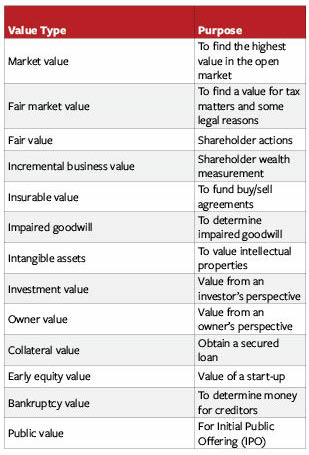
The kind of valuation most appropriate for an ownership transfer depends on its purpose. For example, you might not want to use the same approach to resolve a dispute (such as a divorce settlement) or file bankruptcy as to sell a business to a competitor. Rob Slee in his comprehensive treatise on “Private Capital Markets” outlines thirteen types of business values. All have a different purpose, function and rules for use.
Valuations are a Function of Need
Source: Private Capital Markets by Robert T. Slee, 2nd edition
In selling a business, a great deal depends on who the buyer is. Selling to the employees through an ESOP (Employee Stock Ownership Plan) requires a Fair Market Value assessment with all the rules and limitations of that process. Insurable value for a Buy/Sell agreement is a way to fund the acquisition of part of a private company due to the loss of an existing owner. Still others are interested in what they can garner from the open market. Here, market value is influenced by the state of the business and capital available for funding the purchase.
Many sellers don’t realize that every private company has at least three market values at the same time. Each of these represents the most likely selling price based on the most likely buyer type; Asset, Financial, or Strategic.
Asset Buyers
Asset buyers look at a company’s worth based on net value of the company’s assets. Here, beyond the possible write-up of the assets, the buyer is not buying the company’s earnings stream or giving credit to the company’s operations or goodwill (name, reputation, customer base etc.). This valuation approach is most useful if the business being sold is experiencing negative growth or some of the assets (e.g., real estate) do not contribute to the operations going forward.
Financial Buyers
A financial buyer is one that will pay for the business as a going concern, including goodwill. The valuation is based on the company’s historical financial statements and 3-5 year projections of the P&L and balance sheet. The company’s profit (Earnings Before Interest, Taxes, Depreciation and Amortization or EBITDA) projections are discounted back to the time of purchase to determine a net present value. The discount rate that is applied is a function of the company’s size, industry, dependence on economic conditions, debt leverage, and risk factors such as supplier or customer concentration, management strength, culture, business plan, etc.
Sellers can improve a buyer’s net present value for their company by minimizing these risks before entering into a sale process. Benchmarking the NPV against M&A supply/demand experience helps in framing “what the market will bear.” Competitive valuations are benchmarks that are formulated using multiples of EBITDA of like businesses purchased by like buyers. To achieve a conclusion, a valuation professional will likely apply some weighted average of the various calculations and determine a range of values for the subject business.
Strategic Buyers
A strategic buyer is one who already has some investment in a related business. By combining the existing business with the seller’s business, the buyer expects synergies that will generate improved sales and/or profits beyond what the businesses generate separately. Valuation professionals typically have little insight into what a strategic buyer will pay for a business because only the buyer knows what synergies might have an impact on an integrated concern. Typical synergies can result from the seller’s product, process or technology capabilities as well as customer relationships. Buyers who are consolidators look for economies of scale and lower cost structures as a result of the combination. Growth buyers expect to avoid the costs associated with business development for synergistic sales and operations. Either of these lead to the potential for a greater purchase price than what could be available from a financial buyer if the strategic is willing to share some of the profits from the combined businesses with the seller. On the downside, the value of a strategic buyer to the seller may not be as compelling if the net result of the combination has a negative impact on the seller’s employees, customers, or local community.
The Ultimate Valuation
Owners can secure a premium price for their company when capital for financing is attractive, they have minimized future growth risk in the business, and they find a strategic buyer who is both acceptable and willing to share the benefits of synergies. Fortunately, there are a number of financial advisors that can help make that happen. But it is important to keep in mind, at the end of the day, no matter what the purpose, a business is only worth what someone is willing to pay.
For additional information regarding Florida business sales, acquisitions and valuations, please contact Eric J. Gall at Eric@EdisonAvenue.com or 239.738.6227. Also, visit our Edison Avenue website at www.EdisonAvenue.com or my personal website at www.BuySellFLbiz.com.
Best-selling author and one of the nation's foremost business thinkers Posted: Updated:
We all need concrete references who help us more clearly see the success we want to reach. This not only gives us valuable insights to get to our goals faster, but helps make our goals more "believable" in the first place.
In this case study you'll Meet Stephanie Harkness, serial entrepreneur and former Chairperson of the National Association of Manufacturers.
Stephanie was also my co-author on my 9th book, Build a Business, Not a Job.
Stephanie started out as a home economics teacher in San Jose, California. After 13 years in education, she started up her first business, Expressions in Fine Jewelry. They created high-end jewelry for private clients. For six years she flew around the world meeting clients, sometimes carrying as much as $3 million worth of jewels in her briefcase.
Exciting as that may seem, it got old for her after a while. Stephanie grew tired of the way the business needed her to be there every day, day after day. In essence, Stephanie hadn't built a business, but really she had built a successful job for herself.
It was at this point that her husband Jack took early retirement from General Electric where he worked as an engineering manager. Taking stock of what they wanted to do, they decided to find a business they could do together.
After an intensive period of searching, they ended up buying a struggling injection molding plastics company in Santa Cruz, California. They used Stephanie's retirement money in her teacher's pension for the start-up capital, and jumped in.
They discovered that many of the promises of the man they bought the company from were more fiction than fact, but they persisted.
Over a 20 year period they scaled the company, implementing systems, building an executive team, and positioning the company as a higher end plastics medical device manufacturer (this one decision alone 4-folded the multiple that they later sold for.)
By 2010 the company was incredibly successful, generating millions in profit, while allowing Stephanie and Jack to take 3 months or more of vacations a year. Three years later in 2013, they sold their company for a large 8-figure price.
In a recent interview I did with Stephanie, here are 3 of her top insights to help you follow in her footsteps:
• Embrace hiring better, smarter people than yourself. Too many business owners fear hiring top talent. They say it's because they can't afford to, but generally it's because they fear how they'll feel having top talent on their team. Top talent intimidates them. They fear that top talent won't want to work for them, or stayworking for them. They may not even be aware of these feelings, still they behave based on these limiting beliefs.
One of the things that helped Stephanie succeed so massively was that she always hired the best, smartest talent she could at any given point in her company's development, tabling any insecurities she may have had at the time.
• The time to plan your exit is years in advance. For Stephanie and Jack, the exit they wanted was always to sell their company. So in 2003 they started laying the groundwork that helped them sell for a multiple 3 times higher than their industry average in 2010 when they closed the sale of their company.
What's the exit strategy you want for your business? To sell it? Continue to actively scale it? Or to transition to owning it passively? All three are viable choices, but the time to decide is now so you build with this end in mind.
• Have a vision for your life post-exit that inspires you. Personally, this has been one of my biggest lessons I learned from watching Stephanie. She consciously crafted her plan of what she and Jack were most passionate about that they would transition to after they sold their company. It included travel, and learning, and philanthropy, and investing, and yes, even another business, although this time with a more deliberate and limited role for herself.
Today Stephanie and Jack are living an extraordinary life. They live on the fairway at Pebble Beach, CA, travel the world, and enjoy deep, rich relationships with family and friends.
And she recently launched a new company that she feels will reach a billion dollar valuation in less than 10 years.
Action Time:
Take 10 minutes and just let your imagination fly away with what your life post "exit" could look like for you. Journal your answers and in those quiet moments early in the morning and late at night, feed the ember of this fire so that with time, your vision of your future burns bright and calls your into action.
For additional information regarding Florida business sales, acquisitions and valuations, please contact Eric J. Gall at Eric@EdisonAvenue.com or 239.738.6227. Also, visit our Edison Avenue website at www.EdisonAvenue.com or my personal website at www.BuySellFLbiz.com.
People talk about multiples of revenue. Sure, one can take any price and divide it by the annual revenue of a business and obtain a revenue multiple. A $1 million sale price divided by $750,000 in annual revenue equals a 1.33 revenue multiple. Right? Nothing inherently right or wrong in talking about multiples of revenue.
But revenue is a very poor indicator of value. It’s like talking about price per square foot for a home. Sure, price per square foot is interesting, and one way to conceptualize value or price, but the square footage itself does not drive the value (if you follow me). The price per square foot value of a home is driven by OTHER factors, such as the age, construction materials and quality, lot size, condition, neighborhood, and geographic location. Location of a home is the primary driver of value. And so the value per square foot could swing from $10 to $1,000.
So you want me to source buyers for you that will make offers to buy your business? Okay, the buyers will want to know the revenue, but also about the growth rate, profit, profit margins, customer concentration, management, industry, etc. But it all gets down to what each buyer thinks the business will or can earn on the bottom line profit (more particularly, really, cash flow). What people are willing and able to pay for a business is a function of the profit they expect the business to generate.
Below is a chart that shows median business sale prices as a multiple of revenue. As one can see, businesses sell for a fraction of revenue. Not multiples (at least not very often).
Selling price/revenue multiples DO vary by business type, however, basically because profit margins vary by business type. Manufacturers will, on average, have higher profit margins, i.e., profit as a percent of revenue, than retailers and wholesalers. That’s why the former sell for higher multiples of revenue than do the latter.
So unless you are in a super-charged industry that is enjoying hyper-growth and buyers are paying ridiculous prices, even for companies that are not even profitable, don’t bother me with multiples of revenue. Let’s talk multiples of earnings. Okay?
For additional information regarding Florida business sales, acquisitions and valuations, please contact Eric J. Gall at Eric@EdisonAvenue.com or 239.738.6227. Also, visit our Edison Avenue website at www.EdisonAvenue.com or my personal website at www.BuySellFLbiz.com.