This blog provides useful information to business owners, those wanting to own a business, or individuals interested in commercial income properties. Topics include small and mid-market business sales, mergers, acquisitions, valuations, financing and consulting.
Takeaway:Cory Janssen, co-founder of Investopedia and Divestopedia, shares his nuggets of wisdom learned from selling Investopedia to Forbes.
Cory Janssen co-founded Investopedia.com in 1999 and helped grow it into one of the Web's largest financial sites devoted to investor education. In April 2007, the company was sold to Forbes Media.
1. We were very careful about not building the company around our personalities so eventually, we could sell it if we wanted to.
2. We interviewed brokers and selected a firm in Silicon Valley who had done some similar deals and started a formal process with them.
3. After two months of preparation, the broker put the offer out to 40 to 50 organizations. After four months, we narrowed the list to ten firms who came to visit us.
4. LOIs were requested and we further narrowed the list to three companies. We visited the three companies at their locations and closed with Forbes in April, nine months after we initiated the process.
5. The biggest lesson I didn’t realize beforehand is you have to manage your team differently at different stages of the process. Early on, the investment banker is your best friend because they are incented to get your idea in front of the right people. However, your lawyer is your worst enemy because he’s just racking up your bill.
6. Later in the process, it flips at the point there where the broker figures they got you as much as they can, so at that point, your lawyer is your best friend because your broker doesn’t care about everything you’re doing in the legal agreement.
7. You have to manage the exit team, e.g, tax planners, accountant and other exit planners. They are all on your team, they’re all for you, but you need to treat and manage each differently based on where you are in the deal.
8. You want to align your interests. Before selling my partners and I wrote down our goals for the deal. It helped ground us near the end of the deal when things are going back and forth and you can’t keep your head straight, it grounded us.
9. We also gave the broker an above-market fee over a certain dollar to incent him. Alignment of interests works for whether you’re trying to hire a sales person or whether you’re trying to sell a business.
10. Looking back, we could have made the deal much smoother by having a better exit plan. I didn't know what an exit plan was at the time, to be honest.
For additional information regarding Florida business sales, acquisitions and valuations, please contact Eric J. Gall, CBI, CM&AP at Eric@EdisonAvenue.com or 239.738.6227. Also, visit our Edison Avenue website at www.EdisonAvenue.com. To search for Florida Businesses for Sale: CLICK HERE
Healthcare M&A Transactions can be extremely complex and require numerous steps, negotiations and processes to be accomplished in order for the deal to finally go through. From Letters of Intent to Earn Out Provisions, the process can be one that relies on details and the knowledge of its inner workings in order to be accomplished properly. The Ambulatory M&A Advisor takes a look at the essential steps in an M&A transaction and what they mean to the development of the overall deal.
Christina Van Vort, partner with the law firm of Garfunkel and Wild says that the first essential steps in an M&A transaction come in with the Letter of Intent (LOI).
“The letters of intent can be useful to help the parties shape the transaction and to ensure that they are on the same page as to essential elements. Sometimes, you can go directly to contracts but this often can lead to further delay as the parties begin to “work out” their issues as the draft goes back and forth,” Van Vort says.
At the outset, the parties need to make a calculation as to whether the time to put together an LOI will save time down the road. Often times, the answer is yes and an LOI should be executed, she says, adding that either party can draft the LOI, as the non-drafting party will review and provide comments.
Jay Hardcastle, partner at the law firm of Bradley, Arant, Boult, Cummings says that usually the drafting of a letter of intent follows the execution of the non-disclosure agreement. Meaning, once the parties have exchanged enough confidential information to determine that they want to proceed, the lawyers will draft an LOI.
“Usually lawyers will draft them because they often have a few binding provisions. The binding provisions would typically be a “no shop” clause where the seller would agree to negotiate exclusively with the proposed buyer for a certain number of days, and another covenant to not issue any press releases or allowed to go public with the transaction until both parties are ready,” Hardcastle says.
“I think lawyers should draft them because of those issues, the rest of it is unbinding and generally just contains an outline of the proposed transaction.”
Van Vort agrees that the LOI needs to be done early in a transaction and the parties need to decide what terms, if any, will be binding even if the transaction does not proceed.
“In addition to the important listed above of a LOI, another useful purpose of the LOI is to have a document which can be taken back to a Board for approval before marching into drafting documents.”
Purchase agreement and it’s contents: The purchase agreement is essentially a road map for getting from signing the agreement to closing, and a risk allocation covenant. In terms of the roadmap, it will describe what each party has to do to get the transaction closed. In terms of risk allocation, the purchase agreement will allocate risk for pre-closing and post-closing problems in accordance with the negotiated deal between the parties.
The purchase agreement will contain representations and warranties as to the state of the facility as of the closing date. The seller should do their own due diligence to make sure that those reps and warranties are true to avoid indemnification claims based on falsity of representation.
Alice Gosfield, attorney and owner of Alice G. Gosfield and Associates says representations and warranties are different kinds of provisions in a contract that are essential to the success of the M&A process.
“Typical representations will be things like the entity has been dually authorized throughout its existence necessary for it to conduct its to conduct business as it has; the practice has maintained all of the licenses and approvals that are business.”
According to Gosfield when examining representations and warranties, the first thing to do with the representations and warranties is to ensure that the information provided is as accurate as possible and to the best of the seller’s knowledge. Gosfield says this is important because one of the items they will be asked to represent and warrant is proof of compliance with the law in terms of Stark, Anti-kickback, false claims, and other regulations.
Gosfield says there are some essential or fundamental representations and warranties, and there are others that may be a little bit more peripheral.
“The more fundamental ones tend to be that the people representing own the business and in fact are the ones who owns the business and nobody else has claim to a portion of the business or a portion of the sale proceeds,” Gosfield says.
Also in the representations and warranties, Gosfield says tax areas are examined such as tax returns paid timely and that taxes owed by the business have been paid.
What would representations and warranties be without the process of due diligence? As with any corporate transaction, due diligence is crucial to determine liabilities, responsibilities and potential issues.
According to Van Vort, the due diligence may need to focus on licensure (and any limitations), HIPAA (e.g. and any breach notifications that have occurred and whether a HIPAA plan exists), compliance (e.g. has there been any qui tam allegations and is there a robust program) and billing practices (e.g. have there been any third party audits resulting in payback by the provider).
“However, in healthcare there are some specific and unique concerns. For example, an investigation by a governmental payor could result in a significant financial obligation of the provider. Also, regulatory due diligence is very important because of the complexities of the health care environment,” Van Vort says. As far as due diligence goes, Hardcastle explains that it is beneficial for both sides of the proposed transaction to perform diligence on the selling business. This will prevent unexpected issues and possible indemnifications that could pop up post-sale.
In an M&A transaction there are various types of acquisition structures that can apply. According to Andrew Blustein, partner at Garfunkel Wild, selecting the right structure for one’s healthcare business depends on many factors. Blustein says this mainly includes the type of entity and the goals of the parties.
“When for-profit providers are acquired, deals are usually structured as asset or stock sales. Not-for-profit providers may also sell assets, or a party may acquire control in a different manner. In short, choosing the right structure is very particular to each transaction,” Blustein says.
Hardcastle says the more common structures for physician related outpatient ventures would include asset purchases and partial purchases of interest in the entity that is the actual provider.
“In an asset purchase, the seller sells all of its assets and the buyer assumes selected liabilities. In an interest purchase the buyer buys an interest in the actual entity. The end result is that the existing seller still retains an interest and the resulting entity could be called a joint venture,” Hardcastle says.
Hardcastle goes on to discuss the eaarn out provision. These provisions usually state that a seller may obtain future compensation based on future financial goals of the entity.
Hardcastle says that earn outs occur very infrequently in transactions of this type due to being problematic in the healthcare business.
“This becomes a problem when the seller has any influence over referrals, after the transaction closes. For example, in a surgery center acquisition where the buyer is buying partial interest in the surgery center from surgeons who use the center, an earn out would be inappropriate because the surgeon’s post closing utilization would affect the ultimate purchase price,” Hardcastle says.
For additional information regarding Florida business sales, acquisitions and valuations, please contact Eric J. Gall at Eric@EdisonAvenue.com or 239.738.6227. Also, visit our Edison Avenue website at www.EdisonAvenue.com or my personal website at www.BuySellFLbiz.com.
By Winston Reid|February 15, 2017 “We’ll start conversations with investors once we need the money.” “We’ll talk to buyers when we want to sell.”
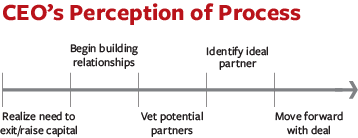
At Axial, we often hear these comments from CEOs embarking on a sale or capital raise for the first time. Their expectation is that as soon as they’re ready to go, they’ll be able to find the right partner and get the deal off the ground.
Those CEOs tend to believe finding a partner will be a simple process of eliminating options to arrive at the best one:
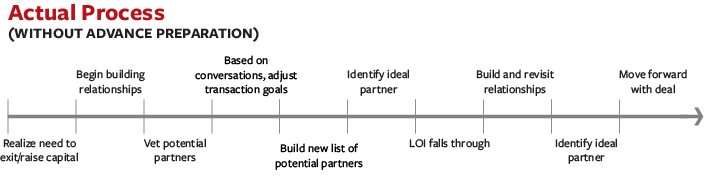
In reality, transactions usually end up looking more like this:
Executing a debt/equity raise or M&A event isn’t a one-time action, but rather the culmination of months, if not years, of relationships and work. Think of your transaction as a funnel. A certain number of your relationships will drop off at each stage in the transaction, due to lack of interest, poor fit, and myriad other reasons. Every stage of the funnel will also inevitably take longer than you expect. Because of this, you must build multiple relationships well ahead of an intended deal to ensure you find a partner who is the right fit for your business.
The best strategy to streamline this process is to engage an M&A advisor or investment banker with experience in your industry or with deal outcomes (business sale, raising capital, raising debt, etc.) like the one you’re seeking. Your advisor can make sure that your goals are clearly outlined at the beginning of the process and introduce you to capital providers and/or buyers who are a good fit. Online platforms like Axial also help make the process more efficient, by enabling you to build relationships with people beyond your geographic area or immediate professional network.
Your company’s performance and market conditions, along with other factors, will impact how broadly you need to build out the top of your funnel. If you want to make sure you complete your transaction accordinging to your timeline, the most important thing to do is start early. Successful CEOs start building relationships at least a year, if not two or three, before a transaction — we recommend setting a goal of building two new relationships with advisors, investors, or capital providers per quarter. When you start early, you…
Can afford to be more selective about the investor/lender/buyer/advisor with whom you sign
Have time to build deeper relationships with a future partner
Leave wiggle-room in case the deal takes longer than expected or you end up needing the money/sale before you first anticipated
With advance planning, the process usually ends up looking more like this:
Thinking strategically about your transaction funnel makes it so that when you’re truly ready to move on a deal, you’ll already have the relationships you need in place. Transactions can be stressful, but preparing in advance will make all the difference.
For additional information regarding Florida business sales, acquisitions and valuations, please contact Eric J. Gall at Eric@EdisonAvenue.com or 239.738.6227. Also, visit our Edison Avenue website at www.EdisonAvenue.com.
Takeaway:Why holding off on signing a letter of intent can be advantageous in a sales process.
One purpose of a letter of intent (LOI) is to document a mutual agreement between the buyer and seller on the major points of the purchase and sale of a business. With this in mind, an LOI is often signed much too early in the process. There is an understandable eagerness if you are selling a business to receive a letter of intent from a prospective buyer as early as possible. In some cases, business owners are even advised that they should request an LOI in order to learn price and terms from the prospective buyer.
The Usual Arguments
Listed below are some of the common reasons that business sellers are encouraged to execute an LOI early in the process. We disagree with these arguments, but it’s still important to understand both sides:
Signing an LOI with a prospective buyer demonstrates to them that you are serious.
The buyer isn’t going to spend considerable time and resources reviewing your company and considering an acquisition unless you have signed an LOI and they have an exclusive period to review your business.
The buyer won’t proceed through the sale process without an LOI because they won’t waste time and money in due diligence and preparing a detailed purchase agreement in case there is a disagreement later about price and terms of the transaction.
While some of this makes sense, it doesn’t hold true for most business sales as:
You don’t need an LOI to demonstrate to a buyer that you are serious – it just takes advanced preparation, planning and hard work.
If the buyer wants to buy the business, they’ll go through additional steps in the process prior to submitting an LOI – you just have to ask and detail your intended process to them.
Your business is a unique asset and if your business has significant differentiators that have made the buyer interested in the first place, they’re unlikely to lose interest if you ask them to follow through with additional steps prior to signing an LOI. They’ll also take you more seriously.
So, then comes the question: If someone wants to make an offer to buy your business and you want to sell, why wouldn’t you accept a written offer? The answer: price and terms.
Price & Terms
If you sign an LOI early in the process, you are likely to sell for a lower price and weaker terms than you deserve. Unless the buyer is well informed about your business, the growth opportunity and all necessary information on which to make a fully informed decision, they are going to price the offer and terms based on a limited understanding. In most cases, the initial offer submitted is a lower-ball offer with some wiggle room in consideration of the uncertainty on which they are basing the offer. Once that offer is in writing in an LOI with an exclusive period, it’s much harder to increase the price and terms.
As an example, let’s say you’ve been talking to a strategic buyer that knows your business well and is experienced in your industry. If you run the right sale process, the maximum they’re prepared to pay for your business is $30 million cash at closing (if they were fully informed about your company). That same strategic buyer, if submitting an LOI early in the process, may only offer $15-$20 million if all they have received is detailed financial information, toured your facility, spoken with you and received answers to some of their questions.
We actually had one recent example where the disparity between the initial written indication of interest and final LOI was far greater than this example. The buyer was a sophisticated international, multi-billion dollar corporation and the initially submitted valuation was fair, in terms of market comparisons. However, with more information about the acquisition opportunity, it became clear that they should be paying a considerable premium to ensure that their offer was accepted. It just takes time and effort for all parties to become better informed and the buyer to understand that they need to maximize price and terms to get the deal done.
When Should I (the Seller) Sign an LOI?
Your advisors should work with you to prepare your business for sale, spend considerable time, effort, analysis, planning, preparation, financial modeling, researching and writing. If they do their job, then it makes sense for you to wait until later in the process to receive a letter of intent because:
The buyer knows you are serious about selling if you or your advisor have spent considerable time up front preparing your business for sale. It is obvious to them that you’re going to sell the business and doesn’t require an LOI for them to feel comfortable spending time and resources analyzing your company.
The work that you have done up front eliminates much of the buyer’s time risk, as you will have already completed most of the work that the buyer would otherwise need to complete. The buyer can issue an LOI based on your presentation of the information and use the period after executing the LOI to challenge, substantiate and investigate all the information and analysis that has been presented to them.
Before an LOI, it is typical to receive an indication of interest, along with a valuation range. This non-binding indication, without any of the typical LOI provisions, requires less work for the buyer and is a useful starting point for valuation discussions. The purpose of an LOI is not for a preliminary discussion/understanding of price and terms – that only benefits the buyer and gives them an exclusivity period.
When it does come time to execute a letter of intent, it is an agreement that would typically go through multiple edits and negotiations before agreeing upon a final version. After all, this should be as close to the final purchase agreement as is feasible.
There are numerous other considerations, but just know that when it comes to your business, your hard work, sweat and tears, that you should be the one to control the sale process, not the buyer. And don’t be concerned about running the buyer off by holding off on signing an LOI. You have to make a serious misstep to run off an interested buyer – if they are aggressive and insist on an early LOI, they’re not likely someone that you want to buy the business anyway. You’ll invariably find that there are more than a handful of logical buyers for your company. It just takes time, experience and hard work to find them.
Formula for a Successful Business Sale
It is a real challenge to sell a business the right way, to achieve the best result for you and your stakeholders and it takes a lot of hard work, but the hard work pays off when it is time to close the deal.
For additional information regarding Florida business sales, acquisitions and valuations, please contact Eric J. Gall at Eric@EdisonAvenue.com or 239.738.6227. Also, visit our Edison Avenue website at www.EdisonAvenue.com.
By Austin D. Potenza II, May, Potenza, Baran & Gillespie|November 15, 2016
Co-author: Shruti Gurudanti
In the process of negotiating and structuring deal, one of the watershed steps is signing a Letter of Intent (“LOI”). Signing an LOI does not mean that the deal is finalized, but can be an important tool to set the tone, schedule and basic terms of the deal, and a way for the buyer and seller to gauge each other’s willingness to proceed.
Below are four major considerations for anyone executing an LOI:
1. LOIs aren’t mandatory.
If the parties are confident that they intend to do a deal, and are comfortable with the material terms, they may choose to skip the LOI and go directly to the preparation of definitive transaction documents. However, depending on the dynamics of a transaction, the parties may wish to begin the process with an LOI. Although one of the most common reasons for executing an LOI is to preserve the confidentiality of the process and the sensitive information that will be exchanged, a simple confidentiality agreement will often suffice for that purpose.
2. LOIs set procedures for due diligence.
In situations wherein the parties are not yet comfortable spending the time and resources to conduct due diligence and draft complex deal documents, the LOI can be a very good investment. An LOI can be used to set expectations around deal structure, scheduling, and other big picture deal points. Material terms that are essentially deal-breakers can be resolved early. Where due diligence is required, the letter of intent can specify the manner in which due diligence will be conducted, including the nature of information that will be disclosed and the manner in which it will be disclosed.
3. LOIs help protect all parties in the deal.
In order to prevent a bidding war, or to allow the buyer an exclusivity period in which to conduct its due diligence, an LOI can include a “no-shop” clause that prohibits either or both sides from approaching third parties for a limited period of time. Likewise, in order to protect a seller from wasting time, money and effort, an LOI may include a break-up fee that is paid if the buyer cancels the transaction for an unpermitted reason.
Many of these points (and more, of course) can be covered in a definitive agreement that provides for a delayed closing (i.e., a period of time between when the parties sign the agreement and when they finalize the transaction). However, the parties may want to set some ground rules before incurring all of that expense. This is where an LOI comes in.
4. LOIs are considered formal legal documents.
It is important to differentiate between what parts of an LOI are intended to be enforceable, and what parts aren’t. Examples of enforceable sections include clauses around confidentiality, no-shop, or break-up fees. Although price and terms typically wouldn’t be included among the enforceable provisions, they set an expectation that is difficult to change absent a good reason.
If the circumstances of the deal warrant, an LOI can be a valuable tool to save time and money. Because it is an important legal document, be sure to have it reviewed by a lawyer with experience in M&A transactions. It also makes sense to have your CPA review it for tax consequences.
For additional information regarding Florida business sales, acquisitions and valuations, please contact Eric J. Gall at Eric@EdisonAvenue.com or 239.738.6227. Also, visit our Edison Avenue website at www.EdisonAvenue.com.
Takeaway:Paul Wormley from Hadley Capital digs deeper into the specifics about what a business owner can expect to change upon closing a deal with a private equity partner in regards to financial reporting and budgeting.
Source: Sergey Khakimullin - Dreamstime.com
In part one and two of this article series, I explained the changes you should expect upon closing a deal with a private equity firm, including changes associated in an asset versus a stock sale, forming a C Corporation from an S Corporation, banking relationships, contracts, and the addition of a board of directors. Part three of this series provides additional insight into what to expect after closing a private equity deal.
Changes in Financial Reporting
All of our companies produce monthly financial statements, including an income statement, a balance sheet, a statement of cash flows with the comparison to the performance of the prior year's month, and performance compared to the budget. Many of the companies that we acquire are producing financial statements on a regular, if not monthly, basis, either internally or using a third party accounting firm; so, typically, this is not a significant change. The one change that may take a little bit of effort is that all of our companies are audited and they produce their financial statements according to generally accepted accounting principles (GAAP). Many of the small companies that we acquire are not producing financial statements according to GAAP and, in every case, there has never been a financial audit of the business. All of our businesses are audited and the standards for an audit tend to be higher than just producing GAAP financial statements. This is an area where we work with our companies so they are prepared for an audit. This is not typically something that is difficult for our companies to achieve, but it’s a change and it is also something that requires an additional expense - around $30,000 for an audit.
In most cases, the companies that we acquire have a dedicated controller and maybe one or two accounting clerks. If we identify in the course of our due diligence that there are financial reporting weaknesses, we work with the companies during the due diligence period to identify solutions to areas of weakness. By the time we close, our goal is to be where we need to be from an accounting and reporting perspective.
Changes in Budgeting
Most of the companies that we acquire do not have budgets. They may perform an annual forecast. In other words, "Last year, we were $14 million in revenue. This year, we’d like to be $15 million in revenue. Last year, we made $1.5 million. This year, we’d like to make $1,750,000," but that would be the extent of their budgeting process. All of our companies go through a formal budgeting process each year. The outcome of that is a monthly budget that includes a revenue and expense forecast, capital expenditure plans, investment plans, etc. In the first year, those budgets are pretty basic. As we go forward, budgets become more detailed and integrated with the company’s overall strategic plans such that significant strategic items that require funding are included in the budget plans. In the strategic plans, there are, for example, revenue growth plans based on a per customer or per product basis that will be incorporated into the revenue budget. In the end, our teams find the budgeting process to be extremely helpful and a great tool to help them improve how they are running the business.
No Surprises
Prior to signing a letter of intent with a target company, we try to have detailed conversations about the question, “What’s going to change?” The time and energy that’s required to complete each of the items outlined in this article series are unique to each company. Our interest is in identifying those things that we think are particularly time consuming or risky in the context of the transaction and work together to come up with a plan to cross that chasm. This helps lower the chance for negative surprises during due diligence and closing a transaction. The sale of a small company involves change regardless of the type of buyer. The goal of this article series is to help business owners gain a better understanding of some of the most common changes involved in a deal with a private equity buyer.
For additional information regarding Florida business sales, acquisitions and valuations, please contact Eric J. Gall at Eric@EdisonAvenue.com or 239.738.6227. Also, visit our Edison Avenue website at www.EdisonAvenue.com or my personal website at www.BuySellFLbiz.com.
Takeaway:Private equity can be an excellent exit alternative for many mid-market business. Learn 10 ways to be more attractive to a private equity investor.
Source: Flynt - Dreamstime.com
Recent financial data shows professional investors such as private equity groups are once again putting money to work in private mid-market companies. Business owners interested in tapping this vein still must clear a number of hurdles to attract private equity investors. The same goes for retiring baby boomers that decide the time is right to sell with middle market valuations on the rise.
In order to help business owners understand what it takes, here are 10 ways to add value and stand out from the crowd.
Audit Your Financials
Sloppy numbers sap value like a poorly tuned engine saps horsepower. You may find investors who will overlook holes in your financial reporting, but you won’t get top dollar. An audit shows a prospective buyer that you are serious about doing the little things right - which can be a powerful signal to send when you are in a negotiating process.
Fill Gaps in Your Team
No one can do everything well - including you. If you can’t be away for a week without checking in on routine problems, then you need a stronger team. This is especially true for private equity groups which almost always are looking for a deep bench when they are recapitalizing a company.
Diversify Your Customer Base
Many business owners are surprised to learn that customer concentration is a major knockout for sophisticated investors. But when businesses derive 40% or 50% of their revenues from one or two customers, a red flag goes up for potential buyers who don’t want the risk of losing a major customer. A good rule of thumb: no one customer should represent more than 10% to 15% of your revenue.
Create an Exit Plan
Sitting down with an investment banker and your other advisors (lawyer, accountant, financial planner, etc.) to plan your exit will eliminate confusion during the business sale process. Fred Wainwright, a certified exit planner at Ledyard Bank in New Hampshire, urges business owners not to wait for a life changing event to force the planning process. "We like to see owners start meeting with their advisors two to three years before a planned transition. That way the owner can act to fill the gaps so his business can become an A or even an A+ company."
Solidify Your Contracts
Everyone knows it costs more to get a new customer than to keep an existing one. Buyers will pay a premium for a business with customers under contract and/or recurring subscription type revenues. This is one of the reasons why companies with service contracts are so popular with investors today.
Build the Product Pipeline
If you want private equity to pay up for the future potential of your company, you need to give them a reason. Consider launching new products or entering new markets to show growth potential. The research you do as part of this effort will also help answer two of the BIG investor questions: (1) "How big is the market?" and (2) "How can you get more of the share?" Confident answers make it hard for buyers to walk away.
Get a Realistic Valuation
Your company will not trade at the same multiple as IBM, but it may be worth more (or less) than you think. Buyers will be armed with this information; to negotiate properly, you should be too. Your investment banker can provide you with a general range of value by providing recent transaction information. To truly get a handle based on your actual performance, you should consider a market assessment by a skilled professional or, in certain cases, a formal valuation by a certified appraiser.
Make an Acquisition
Buying another company is a big undertaking, but often is the fastest way to growth and leads to a more attractive exit upon successful integration. "There is certainly no playbook," says Glenn Fishler, who embarked on an acquisition strategy after 23 years of building his environmental services company one customer at a time. "If you’ve never made an acquisition before and you don’t have people inside the company to guide you, you’ve got to find all the help you can get."
Put Your Records in Order
The better organized you are, the easier it will be to attract investors or sell your company, and the less disruptive you will find the due diligence process. Time will start to speed up the day you accept a Letter of Intent from a prospective buyer. You will be asked for information about your company, your corporate structure, your stockholders, your employees, your customers and your legal affairs. Organizing these records beforehand will help keep the deal on track and, perhaps more important, reaffirm for the private equity group that they are making the right deal.
Protect Your IP
In our knowledge-based economy, intellectual property is more valuable today than ever. To support your business model, catalog your training processes, document your software, trademark your products, copyright your website and keep close tabs on your customer list. These are valuable assets and you want to make sure you get fairly paid for them.
So there you have it, 10 ways to attract private equity. I'm sure there are more, but more often than not, if you get these 10 right, you will bring to the table interested buyers who are more likely to see the deal through.
For additional information regarding Florida business sales, acquisitions and valuations, please contact Eric J. Gall at Eric@EdisonAvenue.com or 239.738.6227. Also, visit our Edison Avenue website at www.EdisonAvenue.com or my personal website at www.BuySellFLbiz.com.
Owners who plan to sell their businesses would be wise to prepare for the due diligence process a few years before the selling process begins. Due diligence by definition is an “investigation” and when it is applied to a business sale, it means the buyer leaves no stone unturned!
Why Is Due Diligence So Important?
After buyers and sellers sign a Letter of Intent (LOI) that outlines the purchase price for the business, the buyers will conduct a thorough review of the seller’s business. Every issue they find will be a reason to reconsider and reduce the purchase price, which is exactly what sellers DON’T want to happen.
For additional information regarding Florida business sales, acquisitions and valuations, please contact Eric J. Gall at info@buysellflbiz.com or 239.738.6227. Also, visit our Florida Business Exchange website at www.fbxbrokers.com and my personal website at www.buysellflbiz.com.