Showing posts with label what to know about mergers and acquisitions. Show all posts

Thursday, July 14, 2016

Top 10 Ways an M&A Transaction Can Go Wrong | Axial


By , SDR Ventures | 

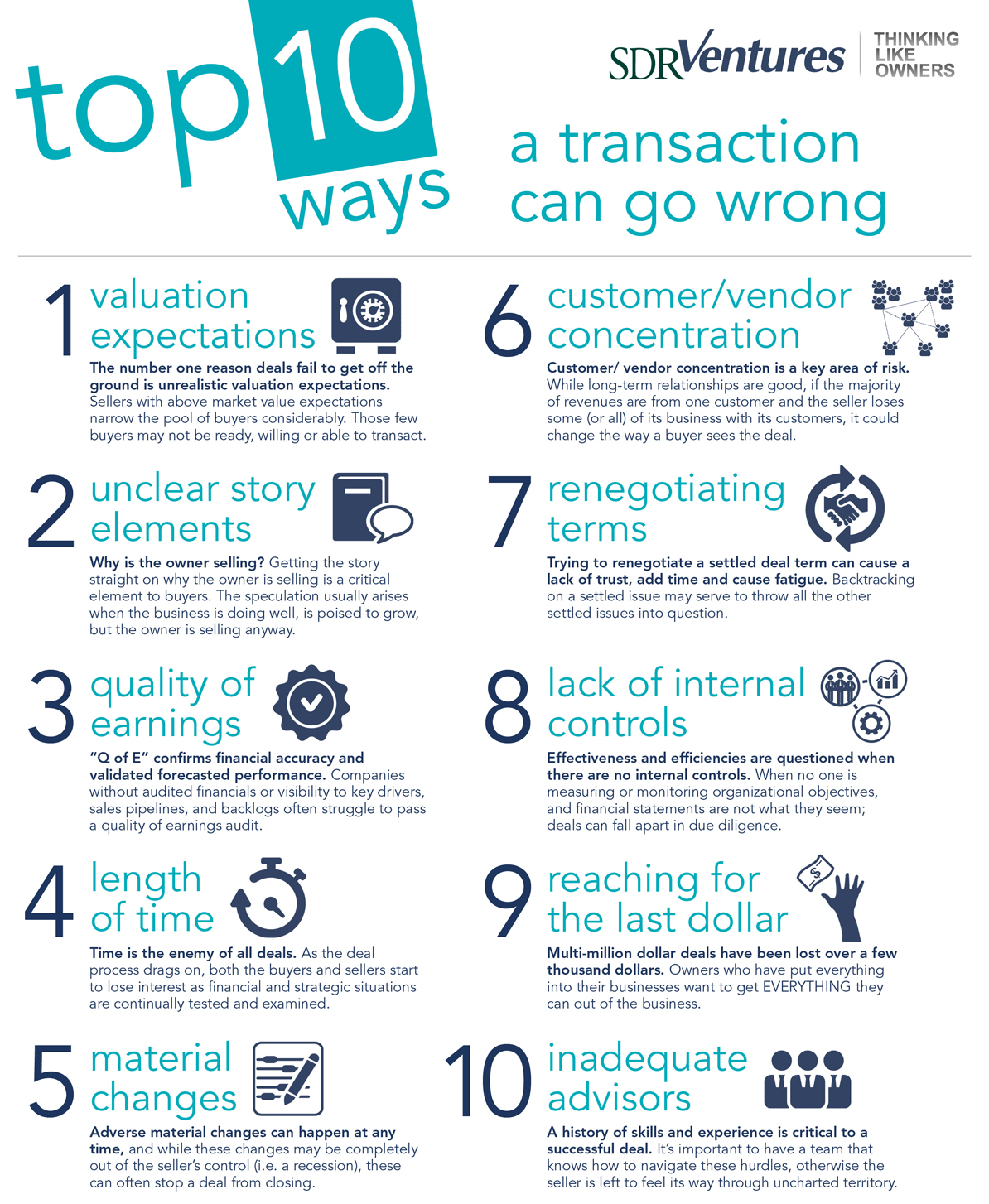
Top-10-ways-a-transaction-can-go-wrong-Axial-SDR Ventures-graphic (1)
Many business owners are jumping on the bandwagon to sell their companies, trying to take advantage of the current hot market and frothy multiples being paid by buyers. With the impending Baby Boomer tsunami, more businesses are and will be for sale over the next few years than at any other point in history. This trend creates a competitive environment among sellers and leads buyers to look more closely at the quality and price value relationship of any potential acquisition.
For some time now, due to strong earnings, low interest rates and favorable capital markets, many buyers have sought to grow their businesses more rapidly through acquisitions vs. organic growth. Therefore, one would think that sellers would have a field day in selling their businesses.
Some sources estimate that 80% of small and middle market business owners who put their businesses up for sale never close the transaction. From years of observation, I have found that most deals fall apart (i.e., fail to close) for 10 basic reasons.
1. Unrealistic Value Expectations
The number one reason deals fail to close is because a seller’s valuation expectations are too high.
Many business owners read and hear about companies or competitors operating in their same space selling for very high valuations. Therefore, they believe that their businesses are worth the same.
2. Unclear Story Elements
Business owners need to think like buyers. Attracting a buyer is like preparing for a beauty contest. Companies that “show best” win first place.
Often, because of poor strategic planning, the business owner cannot articulate clearly the company’s competitive advantages, its growth opportunities, its revenue potential, and its ability to produce significant returns on invested capital.
Further, business owners often fail to communicate the strength of their management team and their entrepreneurial desire to continue growth and expand the business post transaction.
3. Quality of Earnings
Audited financial statements confirm financial accuracy and help validate forecasted performance. Lack of clarity and visibility regarding key business drivers, sales pipeline backlogs, back office operations, and the consistency of growth and earnings inhibit a buyer’s enthusiasm to continue its due diligence.
4. Length of Time
Every deal has a life of its own and its own momentum. Recognizing the ebb and flow of the deal momentum is critical to deal success. Time is the enemy of all deals. As the deal process drags on, both buyers and sellers start to lose interest. Substandard or unduly drawn out due diligence analysis of financial and strategic matters is the worst culprit. If the buyer does not have a strong due diligence team, or if the seller is not prepared well for the buyer’s due diligence process, deal momentum is lost.
5. Material Changes
Material changes in the business’s operations can occur at any time. While these changes may be completely out of the seller’s control (e.g., recession, loss of a large client, loss of a key employee), often these changes can stop a deal from closing.
If a material change does occur, the seller should disclose it promptly and fully to the potential buyer. Nothing will destroy a buyer’s trust quicker than the seller failing to be up front about a material change in the business.

6. Customer/Vendor Concentration
If a significant amount of revenues is concentrated in a few customers, or if critical supply chain raw materials are concentrated in one vendor, the buyer’s perception of risk is elevated substantially.
Regardless of the longstanding business relationship that the seller may have with any customer or vendor, buyers have to factor in the potential loss of that customer or supplier. Ultimately, mapping out the consequences of that loss could cause the buyer to walk away from the deal.
7. Renegotiating Terms of the Deal
Renegotiating the terms, conditions, structure, and representations and warranties of a settled deal can be a deal killer. At the very least, back-tracking deal components that have been previously agreed upon kills deal momentum, adds time, and causes deal fatigue.” It also fosters distrust and can call into question all other components of the deal structure previously negotiated.
8. Lack of Robust Internal Controls
Frequently, the buyer’s due diligence process will reveal sloppiness (or worse) in internal controls (e.g., weak collection processes for aged receivables, manufacturing error rates, aberrations in the financial statements, regulatory filing inconsistencies). A buyer may become concerned that the business is not well run. Effectiveness and operating efficiencies come into question when there is a lack of effective internal controls. Once the buyer becomes concerned about the seller’s internal controls, the deal can go south in a hurry.
9. Reaching for the Last Dollar
It is completely understandable that sellers who have put everything into their business want to get every dollar they can out of their business. Often, owners trap themselves mentally by fixating on a specific price for the company.Many owners will decide to pass on a deal, believing that the next potential buyer will pay more than the current potential buyer. Multi-million dollar deals have been lost over a few thousand dollars.
I recommend to our clients that they should examine all components of the deal’s structure — not just the final offering price. If the particular deal meets their exit plan goals, my counsel is not to get hung up on price components alone.
10. Inadequate Advisors
Selecting a quality deal team is critical to deal success. In my experience, business owners are very good at building successful businesses, but often stumble when seeking to monetize them in some form of exit.
Selling a business is a once-in-a-lifetime event for most business owners. Most owners have never sold a business and do not have the skills to complete a deal on their own.
Research indicates that owners who go it alone more often than not will leave money on the table and fail to obtain the best terms and conditions for the transaction.
I believe a successful deal team has five key members: (1) an experienced M&A consultant to lead the transaction team; (2) a skilled wealth management firm to help owners maximize proceeds and to minimize tax obligations from the sale of the company; (3) a transaction law firm (which may or may not be the owner’s regular corporate law firm) that has significant transaction experience and expertise; (4) a transaction accounting firm familiar with the tax implications of various deal structures and who can work collaboratively with the owner’s wealth management firm; and, (5) a strong investment banking firm with deep industry experience in the space, solid valuation expertise, and keen negotiating and closing transaction skill sets.
Article LINK
For additional information regarding Florida business sales, acquisitions and valuations, please contact Eric J. Gall at Eric@EdisonAvenue.com or 239.738.6227. Also, visit our Edison Avenue website at www.EdisonAvenue.com or my personal website at www.BuySellFLbiz.com.

Thursday, July 16, 2015

8 Essential Tactics for M&A Negotiations | Axial Forum

English: Tugboat negotiating passage between P...
Tugboat negotiating passage between Penmon Point and Puffin Island (Photo credit: Wikipedia)
By  | 
While buyers and sellers often see themselves as seated at two opposite ends of the table, there is one critical goal they share: getting the deal done. Since buyers seek to buy companies at the lowest possible price and most favorable terms, and sellers are looking to realize the fruits of their labor by maximizing price and favorable seller terms, skillful negotiation is an essential component of any deal process.
Mastering negotiation takes time, talent, homework and practice. However, there are a few key negotiating tactics and techniques that can help any buyer or seller work towards success when trying to close a business investment, growth capital, or M&A transaction.
Remember, Price Isn’t Everything
When it comes to the sale or purchase of a company, it’s very easy to fixate on the price. It’s a key piece of the negotiations, but hardly the only one. The terms matter too. If it’s not a full sale, what stake is being transferred? How much control? Does the buyer get the first refusal for future transactions? Does the sale agreement provide the buyer with any recourse against the seller if costly problems arise immediately after the transaction? Is there any seller financing? By creating many terms beyond just price, buyers and sellers can find out what are the top priorities for the other side, and this allows both sides to ultimately make concessions to the other to keep the deal moving forward. Perhaps the seller is comfortable with an earn-out provided the buyer is willing to pay a higher price. If you don’t put an earn-out term on the table, the deal might be off.
Make Concessions Strategic
“Concessions are often necessary in negotiation,” says Harvard Business School professor Deepak Malhotra. “But they often go unappreciated and unreciprocated.” Malhotra offers four strategies to make sure your concessions are returned in kind.
  • First, make sure that your counterpart is aware that you have given up something of value.
  • Second, define how your counterpart can return the favor. Then demand it.
  • Third, if you don’t trust your counterpart to reciprocate, make a contingent concession. In other words, offer to yield on something only if the other side meets a certain condition.
  • Fourth, make concessions in installments. Malhotra points out that people are happier to find two $10 bills on consecutive days than one $20 bill. We like our good news spread out, including in negotiations.
Know Your “Walk Away” Number
A buyer or seller needs to enter negotiations with an understanding of the reasonable range in potential sale prices for the asset. You should know what’s the highest and lowest price the asset could reasonably sell for. Just as important, buyers and sellers must know their “walk-away number”; this number is your final threshold for consummating the deal. This will depend on your BATNA, or Best Alternative to a Negotiated Agreement. Knowing your walk-away number going in takes research and preparation, and sticking to it will help you stay disciplined.
Know Your Opposition
In order to get the other party to agree to a deal, you need to intimately know what their interests are. Getting To Yes, one of the “Bible” books on negotiations technique, recounts that the 1978 Camp David negotiations started with Israel and Egypt positing irreconcilable claims to the same piece of land. It was only when the sides recognized the other’s real interest–Egypt’s wanted its previous borders and Israel wanted its security–they were able to realize an agreement both sides could accept. Egypt got the land but promised to demilitarize it. Also remember that there’s a distinction between your negotiating counterpart and the organization they represent. His or her compensation structure and career goals could be playing a role in their decision-making. Understand what’s driving him or her helps you increase your bargaining power.
First is Sometimes Best
You’ll often hear the advice don’t tip your hand, let the other guy show his cards and make the first offer. But there’s a clear advantage to making the first offer: it anchors the discussions. Studies have shown that the first named price in a negotiation significantly influences subsequent prices in the discussion. There’s also an advantage to using precision when you name your price. There is a caveat: this strategy is especially useful when you are confident you have an information advantage in the negotiation. If you’re not in that position, playing coy might be the ideal strategy to avoid low-balling yourself. For those curious about research on the subject the academic paper “First Offers as Anchors” is an enlightening read.
Don’t Fear Sunk Costs
As negotiations progress, it’s easy to get tunnel vision. So much time has been spent and effort has been exerted, how can you walk away empty-handed? Sometimes you have to because that’s the best option. As was already pointed out above, it’s important to know your alternatives and walk-away number before you enter the negotiations.
Shake Hands, Then Second Guess
After the deal is done, second-guessing can be helpful. Research has shown asking yourself what more could you have done following negotiations can make you more effective. A 2009 study from professors at Haas, Kellogg, and Ohio University found that the second guessers learn more and perform more effectively in the future. Not all self-reflection is equal though. The experiments found it’s better to think about what else you should have done rather than what you did but should have avoided. “Particularly effective negotiators learn from experience by mentally adding rather than subtracting from reality,” wrote the researchers. (You can find a PDF version of their paper here.)
Research, Research, Research
As a number of the tips above already suggested, the buyer and seller need to walk into negotiations after doing their homework. You need to research the asset, its value, your negotiation counterparts and other textbook (and non-textbook) due diligence items beforehand.
For those curious to read more about negotiations, the aforementioned Getting To Yes by Roger Fisher and William Ury is an accessible and useful primer on the topic. And Harvard Law School’s Program On Negotiation has a blog and free newsletter.
Article LINK

For additional information regarding Florida business sales, acquisitions and valuations, please contact Eric J. Gall at Eric@EdisonAvenue.com or 239.738.6227. Also, visit our Edison Avenue website at www.EdisonAvenue.com or my personal website at www.BuySellFLbiz.com.