Showing posts with label business brokers. Show all posts

Monday, October 23, 2017

Capital Superabundance is Transforming Middle Market M&A | Axial

Peter Lehrman Axial | October 18, 2017
Bain & Company coined the term “Capital Superabundance” to describe a flush dealmaking environment in which the availability of financial capital is at record highs while the weighted average cost of capital for companies is experiencing record lows. What follows is how this environment is affecting American middle market M&A and its three major participants: private equity and corporate buyers, investment bankers, and exit-ready or “exit-curious” private companies.
To begin, look at the charts below:
The chart from Bain reveals the near 500% growth since 2003 in ongoing dry powder in the global private equity markets.
When demand rises faster than supply, prices tend to rise.
The chart below details U.S. leveraged buyout purchase prices as a multiple of EBITDA for the past 20 years. Source: Capital IQ.
These macro charts provide the framing for a discussion about the most meaningful effects of Capital Superabundance on its participants in middle market M&A.

Top three effects of Capital Superabundance on private equity investors and corporate buyers:

  1. A respected and highly memorable brand has become a major advantage. Capital Superabundance is rewarding organizations with differentiated brands aligned to credible value creation strategies. 
  2. “Business Development” has gone from an afterthought to top of the strategic agenda. BD excellence has become just as strategic to private equity and corporate development teams as sales and marketing excellence is inside companies. 
    Source: BCG
  3. Revenue-oriented value creation. It is often easier to cut costs than to find sustainable methods to drive revenue growth. Capital Superabundance’s upward pressure on purchase price multiples is rendering cost reductions insufficient. Buyers have responded to this reality with increased expertise around buy-and-build value creation models. These approaches play to buyers’ transaction expertise and utilize the increasingly popular “operating partner” model.

Top three effects of Capital Superabundance on investment bankers:

  1. The “personal Rolodex” approach to winning clients and creating great client outcomes is ancient history. Investment bankers are incorporating modern data services to discover buyers, research real-time buyer intent and engage buyers more intelligently. 
  2. Capital superabundance has made investment banking economic for sub-10M EBITDA opportunities. Combining Capital Superabundance with some of the regulatory changes that have eliminated or relaxed broker dealer capital and oversight requirements for the execution of private M&A, establishing one’s own “micro-boutique” investment bank is easier than ever. Growth in micro-boutiques confirms this.
  3. The brand of an investment bank is more important than ever. Investment banks are leveraging well-established content marketing strategies to disseminate their expertise, clarify areas of focus, and create an inbound funnel of prospective clients. Similar to PE, sector and transaction specialist bankers are outflanking generalists with more memorable and more focused brands.

Top three effects of Capital Superabundance on middle market companies:

  1. It’s the most attractive and sustained seller’s market in at least half a century. Multiples are at record highs for businesses across nearly every sector.
  2. Middle market companies have unusually high amounts of strategic choice and freedom. Capital Superabundance has created a new set of choices for entrepreneurs running middle market businesses. They shouldn’t assume conventional approaches are the only way to realize their liquidity goals.
  3. M&A educational information is more widely available for entrepreneurs than ever. Free and affordable solutions for entrepreneurs such as BizEquity’s software-powered valuation tool, Axial’s online deal network and The Salability Score are examples of online solutions that educate and serve private companies that are considering a financing or exit event. 

For additional information regarding Florida business sales, acquisitions and valuations, please contact Eric J. Gall, CBI, CM&AP at Eric@EdisonAvenue.com or 239.738.6227. Also, visit our Edison Avenue website at www.EdisonAvenue.com. To search for Florida Businesses for Sale: CLICK HERE

Thursday, September 21, 2017

Article Summary: M&A Success Isn’t About Luck — It’s About Taking Control | Axial

I've summarized the key points from the full article. If you would like to read the full article, click at the link at the bottom of my summary -- Eric Gall.

By  | 

  • M&A is alive and well in the middle market,
  • Values and volumes remain strong. 
  • Both strategics and financial sponsors are buying.
  • Values and trends information technology sectors remain relatively high.
Two common questions:

  1. “When will it end?” 
  2. “Is this the right time to be a buyer — or a seller?”
Ken Marlin's response:

  • Don’t trust the pundits. They were wrong on Brexit, wrong on Trump, and have no clue when this cycle will end.
  • Don’t generalize. Some firms do well in a tough economy; some won’t. Some market niches have room to grow; some don't.
  • Take control. Whether a buyer or a seller, the timing of M&A decisions yours. If you are serious about selling, take advantage of buyer interest and momentum.  If you are serious about buying, look beyond recent past performance.
  • It’s about the future. Value is driven by perceptions of your ability to drive future growth over the long term; not about past results. 

For additional information regarding Florida business sales, acquisitions and valuations, please contact Eric J. Gall at Eric@EdisonAvenue.com or 239.738.6227. Also, visit our Edison Avenue website at www.EdisonAvenue.com. To search for Florida Businesses for Sale: CLICK HERE

Friday, August 25, 2017

Article Summary: 5 Lessons We Can All Learn From Tom Brady | Entreprenuer

With football season upon us, I've thrifted this article to summarize just the key points.  To read the entire article, click the link at the bottom of the summary -- Eric Gall.

Tom Brady: Not just an athlete; also a great leader and determined worker.
5 Lessons We Can All Learn From Tom Brady

Here are five lessons entrepreneurs can learn from the greatest to ever play the game. 

1. Keep focused on your goal (even when extreme distractions are present).


  • Brady kept focused in spite of Deflategate and his mother being sick for the prior 18 months.
  • He never lost focus.
  • His burning desire to crush his goals, allowed him to block out distractions. 

2. Always take the high road.


  • Brady could have stuck it to Roger Goodell during the trophy presentation or post-game interviews. 
  • He didn’t. 
  • He let his on-field performance do the talking.
  • Brady has been a class act and a great role model for kids. 

3. Don’t panic in difficult situations.


  • Trailing Atlanta 28 to 3 in the third quarter, Brady never panicked. 
  • He remained calm.
  • His confidence and leadership trickled down to every player on the team.
  • In business keeping calm and focused gives you a chance to figure out a solution.

4. Have complete confidence in your abilities.


  • Critics have been vocal about Brady's age. 
  • At 39, Brady is much older than the league average (26.6 in 2015). 
  • Brady's confidence in his abilities allow him to lead.
  • In business, when your team believes in you, it elevates their self-belief. Without confidence, you have nothing.

5. Never give up.


  • Against great odds, Brady never gave up.
  • The outcome was ring number five and MVP of the greatest Super Bowl game ever played.
  • Entrepreneurs need similar resiliency. 
  • Most fail often before they experience success. 
  • Simply never giving up can often lead to a successful outcome. 
For additional information regarding Florida business sales, acquisitions and valuations, please contact Eric J. Gall at Eric@EdisonAvenue.com or 239.738.6227. Also, visit our Edison Avenue website at www.EdisonAvenue.com.

Tuesday, July 25, 2017

Article Summary: 3 Tweaks to Improve Your Corporate Development Strategy | Axial


By  | 


I've pared down this article to it's key points.  If you would like to read the entire article click on the link at the bottom of this summary -- Eric Gall

The acquisition market is very competitive.
Corporate development teams must continually connect with both CEOs and intermediaries to cover the market and get access to quality deals. 
Here are 3 strategies to supercharge your corporate development strategy: 

1. Play the long game.


  • Demonstrate an interest in partnering with potential targets, rather than simply buying them. 
  • It is a buyers market; therefore, sellers’ expectations are inflated.
  • Sellers look to start a relationship with corporate development teams 3 to 18 months before an acquisition. 
  • CEOs aim to show acquiring companies their progress, give them time to recognize value, and to confirm that they are selling to the right buyer.
  • Diligence identifying and connecting with companies before they go to market will prove advantages.

2. Flip the script.


  • If investment banker calls your company to see if you’re interested in selling, flip the script.
  • Inform the banker your aren’t looking to be acquired, but looking for acquisitions.
  • The banker may have a deal fitting what you’re looking for.
  • Get to know the gatekeepers -- investment bankers are key to unlocking proprietary deal flow.

3. Think scalability.


  • Wherever there is marketplace dispersion, increased interconnectedness will accelerate efficiency and reduce costs, e.g., AirBnB for sublet market, or LinkedIn for job market. 
  • Deal platforms deliver access to a large number of deals across a wide quality spectrum,
  • Online deal platforms make sure you never miss a deal in your networkand offer tools to canvass micro-industries and niches previously too expensive to cover. Teams gain access to a wide range of opportunities and improve their corporate development strategy. 
Article LINK

For additional information regarding Florida business sales, acquisitions and valuations, please contact Eric J. Gall at Eric@EdisonAvenue.com or 239.738.6227. Also, visit our Edison Avenue website at www.EdisonAvenue.com or my personal website at www.BuySellFLbiz.com.

Monday, July 24, 2017

The Ultimate Guide to Selecting a Business Broker | Edison Avenue

If you are thinking about selling or buying a business, here are nine questions you need to ask and the answers you should expect to hear before selecting a business broker:

Click HERE for Slideshare download.

For additional information regarding Florida business sales, acquisitions and valuations, please contact Eric J. Gall, CBI, CM&AP at Eric@EdisonAvenue.com or 239.738.6227. Also, visit our Edison Avenue website at www.EdisonAvenue.com. To search for Florida Businesses for Sale: CLICK HERE

Wednesday, July 19, 2017

Article Summary: Ready to sell your business and retire? | CNBC

Sharon Epperson | Katie Young

NBC Television


Note:  I've thrifted the wording of this article to capture only the key points.  If you would like to read the entire article, click on the link at the bottom of my summary.  Eric Gall.

When it is nearing time to retire and sell your business, will you be prepared?
Force yourself to define your objectives:

  • Will you have enough money to retire?
  • What will be your legacy in the business?
  • How will the transition impact your employees?

Value your company:

  • Who are my prospective buyers?
  • What are typical multiples in my industry? 
  • Is there an accomplished business broker I can speak with?
Prepare for succession:

  • Can the business run without you?
  • Have you developed an internal successor, or second-in-command?
  • Which prospective buyers are the best fit?
Knowing the company you've created will continue to be successful will help you let go and retire well.
Article LINK

For additional information regarding Florida business sales, acquisitions and valuations, please contact Eric J. Gall at Eric@EdisonAvenue.com or 239.738.6227. Also, visit our Edison Avenue website at www.EdisonAvenue.com or my personal website at www.BuySellFLbiz.com.

Friday, June 23, 2017

Article Summary: What to Consider When Buying a Business with Partners | Flagstaff Business News


by  on March 28, 2016 in Columnists

Eric Gall:  Sage advice on partnerships

It is early on a weekday morning and Karen is stepping out of the shower as Bill is stepping into it in order to get ready for the business day. As Bill turns on the water, Karen hears the doorbell. She wraps a towel around herself and runs to the front door only to discover their neighbor Jason standing there. Jason holds out five $100 bills and says, “I’ll give you $500 if you drop your towel.” Karen thinks for a few seconds and decides to accept the offer. She drops the towel and immediately Jason hands her the five bills and walks away.
Karen returns to the bathroom and tells Bill it was just the neighbor, to which he responds, “Did he give you the $500 he promised to repay me today?”
The business lesson is if you have a partner, it is critical they know everything going on or bad things may happen. 


  • I do everything humanly possible to talk anyone out of starting or buying a business with a partner. 
  • It is never a question of if the partnership will run into trouble, it is a question of when. 
  • Every partnership will run into trouble; specifically, unfair division of responsibilities, working harder or longer, more vacation, not working weekends, etc.. 
  • Have a solid and well thought out Partnership Agreement; however, in 30 years of business, never seen a partnership survive.
If you feel the need to ignore my advice, only get a partner if the following apply: 

  • you need help with the purchase price or capital requirement (loan?)
  • other partner has a skill you don’t have.
  • you share the same business drive/passion and can easily split roles and responsibilities. 

Never communicate you and your partner are co-owners and will function as co-presidents. Having very clear roles and boundaries are important for the partnership and the sanity of employees.
If you partner with a spouse or significant other? Clearly define and separate roles and responsibilities. 
If you can go without a partner, do it. If you need a partner, keep your eyes wide open. A business partnership is like a marriage, but without the fun stuff. And by all means, make sure you are communicating constantly so there are no surprises.
Article LINK

For additional information regarding Florida business sales, acquisitions and valuations, please contact Eric J. Gall at Eric@EdisonAvenue.com or 239.738.6227. Also, visit our Edison Avenue website at www.EdisonAvenue.com or my personal website at www.BuySellFLbiz.com.

Thursday, June 22, 2017

Article Review: Advice for Buying a Business in a Small Town | FinanceTownhall.com

Cliff Ennico | Feb 10, 2016
Eric Gall:  I believe there are some good bits of advice in the bottom half of this article beyond normal financial due diligence.  I've highlighted them in red text.

The author was looking to buy a business he could work with his college graduate daughter who he expected would eventually take over and run the business full-time.
He found a hardware store in a small town an hour away with 50 year's history and financials compiled by a reputable accounting firm.
The Seller accepted the author's offer; however, they refused to disclose if there were hidden liabilities or if their equipment and inventory were in good condition. 
The author recognized the following problems in this transaction:

  • I was not a "local," and therefore do not have local knowledge about the business, the community, and things going on there.
  • Financial statements show how the business performed historically. They say nothing about how the business will perform in the future.
  • There may be things happening in the community that will change the way the business will perform after acquiring it and the seller is under no legal obligation to tell you.
Here are the sorts of questions you need to ask:

  • Is a major competitor (such as Lowe's or Home Depot) moving into town?
  • Is a major corporate employer moving out of town and destroying the tax base?
  • Are the town's demographics changing in a way that won't favor a family-owned hardware store?
  • Is the DOT shutting down the road going by the store for major improvements?
  • Is the town changing its zoning laws so that the store will become a "nonconforming use" and difficult to sell to someone else?
If you do decide to buy a business on the seller's terms here are three things you need to do.

  • Hire a Good -- Local -- Accountant or Lawyer. You need to work with a local resident who can answer some of these questions, someone who's been around a long time.
  • Spend time in town. Spend a couple of weeks in the town, chatting up locals, read the local newspapers, and find out if things are happening that will affect the business.
  • Contact the local Police Department first and make sure they know what you are doing.
Article LINK

For additional information regarding Florida business sales, acquisitions and valuations, please contact Eric J. Gall at Eric@EdisonAvenue.com or 239.738.6227. Also, visit our Edison Avenue website at www.EdisonAvenue.com or my personal website at www.BuySellFLbiz.com.

Wednesday, June 21, 2017

Article Review: 4 Deals That Failed and Why | Axial


By  | 


Eric Gall:  Having led the post-acquisition of Jaguar, Land Rover, Volvo and Mazda into Ford Motor Company, I have seen first-hand many of the following post-acquisition conflicts that sink deals:  poor workforce cooperation, leadership conflict, lack of product synergy, market misses, etc..  Here are four more:
After months of work, why are many deals at risk of failing post-closing?
According to Robert Sher, founder "CEO to CEO," the probability of success for mergers is 50 percent.
Those at the negotiation table are seldom the people rolling out synergistic initiatives. Investment bankers, and out-of-touch executives can’t compensate for solid post-merger execution and strategic leadership.
Financials are certainly important, but mergers fail due to consumer and workforce behaviors such as cooperation, allocation of bandwidth, streamlining operations and technologies, target markets, and customer profiles.
“The consequences of a bad deal are far greater for a mid-market company than for a big corporation,” says Sher. “Large companies usually have enough managers and resources to patch things up. Most mid-market companies lack the finances or bandwidth to absorb a bad deal.”
Consider these four failed mergers as examples.

eBay/Skype

Culprit: Customer profiles, culture clashes
In 2005, eBay bought Skype for $2.6 billion. eBay misunderstood its customer base. Buyers and sellers were fine messaging each other through eBay. Expecting them to call each other via Skype missed the mark. 
A culture clash between the two companies also occurred. Skype had a lot of management turnover. eBay sold Skype for $1.6 billion.

Sprint/Nextel

Culprit: Operations and technologies, customer profiles, target market, culture clashes
In 2005, Sprint purchased Nextel for $35 billion. Cultural differences — Sprint bureaucratic; Nextel entrepreneurial. Widespread distrust between leadership. Sprint’s customer service was horrendous; Nextel’s was more attuned.
Poor coordination saw both companies maintain separate headquarters. Combined technologies didn’t mesh. Nextel’s walkie-talkie did not sync with Sprint’s mainstream model. By 2013, Sprint got rid of Nextel’s network entirely.

Arby’s/Wendy’s

Culprit: Target market
In 2008, Arby’s acquired Wendy’s for $2.3 billion. There were nearly double the number of Wendy’s (6,600) than Arby’s (3,600) franchises. Wendy’s accounted for 70 percent of revenues; Arby’s performed poorly. The combined group sold 81.5 percent of Arby’s for $430 million.

AOL/Time Warner

Culprit: Culture clashes, operations and technologies
In 2001, AOL acquired Time Warner for $165 billion. AOL wanted access to content and cable networks to evolve its dial-up technologies; Time Warner wanted an internet presence. Chaos ensued as the dot-com bubble burst, forcing a $99 billion goodwill write-off of the AOL division.
Time Warner developed its Road Runner internet service instead of marketing and evolving AOL. They bumped heads on converging mass media and content outlets. In 2003, Time Warner dropped AOL from the official company name.
Article LINK

For additional information regarding Florida business sales, acquisitions and valuations, please contact Eric J. Gall at Eric@EdisonAvenue.com or 239.738.6227. Also, visit our Edison Avenue website at www.EdisonAvenue.com or my personal website at www.BuySellFLbiz.com.

Tuesday, June 13, 2017

Contact your Representatives and Senators Now!


The language of HR 477, The Small Business Mergers, Acquisitions, Sales & Brokerage Simplification Act of 2017 has been included as Title IV, Subsection A, of HR 10, a Bill to Create Hope and Opportunity for Investors, Consumers and Entrepreneurs, also known as the Financial CHOICE Act.

On June 8th, the US House of Representatives passed HR 10 by a recorded vote of 233-186.  The next stop for this bill will be when it is introduced in the US Senate, and referred to the Senate Committee on Banking, Housing, and Urban Affairs, sometimes also referred to as the Senate Banking Committee.

Click here to read the complete text of HR 10, The Financial CHOICE Act.  

Your US Senators urgently need to hear from YOU that this bill - especially Title IV, Subsection A, The Small Business Mergers, Acquisitions, Sales and Brokerage Simplification Act - is important to you, and to buyers and sellers of privately held businesses in your state.

Passage of this small but important bill will codify the regulatory relief envisioned in the SEC M&A Broker No Action Letter, and will harmonize federal law with coming changes in state securities laws.  

NO NEED TO LOOK UP YOUR SENATORS NAMES, ADDRESSES, AND HONORIFIC SALUTATIONS.  NO NEED TO COMPOSE YOUR OWN LETTER.  JUST CLICK  HERE, AND ENTER YOUR ZIP CODE, NAME AND ADDRESS, AND EDIT /SEND A LETTER THAT HAS ALREADY BEEN DRAFTED FOR YOU! 

Email your US Representative NOW! 
For additional information regarding Florida business sales, acquisitions and valuations, please contact Eric J. Gall at Eric@EdisonAvenue.com or 239.738.6227. Also, visit our Edison Avenue website at www.EdisonAvenue.com. To search for Florida Businesses for Sale: CLICK HERE

Monday, June 12, 2017

Eric J. Gall Joins The Certified Business Intermediary Community


June 12, 2017 (Bonita Springs, FL) -- Eric J. Gall, Managing Partner of Edison Avenue (offices Bonita Springs and Tampa), has been granted the Certified Business Intermediary (CBI) certification from the International Business Brokers Association (IBBA). The CBI, which represents the gold standard in the business brokerage industry, was awarded to individuals who completed the required course work and passed the required exam at the 2017 IBBA Annual Conference in Dallas, Texas in May.
“As the number of CBIs continues to grow, business brokers, buyers, and sellers realize the importance of demonstrating a commitment to excellence in this profession,” stated Louis Vescio, 2017 Chair of the IBBA Board. “I congratulate all of our new CBIs on their hard work and welcome them to this elite community.”
IBBA Press Release Link

For additional information regarding Florida business sales, acquisitions and valuations, please contact Eric J. Gall at Eric@EdisonAvenue.com or 239.738.6227. Also, visit our Edison Avenue website at www.EdisonAvenue.com. To search for Florida Businesses for Sale: CLICK HERE

Tuesday, June 6, 2017

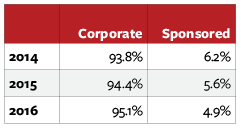
Article Review : Middle Market Lenders Claw for Corporate and Sponsored Deals in Uncertain Climate | Axial

Per Axial data, sponsored (private equity) vs. corporate deal flow has remained fairly consistent over the past three years.
0517_LendersSeek_Table (1)
Sponsored deal flow has been spread evenly geographically with heavier activity in California, Texas, Florida and New York.

0517_SponsoredUSDebtDeals
Here are thoughts of three lenders regarding sponsors vs. corporations:

What’s the difference from your perspective when working with sponsors vs. corporations on a deal?george
“With sponsors, the positive is you’ve had someone who has probably already asked all of the right questions, therefore you can get very quick responses. That way it’s all packaged with a bow on it.
On the corporate side or the non-sponsor side, there is just a much heavier lift. It requires a high level of access to the business owner. I think there is also a large part of the market, on the non-sponsor side, that maybe doesn’t understand yet the total value proposition of this type of financing product. The company still might be of the mindset to call a budge bracket investment bank for an acquisition financing or my local bank down the street.”
– George Mueller, KKR Credit Advisors

What’s one factor that’s key to success in both both types of deals?gregg
“Aligning interests. The best thing about working with sponsors is that they are sophisticated and they are motivated. The worst thing about working with sponsors is that they are sophisticated and they are motivated. Because of that, we always strive for alignment of interest.
When you are lending to a non-sponsor, such as a family business, the business might have a 20 or 30 year orientation, which might not match with the lender’s shorter term orientation. In these situations, alignment is also of utmost importance.”
– Gregg A. Bresner, CION Investment Management


What’s your advice for sponsors and corporations when communicating with lenders? phil
“Behind every credit committee meeting, every credit memo, every credit approval or decline, every credit covenant and every credit agreement are human beings. Fostering good relationships with those human beings requires effort, consistency, communication and time, but fostering good relationships with your lender is always a good long-term strategy for every business owner, CEO, and CFO.
The most important thing for non-sponsored businesses to do is provide good financial reporting. They can avoid surprises by taking the time to regularly communicate and meet with the decision makers at the bank on a regular basis.”
– Phil Kain, Rush Street Capital

For additional information regarding Florida business sales, acquisitions and valuations, please contact Eric J. Gall at Eric@EdisonAvenue.com or 239.738.6227. Also, visit our Edison Avenue website at www.EdisonAvenue.com. To search for Florida Businesses for Sale: CLICK HERE